
Yield Farming: Where Is the Profit — and Where Is the Trap?

What Is Yield Farming? (liquidity mining, DeFi rewards, passive income crypto)
Yield farming is a strategy where users deposit crypto assets into DeFi protocols to earn additional tokens as rewards.
At its core, farming involves:
1️⃣ Providing liquidity
2️⃣ Receiving LP tokens
3️⃣ Staking LP tokens
4️⃣ Earning governance or incentive tokens
It is often referred to as liquidity mining.
Unlike traditional passive income, yield farming usually combines multiple reward layers.
More layers = more complexity = more risk.
How Yield Farming Works Mechanically (liquidity pools, reward emissions, APR vs APY)
Here’s the technical flow:
- A protocol launches a token
- It incentivizes users to provide liquidity
- It distributes newly minted tokens as rewards
- High APY attracts capital
Yield typically comes from:
✔️ Trading fees
✔️ Token emissions
✔️ Bonus incentive campaigns
Important:
APR ≠ real profit
APY ≠ guaranteed return
If the reward token collapses in price, your effective yield drops.
Where Does the High Yield Come From? (token inflation, protocol incentives, emission schedule)
Extremely high yields usually come from:
- Aggressive token inflation
- Early-stage incentives
- Low liquidity pools
- Speculative demand
When a protocol shows 300% APY, ask:
Who is paying this?
Often the answer is:
New token emissions — meaning dilution over time.
If token demand doesn’t keep up with supply, price falls.
Hidden Risks in Yield Farming (smart contract risk, rug pull crypto, impermanent loss exposure)
Yield farming combines multiple risks:
🔴 Smart contract vulnerabilities
🔴 Impermanent loss
🔴 Token price collapse
🔴 Rug pulls
🔴 Governance exploits
🔴 Liquidity drain
In some cases, you are exposed to:
- Two volatile tokens
- A third reward token
- A potentially unaudited protocol
This is compounded risk.
Yield Farming vs Simple Staking
Staking:
✔️ Simpler
✔️ Usually single-asset
✔️ Lower complexity
Yield farming:
✔️ Higher potential reward
✔️ Higher volatility
✔️ Requires active monitoring
Farming is not passive investing. It’s active strategy management.
Most farming strategies are built on top of liquidity pools.
A Realistic Farming Scenario
Example:
You provide ETH / USDC liquidity.
- Pool APR: 20%
- Incentive token adds: 15%
Total advertised: 35%.
But:
- ETH rises sharply → impermanent loss
- Incentive token drops 50%
Your real yield may fall below expectations.
Advertised APY rarely equals realized profit.
How Yield Farming Becomes a Trap
Warning signs:
🔴 Anonymous team
🔴 No audit
🔴 Extremely high APY
🔴 Complex tokenomics
🔴 Rapid emission schedules
Classic trap pattern:
- Token launch
- Hype + 500% APY
- Liquidity rush
- Token dumping by insiders
- Price collapse
This is liquidity extraction disguised as yield.
Is Yield Farming Suitable for Beginners?
It can be — if:
✔️ You use established protocols
✔️ You start with small amounts
✔️ You understand impermanent loss
✔️ You monitor token emissions
It is NOT suitable if:
❌ You chase maximum APY
❌ You invest entire capital
❌ You don’t understand tokenomics
Yield farming requires discipline.
Evaluating a Farming Strategy (TVL analysis, token supply, emission rate)
Before entering a farm:
✔️ Check Total Value Locked (TVL)
✔️ Review token supply schedule
✔️ Understand emission rate
✔️ Analyze protocol longevity
✔️ Verify audit status
Sustainable yield usually means:
Moderate APY + strong volume + proven protocol.
How to Reduce Farming Risk
✔️ Diversify across protocols
✔️ Take profits periodically
✔️ Avoid highly inflationary tokens
✔️ Prefer audited platforms
✔️ Monitor liquidity changes
Never assume yield will remain constant.
High APY can be reduced significantly by impermanent loss.
Frequently Asked Questions
Is 100% APY realistic?
Sometimes — but usually temporary and risky.
Can you lose all your money?
Yes, through exploits or token collapse.
Is farming better than staking?
Higher potential reward, higher risk.
Why do APYs drop over time?
Because emissions dilute and liquidity increases.
Can farming be long-term?
Only in mature, sustainable protocols.
Final Verdict
Yield farming is neither magic nor guaranteed income.
It is:
✔️ A liquidity incentive mechanism
✔️ A token distribution system
✔️ A capital efficiency tool
But also:
- A volatility amplifier
- A token inflation engine
- A potential liquidity trap
Profit exists.
Traps exist.
Understanding emissions, liquidity, and risk dynamics determines which side you end up on.
Yield Farming Profit Simulator PRO+
Model: simplified, made for planning. Real DeFi results depend on slippage, execution, and protocol behavior.1) Base inputs
2) Auto-compound
3) Emission decay (rewards weaken over time)
Example: 40% decay over 90 days means reward emissions drop from 100% → 60% by the end (linear), or faster early (exponential).4) Fees impact
Balance over time (Base)Scenario outcomes (Bear / Base / Bull)5) Multi-pool comparison (up to 3)Enter different APR/IL/Reward change for each pool and compare final values.PoolAPR%IL%Reward Δ%Final ($)Pool A
—Pool B
—Pool C
—
Yield Farming Profit Simulator PRO+
✅ Read more:
- 👉 Liquidity Pools Explained: Mechanics and Risks
The infrastructure behind farming strategies. - 👉 Impermanent Loss Explained in Simple Terms
Why high APY does not equal high profit. - 👉 APR vs APY: Why Yield Numbers Can Mislead
Compounding assumptions vs real outcomes. - 👉 DeFi Lending & Borrowing: How Protocols Really Work
Using loans to amplify farming returns.
DeFi Hub
TVL in Crypto Explained: Complete Guide — From How It’s Calculated to Why $100 Billion Doesn’t Mean What You Think
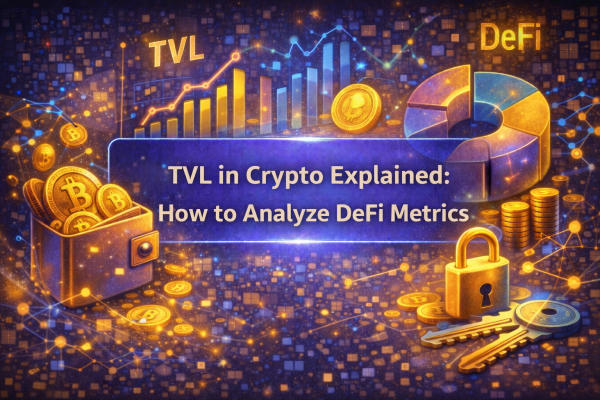
You’re Reading TVL Numbers Every Day and Misinterpreting Most of Them
The DeFi dashboard shows Aave at $12 billion TVL. You conclude that $12 billion in real capital is secured in the protocol. That conclusion is wrong — and it’s wrong in a specific way that matters for investment decisions.
Here’s what’s actually in that $12 billion: a significant portion is the same dollars counted twice or three times. A user deposits $1 million in ETH as collateral, borrows $700,000 in USDC, deposits that USDC somewhere else, borrows again. Each step adds to TVL. One million real dollars created several million in TVL. This is not a data error — it’s how DeFi composability works — but it means TVL is not equivalent to capital deployed.
The crypto total value locked figure peaked at approximately $180 billion in November 2021. By December 2022, after the Terra/LUNA collapse and FTX bankruptcy, it had fallen to roughly $37 billion. A naive reading: the DeFi industry lost $143 billion in user funds. The more accurate reading: price declines, leverage unwinding, and genuine capital outflows all contributed in proportions that require per-protocol analysis to understand.
TVL is simultaneously the most-used metric in DeFi analysis and one of the most frequently misunderstood. This guide explains exactly what TVL measures, how DefiLlama calculates it, what the differences between protocol-level TVL numbers actually mean, why the crypto TVL chart tells a different story than most headlines suggest, and how to use this metric as a genuine analytical tool rather than a marketing figure.
What TVL Actually Measures — and What It Doesn’t
The Technical Definition
TVL (Total Value Locked) is the aggregate dollar value of assets deposited in smart contracts belonging to a DeFi protocol or blockchain ecosystem at a specific point in time. “Locked” is a historical term — most assets can be withdrawn at any moment without penalty. The word means “currently sitting in protocol smart contracts,” not “physically constrained.”
What TVL includes:
- Liquidity in AMM pools (Uniswap, Curve, Balancer)
- Deposits in lending protocols (Aave, Compound, Morpho)
- Collateral positions (MakerDAO — ETH deposited to mint DAI)
- Assets in liquid staking protocols (Lido, Rocket Pool)
- Funds in yield aggregators (Yearn Finance, Convex)
- Liquidity in cross-chain bridges (Stargate, Across)
What TVL explicitly excludes:
- Assets on centralized exchanges
- Cryptocurrency held in self-custody wallets not interacting with protocols
- Trading volume (volume and TVL measure different things)
- NFT valuations (typically excluded from DeFi TVL)
TVL directly reflects the amount of liquidity locked in DeFi protocols, so understanding how pools and yield work is essential defi liquidity mining how pools and yield work.
The Core Measurement Problem: Double Counting
The fundamental limitation of TVL as a capital metric is recursive counting. Follow one dollar through a typical DeFi interaction sequence:
- User deposits $1,000,000 ETH into Aave → Aave TVL increases by $1,000,000
- User borrows $700,000 USDC against the ETH collateral
- User deposits $700,000 USDC into Curve 3pool → Curve TVL increases by $700,000
- User receives LP tokens, stakes them in Convex → Convex TVL increases by $700,000
- User borrows against Convex position, deposits elsewhere…
One million real dollars has now produced $2.4 million+ in TVL. This is not fraud or miscalculation — it’s an accurate description of where assets sit in smart contracts at each layer. But it means the sum of all DeFi TVL cannot be interpreted as the total new capital that entered DeFi.
The Price Sensitivity Problem
TVL changes without any capital movement when asset prices change:
TVL change formula from price movement:
ΔTVL = TVL₀ × (Price₁ / Price₀ – 1)
If Ethereum appreciates 40% and a protocol holds $3 billion in ETH-denominated positions, TVL automatically increases by $1.2 billion with zero new deposits. This means TVL growth in bull markets is partly — sometimes entirely — price appreciation of existing assets, not capital inflows.
The implication for crypto TVL chart analysis: during 2020–2021, much of the “DeFi growth story” told through TVL was ETH, BTC, and other assets appreciating while sitting in protocols. The user base and real capital deployment grew significantly, but the TVL numbers grew faster.
How DefiLlama Calculates TVL: The Industry Standard Methodology
DefiLlama (defillama.com) is the largest independent TVL aggregator, tracking 3,000+ protocols across 200+ blockchains. It is the standard reference for institutional analysts, protocol developers, and serious DeFi researchers.
The Technical Architecture
DefiLlama uses protocol-specific adapters — code written for each individual protocol that queries smart contracts through RPC nodes and reads the actual on-chain state of deposited assets. All adapters are open source on GitHub (github.com/DefiLlama/DefiLlama-Adapters), meaning any researcher can verify the methodology or identify discrepancies.
The key parameters DefiLlama tracks per protocol:
- TVL — the standard figure including all assets in contracts
- Staking — separately tracked native token staking
- Pool2 — liquidity involving the protocol’s native token paired against ETH or stablecoins (often more volatile and separately highlighted)
- Treasury — protocol-owned assets
The “Exclude Double Counting” filter: DefiLlama offers a toggle that removes recursive TVL — assets that appear in multiple protocol layers simultaneously. This produces what analysts call “adjusted TVL” or “net TVL,” which more accurately represents the base layer of real capital in the ecosystem. The difference between gross and adjusted TVL can be 30–50% of the total figure.
How Protocol TVL Differs From Chain TVL
Protocol TVL is the TVL of a single application — Uniswap, Aave, or Compound as individual entities.
Chain TVL is the aggregate:
Chain TVL = Σ TVL of all protocols deployed on that chain
With important caveats: assets bridged from one chain can appear in both chains’ TVL depending on methodology, creating cross-chain double counting at the ecosystem level.
Why TVL Matters: What It Genuinely Measures When Used Correctly
Liquidity Quality for DEX Users
For decentralized exchanges, TVL directly determines user experience. Deeper liquidity pools produce lower slippage on trades — the difference between what you expect to receive and what you actually receive when executing a swap.
A concrete illustration: swapping $50,000 of USDC to USDT on a pool with $10 million TVL produces approximately 0.05% slippage. The same swap on a pool with $500,000 TVL produces roughly 1.0% slippage — a $500 difference on a $50,000 trade. TVL creates measurable user value in this context.
Demonstrated Security Track Record
High TVL that has persisted for 12+ months is indirect evidence that the protocol’s smart contracts have been tested by adversarial conditions. Hackers actively target DeFi protocols — the ones that aren’t successfully exploited over extended periods with significant funds at stake have something meaningful: either security through time or security through code quality (ideally both).
This is probabilistic reasoning, not a guarantee. Some protocols held significant TVL and were later exploited. But a protocol with $5 billion TVL that has operated for three years has faced more attack attempts than a protocol with $5 million TVL that launched last month.
The TVL/Revenue Ratio: DeFi’s Version of P/E
The ratio of TVL to annualized protocol revenue indicates capital efficiency — how effectively the protocol monetizes the assets deposited:
TVL/Revenue = TVL / Annualized Revenue
Lower ratios indicate more efficient use of TVL. This is analogous to the price-to-earnings ratio in equity analysis — a protocol earning $100M annually on $2B TVL (20x) is extracting more value per dollar of deposited capital than a protocol earning $10M on $2B TVL (200x).
Where TVL Applies: Protocol-by-Protocol Analysis
Compound TVL: The Pioneer Lending Protocol
Compound (compound.finance) launched in 2018 as one of the first DeFi lending protocols. Its TVL reflects the total assets deposited across all lending markets — USDC, USDT, ETH, WBTC, and others.
The Compound TVL accounting nuance: Compound’s TVL includes both supply (assets deposited as collateral) and the value of loans outstanding. Since loans are backed by the same deposited collateral, this creates structural double counting. A user depositing $1M in ETH and borrowing $700K USDC adds $1.7M to gross TVL for $1M in real capital deployed.
Historical trajectory: Compound TVL peaked at approximately $12 billion in 2021 during the COMP liquidity mining era. By 2024, it had declined to $2–3 billion as competition from Aave and the newer Morpho protocol took market share. The decline in TVL preceded and accompanied the decline in COMP token price — the two are correlated because liquidity mining incentives that drove TVL also supported token demand.
CRV TVL: When TVL Is a Political Battleground
Curve Finance’s TVL — the CRV TVL — represents something qualitatively different from most other protocols: it’s the subject of an active, ongoing competition between external parties who want to control where liquidity flows.
The Curve Wars context: Curve’s gauge system directs new CRV emissions to liquidity pools based on veCRV voting power. Protocols competing for stable stablecoin liquidity — protocols like Frax, LUSD, and dozens of others — need their pools to attract CRV rewards to attract LPs. Controlling veCRV means controlling where hundreds of millions in annual CRV rewards flow.
This created Convex Finance (a TVL overlay protocol accumulating veCRV), Votium and Hidden Hand (bribe markets where protocols pay veCRV holders for their gauge votes), and an entire ecosystem organized around influencing Curve’s TVL distribution.
What Curve TVL actually tells you: which stablecoin pairs have sufficient demand (and backed incentive programs) to maintain liquidity. The ~$2–3B in 2024 Curve TVL represents a combination of organic stablecoin swap demand and ongoing protocol bribe economics. Distinguishing the two requires looking at which pools have bribe activity versus which maintain TVL without external incentives.
To interact with DeFi protocols and track TVL metrics, users need a secure wallet connection walletconnect explained for defi access.
BSC DeFi TVL: High Volume, Different Risk Profile
BNB Chain’s aggregate TVL — BSC DeFi TVL — reflects a different DeFi ecosystem profile than Ethereum:
PancakeSwap: the dominant DEX on BNB Chain, typically $1.5–2.5B TVL. Lower fee tiers than Ethereum DEXes, higher retail participation due to lower gas costs.
Venus Protocol: the primary lending protocol on BNB Chain, $1–1.5B TVL. Had a significant risk event in 2021 when XVS token price manipulation through a large position caused protocol losses, demonstrating that BSC’s lower barriers to entry for new assets created different risk characteristics than Ethereum’s more curated asset markets.
Characteristics of BSC DeFi TVL: higher proportion of retail users, more exposure to newer and riskier assets (including meme tokens and unaudited protocols), lower gas costs making frequent small transactions economical. TVL on BSC is generally more volatile than Ethereum — less institutional capital acts as a stabilizing factor.
The frequently searched “Binance TVL” requires disambiguation: Binance exchange maintains substantial cold and hot wallets whose aggregate value far exceeds BSC DeFi TVL — but these are custodial CEX assets, categorically different from on-chain DeFi TVL.
Acala TVL: Polkadot’s DeFi Experiment
Acala serves as the DeFi hub for the Polkadot ecosystem — offering a DEX, a stablecoin (aUSD), and liquid DOT staking (LDOT). Its TVL ($50–200M range in 2024) reflects Polkadot DeFi’s smaller scale compared to Ethereum.
The August 2022 incident: a smart contract bug created $1.2 billion in erroneously minted aUSD within hours of a new liquidity pool launch. An emergency governance vote was executed to trace and burn the erroneous tokens. The incident is notable for what happened next: full recovery through governance action, with no permanent user losses.
What Acala TVL measures: confidence in the Polkadot DeFi ecosystem specifically — DOT-denominated positions, cross-chain assets bridged through the XCM protocol, and the aUSD stablecoin’s collateral backing. It’s more useful as an indicator of Polkadot ecosystem adoption than as a comparable figure to Ethereum DeFi TVL.
Crypto.com and Cronos Chain TVL
The “crypto.com TVL” query typically refers to the Cronos blockchain ecosystem TVL ($400–700M range), not the centralized exchange’s balance sheet. Key protocols:
VVS Finance: the primary DEX on Cronos. Launched with significant CRO incentives that drove initial TVL, which subsequently declined substantially as incentives were reduced — a textbook example of incentive-driven versus organic TVL.
Tectonic: Cronos lending protocol. Smaller but more stable TVL as the incentive-chasing capital left and organic users remained.
The distinction matters: Cronos chain TVL reflects genuine DeFi activity; Crypto.com exchange’s total assets represent a different category entirely and should not be compared to DeFi TVL figures.
Risk Score: Evaluating a Protocol’s TVL Quality
Risk Score = (TVL_concentration × TVL_age) + (Native_token_dominance × No_audit)
Each parameter rated 0 to 5:
- TVL_concentration — how concentrated among a few wallets (0 = widely distributed, 5 = 90% in 5 addresses)
- TVL_age — how long has TVL been at current levels (0 = stable 2+ years, 5 = reached current TVL within last month)
- Native_token_dominance — what % of TVL is the protocol’s own token (0 = <10%, 5 = >70%)
- No_audit — security audit status (0 = multiple audits from top firms, 5 = no audit)
Score interpretation:
- 0–5: Mature, reliable TVL
- 6–12: Standard DeFi risk
- 13–20: High risk — new or unstable
- 21–50: Critical risk — probable red flags
Scored Protocol Examples
| Protocol | Concentration | TVL age | Native token % | No audit | Score | Assessment |
|---|---|---|---|---|---|---|
| Aave V3 | 1 | 0 | 1 | 0 | 2 | Reliable |
| Uniswap V3 | 1 | 0 | 0 | 0 | 1 | Reliable |
| Lido Finance | 1 | 0 | 1 | 0 | 2 | Reliable |
| Unknown yield farm | 5 | 5 | 5 | 5 | 50 | Critical |
| New DEX fork (2 weeks old) | 4 | 5 | 4 | 3 | 27 | Critical |
Real Cases: TVL as Signal and as Misleading Metric
Case 1: Terra/LUNA — $18 Billion TVL Built on Structural Impossibility
April 2022. Anchor Protocol on the Terra blockchain showed TVL of $18 billion — among the largest in DeFi. Anchor offered 19.5% APY on UST deposits, attracting capital from across the ecosystem.
What proper TVL analysis would have revealed:
- Approximately 80% of Anchor’s deposits were in UST — an algorithmic stablecoin whose peg depended on LUNA’s market cap
- Anchor’s 19.5% yield was funded by a reserve that was depleting, not by organic lending demand
- The TVL was a function of incentive-driven deposits with no sustainable revenue model beneath them
- Revenue/TVL ratio: near zero — the protocol was paying yield without equivalent income
The collapse sequence (May 2022): Large UST withdrawals from Anchor began depressing the UST peg → depeg triggered algorithmic LUNA minting to restore parity → LUNA inflation accelerated the price decline → price decline made the peg defense impossible → UST collapsed entirely.
The result: $18B TVL to effectively $0 in 72 hours. Total ecosystem losses: $40–60 billion.
The lesson for TVL analysis: TVL built on yield subsidies rather than real revenue has no stable foundation. Anchor’s TVL/Revenue ratio should have immediately flagged unsustainability to any analyst using both metrics together.
Case 2: Uniswap V3 — When TVL and Volume Diverge Meaningfully
Uniswap V3 launched in May 2021 with concentrated liquidity mechanics. The design allows LPs to concentrate capital in specific price ranges, dramatically increasing capital efficiency — but also meaning that TVL and volume have a different relationship than V2.
The V3 data pattern:
- Uniswap V3 TVL: approximately $3–5B
- Uniswap V3 daily volume: $1–3B (on high-activity days)
- This implies volume/TVL ratios of 20–60% daily — extremely high capital efficiency
Comparison to Uniswap V2:
- Uniswap V2 held higher absolute TVL during some periods ($5–8B)
- But volume/TVL ratio was significantly lower because liquidity was spread across the full price range
The analytical implication: a TVL comparison of V2 vs V3 without the volume context would suggest V2 was “larger” or “more important” when V3 was actually more efficiently utilized. This illustrates why TVL alone is an incomplete metric — the same dollar of TVL can produce dramatically different economic activity depending on protocol design.
Case 3: Lido Finance — TVL That Accurately Represents Real Capital
Lido Finance is one of the clearest examples of TVL that closely reflects genuine capital deployment. Lido enables liquid staking — users deposit ETH and receive stETH, which earns staking rewards while remaining usable in DeFi.
Why Lido’s TVL is high-quality:
- Every dollar of TVL represents real ETH staked on Ethereum validators
- No recursive leverage is possible at the Lido layer itself (stETH may be used in other protocols, but that’s tracked separately)
- Revenue is directly tied to Ethereum staking yields — approximately 4–6% APR distributed as stETH appreciation
- TVL/Revenue ratio: approximately $30B TVL / $600M annual revenue = 50x, which is reasonable for infrastructure with predictable yield
Most TVL is generated on decentralized exchanges where users provide liquidity and swap tokens pancakeswap how dex and liquidity pools work.
The Lido TVL chart pattern: grows steadily with Ethereum adoption, declines when ETH price falls, and shows no artificial spikes from liquidity mining programs. This is what “organic TVL” looks like.
The market share dimension: Lido controlling 30%+ of all staked ETH creates systemic considerations that go beyond TVL — it’s the dominant liquid staking provider in a critical Ethereum security context.
Case 4: The MakerDAO TVL Story — From DeFi Pioneer to Real-World Asset Integration
MakerDAO’s TVL tells a nuanced story of protocol evolution that TVL alone doesn’t capture.
2020–2021: MakerDAO TVL grew primarily through ETH collateral as users minted DAI. TVL tracked ETH price closely — when ETH appreciated, TVL grew; when ETH fell, TVL fell. The primary risk was ETH liquidation cascades during sharp price drops (Black Thursday 2020 demonstrated this).
2022–2023: MakerDAO began significant Real World Asset (RWA) integration — US Treasury bills, corporate credit, and other off-chain assets became collateral for DAI. This created TVL that is less volatile than ETH-denominated TVL and generates yield from traditional finance instruments.
The TVL interpretation shift: MakerDAO’s TVL in 2024 ($7–8B) includes a substantial portion in RWA collateral. This TVL behaves differently from DeFi-native collateral — it doesn’t decline with crypto prices, but it introduces different risks including regulatory exposure and counterparty risk with real-world entities.
Revenue growth: MakerDAO’s revenue grew substantially through this transition. The protocol earned significant income from US Treasury yields through its RWA programs, making it one of the most profitable DeFi protocols by revenue in 2023.
Comparing TVL Across Protocol Categories
| Category | Example protocols | TVL interpretation | Double counting | Revenue relationship |
|---|---|---|---|---|
| AMM DEX | Uniswap, Curve | Real trading liquidity | Minimal | Direct (fees = % of volume) |
| Lending | Aave, Compound | Supply + borrows (inflated) | High | Indirect (interest rate spread) |
| Yield aggregator | Yearn, Convex | Layered on other TVL | Very high | Indirect (% of yield generated) |
| CDP/Stablecoin | MakerDAO | Collateral backing debt | Moderate | Direct (stability fees) |
| Liquid staking | Lido, Rocket Pool | Staked native assets | Low | Direct (staking reward share) |
| Bridges | Stargate, Across | Transit liquidity | Minimal | Direct (bridge fees) |
How to Analyze TVL Properly: Step-by-Step Guide
Mini-Guide: Evaluating a DeFi Protocol Through DefiLlama
Step 1 — Navigate to defillama.com
The homepage ranks protocols by TVL with filters for chain, category, and time period. Search for the protocol you want to evaluate.
Step 2 — Enable the “Exclude Double Counting” filter
In the top navigation, toggle this option. It removes recursive TVL where the same assets appear at multiple protocol layers. This typically reduces the displayed TVL by 20–50% but gives a more accurate picture of base capital.
Step 3 — Examine the TVL chart over 12+ months
Look for:
- Trend direction: consistently growing, stable, or declining?
- Anomalies: sharp single-day drops often indicate exploits, governance crises, or major protocol problems
- TVL age at current levels: is this TVL earned over time or created recently through incentives?
Step 4 — Check the asset breakdown
The “Breakdown” section shows what tokens compose the TVL. Red flags:
- More than 50% in the protocol’s native token (self-bootstrapped TVL)
- Concentration in tokens with thin external markets
- Sudden shifts in composition without explanation
Step 5 — Compare TVL with fees and revenue
DefiLlama’s “Fees and Revenue” section shows daily income. Calculate:
Capital Efficiency Ratio = Annual Revenue / TVL
Higher is better. Example comparison:
- Uniswap V3: ~$600M annual revenue on ~$4B TVL = 15% efficiency ratio
- A hypothetical liquidity mining protocol: $2M annual revenue on $500M TVL = 0.4% efficiency ratio
Step 6 — Check protocol health indicators
- Audit status (listed on protocol page)
- Competitor comparison (same category filter)
- Time since last security incident
TVL Analysis Checklist Before Interacting With a Protocol
- ✅ TVL verified through DefiLlama with double-counting excluded
- ✅ TVL chart reviewed over 12+ months — no unexplained sharp drops
- ✅ Asset breakdown checked — no >50% native token concentration
- ✅ Revenue/TVL ratio calculated and compared against category peers
- ✅ Volume/TVL ratio checked for DEXes (should be >5% daily for active protocols)
- ✅ TVL has existed at current levels for 6+ months (not liquidity-mining-inflated)
- ✅ Security audit confirmed from a recognized firm
- ✅ Wallet concentration checked — TVL distributed across thousands of users, not ten whales
How Scammers Manipulate TVL
Wash TVL Through Coordinated Wallets
A protocol team creates multiple wallets, deposits the protocol’s own tokens back and forth between them, and reports the resulting figures as TVL. Identification: native token constitutes >60% of reported TVL, a handful of large deposits appeared simultaneously in the first week of launch, and trading volume is negligible relative to TVL.
The Incentive Cliff Setup
A protocol advertises “$200M TVL” achieved through massive temporary yield incentives scheduled to end immediately after a token launch or media event. After the event, incentives disappear, TVL collapses 95%, and the media coverage has already served its purpose. The metric served its marketing function before it could be properly evaluated.
Misleading Aggregation in Press Releases
“Our ecosystem has achieved $X billion in TVL” — combining on-chain DeFi TVL with centralized exchange balances, vesting schedules, and protocol-owned liquidity in ways that wouldn’t survive independent verification. Always cross-reference claims against DefiLlama data with methodology transparency.
The Fork TVL Narrative
“Leading fork of [established protocol] with growing TVL” — a two-week-old fork with $3M in TVL, mostly from the founding team’s own deposits, compared to an established protocol with years of security history. TVL without time dimension is a misleading metric.
Who Is at Risk From Misreading TVL
| Profile | Core vulnerability | Typical outcome |
|---|---|---|
| New DeFi participants | Treat TVL as equivalent to capital safety | Deposit into high-TVL protocol that is mostly self-bootstrapped |
| DeFi token investors | Use TVL as primary valuation metric | Buy governance tokens based on TVL without revenue analysis |
| LP providers | Don’t analyze TVL distribution | Enter pools dominated by a few whales who exit simultaneously |
| Analysts without context | Compare TVL across protocol categories | Draw incorrect conclusions comparing lending TVL to DEX TVL |
| Media consumers | Accept “TVL grew” headlines as unambiguously positive | Miss that growth was entirely price appreciation, not new capital |
When TVL Is Not a Reliable Indicator
- For protocols under 6 months old. Insufficient history to distinguish incentive-driven TVL from organic capital. Team and early investor deposits can create misleading TVL figures.
- During active liquidity mining programs. TVL that exists because of token rewards rather than genuine protocol utility will leave when rewards end. This is “mercenary liquidity.”
- When native token exceeds 50% of TVL. The team controls the majority of the asset composing TVL. This gives them the ability to inflate and deflate the metric at will.
- For cross-category comparisons without normalization. Lending TVL, DEX TVL, yield aggregator TVL, and bridge TVL use different methodologies and have different relationships to actual capital deployment.
- As a security proxy. High TVL has not prevented significant exploits. Euler Finance ($197M exploit in 2023), Ronin Network ($625M in 2022), and Nomad Bridge ($190M in 2022) all had substantial TVL at the time of their exploits.
- In a falling price environment. TVL decline during a broad market selloff may reflect price depreciation of existing assets with stable user numbers and stable deposited token quantities.
Myths About TVL
| Myth | Reality |
|---|---|
| “High TVL means the protocol is secure” | Euler Finance ($197M exploit), Ronin ($625M), and Nomad ($190M) all had significant TVL when exploited |
| “Total DeFi TVL equals total capital in DeFi” | Recursive leverage means gross TVL overstates actual base capital by 2–5x or more |
| “TVL growth means the protocol is becoming more popular” | TVL grows automatically when asset prices rise, even with no new users or deposits |
| “You should compare protocols by TVL” | Without revenue and volume data, TVL comparison is like comparing companies by asset size without looking at profitability |
| “DefiLlama TVL is perfectly accurate” | Best available independent data, but adapter methodologies vary and some protocols use non-standard accounting |
| “TVL decline means users are leaving DeFi” | Price declines reduce TVL without any change in user count or deposited token quantities |
Frequently Asked Questions (FAQ)
What is TVL in crypto and why does it matter?
TVL (Total Value Locked) is the aggregate dollar value of assets deposited in a DeFi protocol’s smart contracts. It matters because it indicates how much capital users trust the protocol with, directly determines liquidity quality for trading and borrowing, and provides a rough proxy for protocol adoption. Its main limitation: recursive deposits and price movements mean TVL is not equivalent to “actual capital deployed.”
What is DefiLlama and why is it the standard for TVL data?
DefiLlama (defillama.com) tracks 3,000+ protocols with open-source adapters that query smart contracts directly. It’s the standard because its methodology is publicly verifiable, it offers “adjusted TVL” that excludes double counting, and it provides comparative data across chains and protocol categories simultaneously. Always use the “Exclude Double Counting” filter for the most accurate capital picture.
How is Compound TVL different from Curve TVL?
Compound TVL includes both supply (deposited collateral) and outstanding borrows, creating structural double counting — a user’s deposited $1M ETH and their $700K USDC loan both count toward TVL. Curve TVL represents actual trading liquidity in stablecoin and correlated asset pools — closer to real deployable capital with minimal double counting. Comparing them directly without this context produces misleading conclusions.
Why did DeFi TVL fall from $180 billion to $37 billion in 2022?
Three distinct factors contributed: crypto price declines automatically reduced the dollar value of existing deposits, Terra/LUNA’s collapse destroyed $40–60B in ecosystem value including $18B in Anchor Protocol TVL, and the broader deleveraging cycle reduced recursive lending positions. These factors are analytically separable — price depreciation alone accounted for a significant portion without any change in DeFi adoption.
What is a good TVL/Revenue ratio for a DeFi protocol?
There’s no universal benchmark — it varies significantly by protocol category. As rough reference points: AMM DEXes like Uniswap achieve 5–20x (TVL divided by annual revenue), lending protocols typically 50–150x, yield aggregators 100–300x. Protocols above 500x are either very early-stage with growing revenue or have TVL significantly in excess of their actual revenue-generating capacity.
How do I know if a protocol’s TVL is organic or artificially inflated?
Four checks: (1) What percentage of TVL is the protocol’s own native token? Above 50% is a red flag. (2) Has TVL been at current levels for more than 6 months without active liquidity mining programs? (3) Is there proportional trading volume or loan activity relative to TVL? (4) Is TVL distributed across thousands of users or concentrated among a dozen whale wallets? Organic TVL passes all four; artificial TVL typically fails at least two.
What’s the difference between BSC DeFi TVL and Binance TVL?
BSC DeFi TVL is the aggregate TVL of DeFi protocols running on BNB Smart Chain — decentralized applications where users control their own assets through smart contracts. “Binance TVL” in the context of the centralized exchange refers to the exchange’s custody of user assets — a categorically different thing, not DeFi TVL, not governed by smart contracts, and not tracked by DefiLlama or similar aggregators.
Conclusion
Rule 1. Always verify TVL through DefiLlama with the “Exclude Double Counting” filter enabled. Self-reported TVL from protocol marketing materials is a promotional figure. Independent aggregators with transparent, open-source methodology provide the analytical figure. The difference can be 30–60% of the total number.
Rule 2. Analyze TVL alongside revenue and volume, not as a standalone metric. TVL tells you how much capital is deposited. Revenue tells you whether that capital is generating sustainable protocol income. Volume tells you whether that capital is actively being used. A protocol with $5B TVL and $500K in annual revenue is not comparable to a protocol with $1B TVL and $100M in annual revenue — the second is dramatically more capital-efficient.
Rule 3. Never compare TVL across different protocol categories without accounting for structural differences in how TVL is counted. Lending protocol TVL, AMM DEX TVL, and yield aggregator TVL measure structurally different things with different degrees of double counting. Meaningful comparison happens within categories, not across them.
The principle: TVL is a proxy metric — a useful but imperfect instrument that answers one specific question: how much capital do users trust this protocol with right now? It doesn’t answer whether the protocol creates real value, whether it’s secure, whether it’s growing its user base, or whether its revenue model is sustainable. When used as a component of a broader analytical framework that includes revenue, volume, user metrics, and security history, TVL becomes genuinely useful. When used as a single-number summary of protocol quality, it misleads at least as often as it informs.
The hard criterion: if a protocol shows high or rapidly growing TVL with negligible revenue after six or more months of operation, that TVL exists because of token incentives being paid to attract capital — not because the protocol creates value that capital wants to access. This incentive-based TVL will disappear when the incentives end, often faster than it arrived. Never make investment decisions in protocol tokens based primarily on TVL without verifying the revenue sustainability beneath it. Anchor Protocol’s $18 billion TVL was sustained by yield that had no revenue basis — and the entire structure collapsed in 72 hours.
Read more:
- DeFi Liquidity Mining: How Pools and Yield Work – How liquidity drives TVL and rewards.
- PancakeSwap Explained: DEX and Liquidity Pools – Where TVL is created through swaps and farming.
- Flash Loan Explained: How It Works – How instant loans affect DeFi liquidity.
- Governance Token Explained: DAO Voting in DeFi – How governance impacts protocol TVL.
- WalletConnect Explained: Access DeFi Safely – Connect your wallet and interact with DeFi.
You Hold a “Voting Token.” But What Are You Actually Voting On — and Does It Matter?
You bought UNI, COMP, or AXS. The project page says “token holders govern the protocol.” That sounds like meaningful ownership. The reality: Uniswap’s last contested governance vote had 96% of participating tokens controlled by five addresses. Your 200 UNI changed nothing.
That’s one side of the truth about governance tokens. The other side: MakerDAO governance survived the Black Thursday crisis of March 2020 — a $4 million bad debt event — without losing a single dollar of user funds, purely through emergency on-chain governance votes executed by an engaged token holder community. Curve’s veTokenomics created a multi-billion dollar “governance wars” ecosystem where protocols paid hundreds of millions of dollars to influence emission allocation. Compound’s COMP distribution in 2020 bootstrapped an entire DeFi movement by distributing real governance power to real protocol users.
Governance tokens are neither purely marketing instruments nor purely speculative assets. They’re coordination mechanisms for decentralized protocols — with real consequences when they work, real vulnerabilities when they don’t, and real risks for holders who don’t understand what they’re actually holding.
This guide covers everything: the technical mechanics of governance systems, a detailed breakdown of specific tokens from the keyword cluster (RARI, FORTH, 1INCH, AXS, BNT, and others), how to evaluate whether any given governance token has genuine value, and how to avoid buying “voting rights” over protocols that nobody votes on.
The Three Governance Models That Actually Exist in DeFi
Before examining specific tokens, understanding the spectrum of governance implementation prevents the most common mistake: assuming all governance tokens work the same way.
Model 1: Fully On-Chain Governance With Timelock
Every proposal is a smart contract transaction. If it passes the quorum threshold, it executes automatically after a mandatory delay period (typically 48–72 hours). The timelock gives the community time to exit if a malicious proposal passes.
Examples: MakerDAO (MKR), Compound (COMP), Aave (AAVE)
Strengths: genuinely trustless, no team veto, verifiable on-chain history
Vulnerabilities: flash loan governance attacks if timelock is absent or too short (Beanstalk’s $182M exploit demonstrated this)
Model 2: Off-Chain Signaling + Multi-Sig Execution
Votes happen through Snapshot (gasless, off-chain). Results are implemented by a team multi-sig wallet. No on-chain enforcement.
Examples: most smaller DAOs, early-stage protocols
Strengths: low cost for participants (no gas), accessible to small holders
Vulnerabilities: team can technically ignore results; the “governance” is advisory, not binding
Model 3: Vote-Escrowed (veToken) Governance
Governance power requires locking tokens for time periods. Longer lock = more voting power. Creates strong incentives for long-term alignment but also creates secondary markets for governance power.
Examples: Curve (CRV/veCRV), Balancer (BAL/veBAL), Frax (FXS/veFXS)
Strengths: aligns governance power with long-term holders; creates genuine financial incentive to acquire voting power
The innovation this created: the entire “Curve Wars” ecosystem — protocols competing for veCRV to direct emissions toward their pools — emerged from this governance design
Governance tokens are mostly used inside DeFi protocols and DAO ecosystems to vote on treasury, fees, and protocol parameters, so understanding DeFi yield mechanics is important defi liquidity mining how pools and yield work.
What Is a Governance Token: Technical Definition
A governance token is a cryptographic token that confers the right to participate in protocol decision-making proportional to the quantity held. Decisions subject to governance include:
- Protocol parameters (fee rates, collateralization ratios, liquidation thresholds, interest rate models)
- Treasury fund allocation
- Smart contract upgrades
- New asset listings or integrations
- Emission schedules and reward distributions
- Emergency actions during crisis events
The key distinction from equity: most governance tokens do not confer rights to protocol revenue. Holding UNI gives you the ability to vote on Uniswap’s parameters but not a claim on Uniswap’s $1 billion+ in annual trading fees. This distinction is critical for valuation — and is frequently obscured in marketing.
The exceptions: tokens where governance and fee sharing are explicitly linked include CRV (veCRV holders receive 50% of trading fees), 1INCH (stakers receive protocol revenue), and GMX (GMX stakers receive 30% of protocol fees). These have a different value proposition than pure-governance tokens.
How Governance Actually Works: Compound’s Governor Bravo as the Industry Standard
Compound’s Governor Bravo system is the governance architecture that most major DeFi protocols have forked. Understanding it explains how on-chain governance works in practice.
The Proposal Lifecycle
Proposal creation threshold: A wallet must hold or have delegated ≥25,000 COMP to create a proposal. This prevents spam — only serious participants with significant stake can initiate governance changes.
Voting period: 3 days. Token holders vote For, Against, or Abstain. Voting power snapshots at the block when the proposal was created, preventing last-minute buying to influence a specific vote.
Quorum requirement: 400,000 COMP must vote For for a proposal to pass. With a circulating supply of roughly 8 million COMP, this is approximately 5% quorum — achievable but not trivial.
Timelock: Passed proposals enter a 48-hour timelock before execution. During this window, any large holder can sell their tokens in response to a proposal they dislike, and the team can prepare for protocol changes.
On-chain execution: After the timelock, the proposal executes as a smart contract transaction — changing protocol parameters, distributing treasury funds, or upgrading contracts.
The Delegation System
Governance requires active participation, but most holders are passive. The delegation system allows any holder to assign their voting power to another address without transferring tokens.
Voting power formula:
Effective Voting Power = Your tokens + Tokens delegated to you by others
This creates a class of professional delegates — researchers, DeFi firms, and community leaders who aggregate voting power from passive holders and use it actively. Gauntlet and Chaos Labs both operate as delegates in multiple major protocols.
The veToken Model: When Governance Has Financial Consequences
Curve’s vote-escrowed system adds economic stakes to governance participation:
veCRV calculation:
veCRV = CRV locked × (weeks remaining on lock) / 208
Locking 1,000 CRV for 4 years (208 weeks): veCRV = 1,000 × 208/208 = 1,000 veCRV Locking 1,000 CRV for 1 year (52 weeks): veCRV = 1,000 × 52/208 = 250 veCRV
veCRV holders receive: 50% of all Curve trading fees, boosted CRV rewards (up to 2.5x), and the right to direct gauge emissions. That last right — directing where new CRV flows — is what created the Curve Wars. Controlling veCRV means controlling where hundreds of millions in annual rewards flow. That control has monetary value, and protocols paid for it.
Specific Tokens From the Keyword Cluster: What Each One Actually Does
RARI Governance Token: Rarible’s NFT Platform Governance
RARI is the governance token for Rarible, an NFT marketplace that launched in 2020. It was notable for its weekly distribution mechanism: RARI was distributed to active Rarible users proportional to their trading volume, creating an ongoing “use the platform to own the platform” dynamic.
What RARI governance controls:
- Platform fee parameters
- Protocol treasury allocation
- Reward distribution criteria
- Feature prioritization
The Rari Capital disambiguation: Rari Capital (a separate DeFi yield protocol) also used the RARI ticker for its governance token before merging with Tribe DAO in 2021. This created persistent confusion in search results. The Rarible NFT platform RARI and the Rari Capital RARI were different tokens — the Rari Capital RARI was converted to TRIBE during the merger.
Current governance activity: moderate. The NFT market’s decline from 2022 peaks reduced platform revenue and governance urgency.
FORTH Crypto: Governing the Ampleforth Rebasing Protocol
FORTH is the governance token for Ampleforth, the protocol behind AMPL — a supply-elastic currency that automatically adjusts supply each day based on TWAP price relative to a CPI-adjusted target.
What FORTH governance controls:
- Rebase oracle parameters
- Expansion and contraction rate adjustments
- Protocol treasury management
- Future AMPL ecosystem development
The retroactive distribution: FORTH was distributed in April 2021 to every address that had interacted with AMPL before a snapshot date. This retroactive airdrop model — giving governance to people who actually used the protocol — has become a standard for legitimate governance token launches.
Key data: 15 million FORTH total supply, with approximately 67% distributed to historical AMPL users. The remaining 33% went to ecosystem development and the Ampleforth Foundation.
Honest assessment: FORTH governance activity is limited. AMPL’s unique mechanics mean that governance changes to oracle parameters could have significant effects, but proposals are infrequent.
1INCH Governance: Where Voting Has Financial Upside
1INCH is the governance and utility token for 1inch Network, the leading DEX aggregator. Launched December 2020 with a retroactive airdrop to all prior users — one of the largest governance token airdrops to that point.
What makes 1INCH governance unusual: staking 1INCH generates “unicorn power” used for voting, and stakers receive a portion of fee revenue from the 1inch protocols. This fee-sharing component gives 1INCH holders a direct financial stake in protocol performance that most governance-only tokens lack.
1inch instant governance: the protocol distinguishes between “instant governance” (parameters adjustable immediately through voting) and “standard governance” (requires full timelock cycle). Instant governance handles operational parameters; standard governance handles structural changes.
Treasury: 1inch DAO controls significant protocol-owned assets, and treasury allocation decisions have been active governance subjects.
AXS: The Governance Token Governing a Billion-Dollar Game Economy
AXS (Axie Infinity Shards) governs the Axie Infinity gaming ecosystem, with particular authority over the Community Treasury that held over $1 billion during the play-to-earn peak of 2021.
What AXS governance controls (formally):
- Community Treasury allocation
- Ecosystem fund distribution
- Game parameter changes
- Partnership and development decisions
The staking dimension: AXS can be staked for rewards, with APRs that reached 150%+ during peak demand. This staking utility drives significant AXS demand independent of governance participation.
Honest assessment of AXS governance quality: despite the formal governance structure, Sky Mavis retains significant practical control. Voter participation in AXS governance proposals is low. Most holders interact with AXS as a staking and speculative asset rather than as governance participants. The governance structure is real but underutilized.
SLP disambiguation: Smooth Love Potion (SLP) is Axie Infinity’s other token — an in-game currency for breeding. AXS is governance/staking; SLP is utility. These are frequently confused.
BNT: Bancor’s Dual-Purpose Token
BNT (Bancor Network Token) is unusual: it functions simultaneously as governance token and as the required pairing asset for all Bancor liquidity pools. Every liquidity position on Bancor requires BNT as one side of the pair — giving BNT a utility function independent of governance.
What BNT governance controls:
- Impermanent Loss protection parameters
- New token whitelist decisions
- Protocol fee rates
- Emergency protocol actions
The 2022 controversy: Bancor’s Impermanent Loss Protection program — a significant competitive advantage that distinguished Bancor from other AMMs — was suspended in 2022 due to “hostile market conditions” and what the team characterized as an attack on the protocol. This decision was executed through governance, technically legitimizing it. But it impacted thousands of LPs who had relied on IL protection as a protocol guarantee. The governance mechanism worked as designed; the question was whether “governance can vote to remove a previously guaranteed feature” represented acceptable governance scope.
APY Governance Token: Revenue-Sharing Yield Optimizer
APY is the governance token for APY.Finance, an automated yield optimization protocol that routes assets between DeFi strategies to maximize returns.
What distinguishes APY: the protocol shares a percentage of yield generated with APY token stakers. This revenue-sharing model means APY holders have a direct financial interest in protocol performance — governance decisions about strategy selection have immediate income implications for voters.
AGOV Token
AGOV is associated with the ANSWER Governance project, a Japanese blockchain initiative. It represents a smaller, more niche governance token. Current AGOV token price and market data should be verified through CoinGecko or CoinMarketCap as this market is more volatile and less covered than major protocol tokens.
BCUG Token
BCUG is associated with Blockchain Cuties Universe, a blockchain-based collectibles game. Represents GameFi governance — a segment where governance participation tends to be low because the player community is focused on gameplay rather than protocol politics. BCUG governance decisions relate to game mechanics and in-game economy parameters.
Many governance decisions happen inside DEX and AMM platforms where token holders vote on emissions and liquidity rewards pancakeswap how dex and cake token work.
Why Governance Token Value Is Not What Most Buyers Assume
The “Ownership Narrative” Problem
Governance tokens are frequently marketed with language implying ownership: “become a co-owner of the protocol,” “govern the future of DeFi.” This language implies equity-like rights. In most cases, the reality is narrower: the right to cast votes on protocol parameters, which may or may not be binding, and which may or may not be implemented by the team regardless of outcome.
The value of governance rights scales directly with what those rights govern. MKR governance controls the risk parameters for a $5B+ DAI supply. That’s genuinely significant. A governance token for a $500K TVL protocol with three active users — the voting rights govern almost nothing.
When Governance Tokens Do Have Financial Value
Direct financial value in governance tokens comes from specific mechanisms:
1. Fee switch authority: The governance vote to enable or disable protocol fee sharing is potentially worth billions. UNI holders don’t currently receive Uniswap’s fees, but governance retains the authority to activate a fee switch that would redirect a portion to UNI holders. The optionality has value even without exercise.
2. Treasury control: Uniswap’s governance controls $7B+ in UNI treasury. The ability to influence how that capital is deployed — grants, liquidity incentives, acquisitions — has real value.
3. Emission direction: For protocols with ongoing token emissions (Curve, Balancer), governance over where emissions flow creates measurable financial value. Protocols paid over $100 million in bribes for Curve gauge votes.
4. Direct revenue sharing: For protocols that explicitly distribute fees to governance stakers (1INCH, veCRV, GMX), governance token value correlates directly with protocol revenue.
Where and When Governance Tokens Matter Most
DeFi Protocol Parameters: Where Governance Has Life-or-Death Consequences
MakerDAO’s governance sets the stability fees, collateralization ratios, and liquidation parameters for DAI. A wrong governance decision could destabilize a $5B+ stablecoin. MakerDAO governance has survived multiple market crises precisely because its token holders made difficult decisions under pressure: adding USDC as collateral during Black Thursday (controversial but stabilizing), raising stability fees to maintain the peg, and executing debt auctions when the system was undercollateralized.
The “Curve Wars” Application: Governance as Infrastructure Battle
The Curve Wars created the clearest demonstration that governance tokens have financial value proportional to what they control. DeFi protocols needed cheap, deep stablecoin liquidity. Curve’s gauge system distributes CRV emissions to pools based on veCRV vote allocation. Controlling veCRV = controlling where $300M+ annually in CRV rewards flows.
This created the bribe market. Votium and Hidden Hand became platforms where protocols paid veCRV holders for their gauge votes. Convex Finance built a $4B+ TVL business by aggregating veCRV from depositors and selling voting services to protocols. The entire structure rests on governance token value — and that value is quantifiable.
DAO Treasury Management: Governance as Fiduciary Responsibility
Gitcoin (GTC), ENS, Uniswap — these protocols control eight and nine-figure treasuries. Every allocation decision requires governance. This creates genuine stakes: governance decisions on grant programs, liquidity incentives, and development funding have real consequences for protocol development and token value.
Risk Score: Evaluating Any Governance Token
Risk Score = (Centralization × Activity) + (Anonymity × Direct Transfer)
Each parameter rated 0 to 5:
- Centralization — how concentrated is voting power (0 = broadly distributed, 5 = >90% in five wallets)
- Activity — how active is governance (0 = regular proposals, high quorum, 5 = no proposals in 6+ months)
- Anonymity — how known is the team (0 = doxxed, VC-backed, audited, 5 = fully anonymous with no history)
- Direct Transfer — can the team extract treasury without governance (0 = timelock + multi-sig, 5 = owner can withdraw unilaterally)
Score interpretation:
- 0–5: Functional governance with real decentralization
- 6–12: Moderate risks — monitoring required
- 13–20: High risk — governance centralized or inactive
- 21–50: Critical — governance decorative or dangerous
Scored Examples
| Protocol | Centralization | Activity | Anonymity | Direct Transfer | Score | Assessment |
|---|---|---|---|---|---|---|
| MakerDAO (MKR) | 1 | 0 | 0 | 0 | 0 | Excellent governance |
| Compound (COMP) | 2 | 0 | 0 | 0 | 0 | Good governance |
| 1inch (1INCH) | 2 | 1 | 0 | 0 | 2 | Good governance |
| Axie Infinity (AXS) | 3 | 3 | 1 | 1 | 10 | Moderate risk |
| Unknown DAO token | 5 | 4 | 5 | 4 | 45 | Critical |
Real Cases: Governance in Action — With Specific Numbers
Case 1: Compound’s COMP Distribution — Bootstrapping DeFi Summer With Governance Design
June 2020. Compound activated its COMP liquidity mining program — distributing COMP tokens to protocol users proportional to their lending and borrowing activity. This was a governance mechanism: COMP holders could vote to change the distribution parameters.
What the numbers looked like:
- Week 1: TVL increased from $100M to $500M
- Week 2: TVL reached $1.5 billion
- COMP price at launch: ~$70; peaked at $340 within three weeks
The governance feedback loop: the initial distribution was concentrated on BAT (Basic Attention Token) lending, creating 30%+ APRs on BAT because COMP rewards outweighed interest costs. Community members noticed the distortion. A governance proposal changed distribution to be more even across assets. This required a successful governance vote — and it passed, demonstrating that user-driven governance could correct protocol incentive problems in real time.
The broader effect: Compound’s COMP distribution inspired Balancer (BAL), Yearn (YFI), and dozens of other protocols to implement liquidity mining with governance tokens. The architecture of “distribute governance rights to users” became the template for DeFi’s growth phase.
Case 2: The Build Finance Hostile Takeover — When Apathy Enables Governance Attacks
February 2021. Build Finance DAO — a decentralized protocol with a governance token (BUILD) controlling a treasury and minting rights — was targeted by a hostile governance attacker.
The sequence:
- Attacker quietly accumulated 68% of BUILD voting power over several weeks
- Created a governance proposal granting unlimited token minting rights to a specific address
- The holder community, largely apathetic, didn’t notice or didn’t vote against
- Proposal passed with the attacker’s supermajority
- Attacker minted new BUILD tokens and sold them into the market
- Price collapsed; remaining treasury drained
Total losses: approximately $470,000 from a protocol that had genuine development activity and an engaged (if small) community.
Why this happened: BUILD governance had no quorum requirement — any proposal with majority of voting tokens could pass regardless of participation rate. With most holders abstaining, a determined attacker with 68% of voting power needed only their own votes. The lack of a minimum participation threshold made the system vulnerable to exactly this exploit.
What it changed: the BUILD exploit became a reference case for governance design. Many protocols subsequently added quorum requirements and time-weighted voting power (preventing rapid accumulation for a single vote) precisely because of this attack vector.
To participate in DAO voting and governance proposals, users need a secure wallet connection walletconnect explained for dao and dapp voting.
Case 3: Aave’s Safety Module — Governance With Real Financial Stakes
March 2023. Silicon Valley Bank collapse creates temporary USDC depeg ($0.87 at the lowest). USDC is a major collateral asset in Aave. Multiple Aave positions become undercollateralized faster than the liquidation system can process.
The governance response in real time:
- Emergency governance proposal to freeze USDC markets and adjust collateralization parameters
- Aave’s Guardian role (a multi-sig with emergency powers delegated by governance) implemented temporary measures immediately
- Full governance vote followed to make permanent parameter adjustments
The Aave Safety Module: Aave token holders can stake AAVE in the Safety Module as a backstop for protocol insolvency events. In exchange, they earn staking rewards. If there’s a shortfall event, up to 30% of staked AAVE can be slashed to cover losses.
This creates a genuine financial alignment: AAVE stakers earn rewards but bear risk if governance fails to prevent protocol insolvency. It’s one of the clearest examples of governance token holders having both economic upside and downside tied to governance quality.
Outcome: Aave navigated the USDC depeg without a shortfall event. The governance structures — including the delegated emergency guardian role — provided sufficient flexibility to respond quickly.
Case 4: ENS DAO — How Governance Allocated $10M in a Single Vote
November 2022. Ethereum Name Service (ENS) DAO — which controls the ENS treasury and protocol parameters — received a governance proposal from the Gitcoin grants program for a $10 million allocation to fund public goods development.
The governance mechanics:
- Proposal submitted to ENS governance forum with detailed specifications
- Two-week community discussion period
- Snapshot vote (off-chain) for temperature check
- On-chain vote for binding decision
The controversy: $10M is a significant portion of a DAO treasury. Multiple delegates argued the allocation was too large without clear deliverables. Counter-arguments emphasized the importance of public goods funding for the broader Ethereum ecosystem. The governance debate was substantive — not a rubber stamp.
Outcome: the proposal passed after modifications reducing the initial allocation and adding milestone-based disbursement. The governance process produced a better outcome than either the original proposal or a simple rejection.
Why this matters: ENS governance demonstrates that large, consequential financial decisions can be made through decentralized governance when the token distribution is genuinely broad and the community is engaged. ENS governance tokens were distributed via airdrop to all .eth domain holders — a broad base that included genuine protocol users.
Comparing Governance Tokens: What Holders Actually Get
| Token | Protocol | Governance model | Fee sharing | Staking yield | Treasury size | Governance activity |
|---|---|---|---|---|---|---|
| MKR | MakerDAO | On-chain, timelock | MKR burn | No | $200M+ | Very high |
| COMP | Compound | Governor Bravo | No | No | $450M+ | High |
| UNI | Uniswap | On-chain | No (yet) | No | $7B+ | Moderate |
| CRV | Curve | veToken | Yes (veCRV) | Yes (via lock) | N/A | Very high |
| AAVE | Aave | On-chain, timelock | Safety Module | Yes | $500M+ | High |
| 1INCH | 1inch | On-chain + instant | Yes | Yes | Moderate | Moderate |
| AXS | Axie Infinity | Partial on-chain | No direct | Yes | $1B+ (peak) | Low |
| RARI | Rarible | Partial | No | No | Small | Moderate |
| FORTH | Ampleforth | On-chain | No | No | Small | Low |
| BNT | Bancor | On-chain | No direct | No | N/A | Moderate |
The Mistakes Governance Token Holders Make
Mistake 1: Buying Governance Rights Without Checking What They Govern
Governance rights over a $500K TVL protocol are nearly worthless. The same governance rights over a $5B TVL protocol with active fee generation have measurable financial value. The token name and the word “governance” are identical — the underlying value is orders of magnitude different.
Mistake 2: Confusing Voting Rights With Revenue Rights
UNI holders cannot currently claim Uniswap’s trading fees. COMP holders cannot claim Compound’s interest income. The right to vote on whether to enable fee sharing is not the same as fee sharing being active. Many buyers purchase governance tokens expecting income they won’t receive.
Mistake 3: Not Checking Holder Concentration Before Buying
A token where the top 10 addresses hold 75% of supply is functionally centralized regardless of what the governance documentation claims. Checking BscScan or Etherscan’s token holders tab before purchasing any governance token takes two minutes and reveals whether your vote would have any meaningful weight.
Mistake 4: Free-Riding on Other Holders’ Participation
“I only have 50 tokens — my vote doesn’t matter.” If all small holders reason this way, governance participation collapses and large holders or organized groups capture the protocol. The Build Finance attack succeeded partly because most holders assumed their participation was unnecessary. Delegating to an active participant — at zero cost, with no transfer of tokens — is a meaningful alternative to abstaining.
Mistake 5: Treating Governance Tokens as Simple Price Speculation
Some governance tokens have genuine value tied to protocol revenue, treasury control, or emission direction. Many have no financial value beyond speculation. Trading them as if they’re equivalent is a category error. The analytical framework matters.
How to Participate in Governance: Step-by-Step
Mini-Guide: First Participation in Aave Governance
Step 1 — Acquire AAVE
Purchase AAVE on any major exchange. Minimum for voting: any amount above 0 (voting is open to all holders). For proposal creation: governance contracts require delegated voting power above a minimum threshold.
Step 2 — Delegate Your Voting Power
Navigate to governance.aave.com → Connect wallet → Delegation settings. Options:
- Delegate to yourself: vote independently on all proposals
- Delegate to a recognized delegate: Gauntlet, Chaos Labs, and other research firms publish their delegation pages and voting rationale
Delegation is a free off-chain action for AAVE (unlike Compound where delegation requires gas).
Step 3 — Review Active Proposals
governance.aave.com → Proposals. For each active proposal:
- Read the AIP (Aave Improvement Proposal) on the governance forum
- Review the risk assessment if it involves collateral parameter changes
- Look at the voting rationale posted by major delegates
- Check the Snapshot vote if it’s in the temperature check phase
Step 4 — Vote On-Chain
For binding votes: select your position → Cast Vote → confirm in your wallet (approximately $15–30 in gas on Ethereum mainnet, under $1 on Polygon). The vote is permanently recorded on-chain.
Step 5 — Track the Outcome
Governance proposals have defined timelines. After the voting period ends, passed proposals enter the timelock. After the timelock, execution is automatic. Follow the governance forum for implementation updates.
Checklist Before Buying Any Governance Token
- ✅ Protocol governance proposals verified in the last 6 months (governance forum or on-chain)
- ✅ Holder concentration checked (top 10 holders < 60% is a rough minimum standard)
- ✅ Fee sharing or staking yield clearly understood (vote-only vs. revenue-sharing)
- ✅ Timelock confirmed in the governance smart contract
- ✅ Governance contracts audited by a recognized firm
- ✅ Minimum threshold for meaningful voting influence understood
- ✅ Treasury size and access mechanisms verified
- ✅ Team’s actual vs. nominal control over governance assessed
How Scammers Use Governance Token Psychology
The “Early Co-Owner” Narrative
“Buying [TOKEN] today is like owning early Ethereum — you become a co-owner of the protocol.” This framing conflates governance rights (the right to vote) with ownership rights (the right to revenue and assets). Most governance tokens provide neither revenue nor asset claims. The “ownership” is narrowly defined as protocol parameter voting, which the framing buries.
The “Fee Switch Coming Soon” Indefinite Promise
“The fee switch is currently off, but the community will vote to activate it soon — at which point holders will receive protocol revenue.” This is sometimes genuinely true (Uniswap’s fee switch discussion is legitimate). It’s also a mechanism for maintaining token demand without delivering financial value. When “soon” extends across multiple years without activation, the promise functions as price support rather than a genuine roadmap item.
Fabricated Governance Activity as Price Catalyst
A token project creates high-profile “governance votes” on inconsequential questions — “which chain should we expand to next?” — with significant social media promotion. The votes create an appearance of community engagement. The protocol has minimal real usage. The governance theater maintains interest and price while insiders distribute their holdings. On-chain verification: if the governance vote results in no on-chain execution, it’s signaling governance, which carries no binding commitment.
“Best Governance Token” Lists From Compensated Sources
Influencers publish rankings of “top governance tokens for 2024” where every listed token has paid for inclusion. The lists emphasize APY numbers without disclosing whether those APYs come from protocol revenue or inflationary token emissions. No analysis of actual governance activity, voter participation rates, or concentration metrics appears because that analysis would undermine the paid recommendations.
Who Is at Risk
| Profile | Core vulnerability | Typical outcome |
|---|---|---|
| Buyers of “governance power” without understanding the protocol | Purchasing voting rights over low-TVL, low-activity protocols | Token has no utility beyond speculation |
| Small holders who don’t participate | Apathy enables centralization | Build Finance scenario in less visible protocols |
| Holders expecting dividends from governance tokens | Confusing voting rights with revenue rights | No income despite holding |
| Buyers based on influencer “best governance token” lists | Paid promotion without disclosure | Losses when promoters exit |
| Participants in poorly designed DAO governance | No timelock, no quorum → hostile takeover | Treasury drain through legitimate governance vote |
When Governance Tokens Do NOT Work: Honest Limitations
- Voter apathy at scale. Compound’s voter turnout regularly falls below 5% of circulating supply for non-contentious proposals. The governance system works in theory; in practice, three to five large holders determine most outcomes. This isn’t a fixable design problem — it’s human behavior at scale.
- Information asymmetry makes technical governance inaccessible. Risk parameter proposals for DeFi lending protocols require quantitative risk modeling expertise that most token holders don’t have. Governance becomes “we trust the risk teams who propose parameters” — which is rational but not meaningfully decentralized.
- Flash loan governance attacks without proper timelocks. Beanstalk’s $182 million exploit demonstrated that on-chain governance without timelock is vulnerable to attacks that temporarily acquire supermajority voting power through borrowed capital. Even with timelock, sufficiently large flash loans could theoretically manipulate short-period votes.
- Regulatory classification risk. In jurisdictions where governance tokens with fee sharing are classified as securities, holders face legal risk and protocols face regulatory action. This creates uncertainty that suppresses governance token value independent of protocol performance.
- Protocol obsolescence. A governance token for a protocol that loses its use case to better competitors has governance rights over something that’s being abandoned. First-mover advantage in DeFi is real but not permanent; governance tokens of displaced protocols lose value regardless of governance quality.
Myths About Governance Tokens
| Myth | Reality |
|---|---|
| “Governance token = ownership share in the protocol” | Most governance tokens confer voting rights only, not revenue rights or asset claims |
| “More tokens = proportionally more power” | True in mechanics, but highly concentrated distribution means small holders have negligible real influence |
| “On-chain governance is secure” | On-chain governance without timelock is vulnerable to flash loan attacks. Beanstalk lost $182M through exactly this mechanism |
| “Low voter turnout means the governance is failing” | Low turnout on routine proposals is normal. What matters is whether the system mobilizes during contentious or critical decisions |
| “Governance tokens with high APY staking are good investments” | High staking APY from token emissions rather than protocol revenue is inflationary, not yield. The APY often reflects token debasement, not value creation |
| “My vote doesn’t matter so there’s no point participating” | This reasoning, applied by all small holders simultaneously, is precisely what creates exploitable governance vacuums. Delegation is a low-cost alternative |
Frequently Asked Questions (FAQ)
What is a governance token in simple terms?
A token that gives you the right to vote on decisions affecting a decentralized protocol. Similar to shareholder voting rights — but in most cases without the accompanying right to company profits or assets. The vote controls protocol parameters, treasury spending, and sometimes emission allocation. Value depends entirely on what the protocol does and how actively governance functions.
Which governance tokens have real financial value for holders?
Tokens with explicit financial returns to holders include: CRV/veCRV (50% of Curve trading fees + boost on farming rewards), 1INCH (protocol fee sharing for stakers), AAVE (Safety Module staking rewards, though with slashing risk), and GMX (30% of protocol fees to GMX stakers). Tokens without explicit fee sharing — UNI, COMP — have value tied to treasury control and future fee switch optionality rather than current income.
What is the RARI governance token?
RARI is the governance token for Rarible, an NFT marketplace. It governs platform parameters including fee rates and reward distributions. It was distributed through a novel weekly airdrop to active platform users. A separate project, Rari Capital, also used the RARI ticker before merging into Tribe DAO — these were different tokens with different functions despite identical tickers.
How does AXS governance work in Axie Infinity?
AXS formally governs the Axie Infinity Community Treasury and ecosystem fund. However, practical governance activity is low — most AXS holders interact with the token through staking for rewards rather than through governance participation. Sky Mavis retains significant operational control over the game’s development. AXS governance is real but less active than the major DeFi protocol governance systems.
What is FORTH crypto?
FORTH is the governance token for Ampleforth, controlling the parameters of the AMPL rebasing algorithm. It was distributed retroactively to historical AMPL users in April 2021. The total supply is 15 million FORTH. Governance activity is limited because AMPL’s mechanics don’t require frequent parameter changes — the protocol is relatively stable in its current form.
How does 1INCH governance differ from standard governance tokens?
1INCH governance is unusual in two ways: stakers receive a portion of protocol revenue (not just voting rights), and the governance system includes “instant governance” for operational parameters alongside standard timelock governance for structural decisions. The revenue sharing component gives 1INCH holders a direct financial stake in protocol performance that purely governance-focused tokens lack.
How do I evaluate whether a governance token is worth holding?
Four questions determine governance token value: (1) What does the protocol actually control, and how large is it? (Higher TVL/revenue = more valuable governance.) (2) Does the governance token have explicit fee sharing or only voting rights? (3) Is governance actually active — proposals, votes, forum discussion in the last 90 days? (4) Is voting power distribution genuinely broad or concentrated in a few addresses? Tokens scoring well on all four criteria — MKR, CRV, AAVE — represent genuine governance value. Tokens scoring poorly on all four are primarily speculative.
Conclusion
Rule 1. Before buying any governance token, verify governance activity: how many proposals were submitted in the last 6 months, what was the voter turnout, and how is voting power distributed across holders? A governance token for a protocol with no proposals in six months is not a governance asset — it’s a speculative token with a governance marketing label.
Rule 2. Distinguish voting rights from revenue rights and state this clearly to yourself before buying. Most major governance tokens — including UNI — do not currently distribute protocol revenue to holders. The right to vote on whether to enable revenue sharing is not the same as receiving that revenue. Know which you’re actually getting.
Rule 3. If you hold governance tokens and don’t have enough to vote meaningfully on your own, delegate your voting power to an active participant. Delegation transfers no tokens, costs nothing on chains with off-chain voting, and converts your passive holding into active governance participation. The Build Finance exploit was enabled by passive holders who didn’t bother. Your participation, or your delegation, is part of the system’s security.
The principle: governance token value is directly proportional to the product of two factors — what is actually being governed (measured by TVL, revenue, and strategic importance) and how genuinely decentralized that governance is (measured by voting power distribution, participation rates, and binding on-chain implementation). A token with high scores on both dimensions has genuine governance value. A token with low scores on either dimension has primarily speculative value regardless of how sophisticated the governance marketing appears.
The hard criterion: if you cannot find on-chain evidence of binding governance proposals — transactions executed as the result of governance votes, visible on Etherscan or the relevant block explorer — for any protocol whose governance token you’re evaluating, the governance is not on-chain. Off-chain signaling governance is advisory, not binding. The team retains operational control. That changes the investment thesis entirely: you’re not buying governance rights, you’re buying a token whose value depends on a team’s voluntary compliance with community signals. Verify the execution trail before treating any governance token as a governance asset.
Read more:
- Flash Loan Explained: How It Works – Instant DeFi borrowing and protocol mechanics.
- DeFi Liquidity Mining: How It Works – Liquidity pools, APY and rewards.
- PancakeSwap Explained: How to Use CAKE – DEX, governance features and CAKE utility.
- WalletConnect Explained: How to Use Safely – Safe wallet connection for DAO voting.
- What Is a Crypto Wallet and How It Works – Essential basics before DeFi and DAO usage.
DeFi Hub
Flash Loan: Complete Guide — From Atomic Transaction Mechanics to Real Profit and Protocol Attacks
$50 Million With No Collateral, No Credit Check, No Application
In February 2023, an arbitrageur borrowed $200 million in USDC from Aave, executed a cross-protocol arbitrage operation across four DEXes, and returned the full amount plus $180,000 in fees — all within a single Ethereum transaction lasting approximately 12 seconds. Net profit after gas: roughly $420,000.
In April 2022, the Beanstalk protocol lost $182 million through a flash loan attack that exploited a governance vulnerability. The attacker borrowed $1 billion in assets, used them to acquire supermajority voting power, passed a malicious governance proposal that transferred all protocol funds to their address, and returned the borrowed assets — all within one transaction. The protocol was left insolvent.
Same mechanism. Entirely different outcomes. The flash loan was used legitimately in the first case, exploited as an attack amplifier in the second.
Most people encounter flash loans in one of three ways: as a concept in a DeFi exploit story, as a “get rich quick” scheme from a scam website promising “$10,000 daily with no coding,” or as a tool they’ve heard of but don’t understand. This guide covers all three angles: what flash loans actually are technically, which flash loan providers and platforms are legitimate, why every “flash loan without coding” service charging an upfront fee is a scam, and what real flash loan applications look like with specific numbers.
What Is a Flash Loan
A flash loan is an uncollateralized loan that must be borrowed and repaid within a single atomic blockchain transaction. If the borrower fails to return the full amount plus fees before the transaction ends, the entire transaction reverts — every operation within it is rolled back as if none of it ever happened. The lender bears zero credit risk.
This is only possible because of a property unique to smart contract blockchains: transaction atomicity. On Ethereum and other EVM-compatible chains, a transaction either fully executes or fully fails. There is no partial execution state that persists. A flash loan embeds a conditional — “repay or revert” — directly into the transaction’s execution logic.
Properties that define a flash loan:
- No collateral required: the atomicity guarantee replaces collateral as the security mechanism
- No identity or credit check: the smart contract doesn’t know or care who the borrower is
- Instantaneous: the entire lifecycle happens within one transaction’s execution time
- Small fee: typically 0.05%–0.09% of borrowed amount
- Self-enforcing: no counterparty trust needed; the blockchain enforces repayment automatically
Flash loans are an EVM-specific concept. Bitcoin’s script language is too limited for the complex conditional logic required. On Solana, a similar but architecturally different mechanism exists. For practical purposes, flash loans mean Ethereum, Polygon, Arbitrum, Optimism, Avalanche, and BNB Chain.
Flash Loan vs Standard DeFi Loan vs Traditional Loan
| Parameter | Flash loan | Standard DeFi loan | Traditional loan |
|---|---|---|---|
| Collateral required | None | 150%+ typically | Varies, often required |
| Duration | One transaction | Days to months | Months to years |
| Credit check | None | None | Required |
| Lender risk | Zero (atomicity) | Liquidation risk | Default risk |
| Use case | Specific on-chain operations | General capital access | General capital access |
| Cost | 0.05%–0.09% flat | 2%–20% APR | 3%–30% APR |
| Accessible without programming | No (all claims otherwise are scams) | Yes | Yes |
How a Flash Loan Works: The Atomic Transaction Mechanics
The Four Phases of Every Flash Loan
Every flash loan follows the same structural pattern regardless of which provider or protocol is used:
Phase 1 — Initiation: The borrower’s smart contract calls the flash loan function on the provider’s contract (for example, flashLoanSimple() on Aave V3). The call specifies which token, what amount, and passes encoded parameters for the subsequent logic.
Phase 2 — Capital transfer: The provider’s contract verifies available liquidity and transfers the requested tokens to the borrower’s contract address. At this moment, the borrower has the capital.
Phase 3 — Callback execution: The provider’s contract calls a specific function on the borrower’s contract — the “callback.” This is where the borrower’s logic executes: arbitrage trades, liquidations, debt refinancing, or any other operations. This entire business logic happens within the same transaction.
Phase 4 — Repayment verification: After the callback completes, the provider’s contract checks that it has received back the original amount plus the fee. If yes: the transaction succeeds, all state changes are written to the blockchain. If no: the transaction reverts, every state change is undone, and it’s as if the transaction never occurred.
Why the “No Collateral” Property Is Not a Free Lunch
Flash loans are frequently described as “free money” or “no-collateral lending” in a way that implies they’re something for nothing. They’re not. The mechanism works because:
The lender’s capital is never actually at risk. Either the loan is repaid within the same transaction (lender gets capital + fee) or the transaction fails entirely (lender’s capital never left). The atomicity of EVM transactions provides a mathematical guarantee that no intermediate state — “capital lent but not returned” — can persist on-chain.
The borrower has no risk either — if the operation doesn’t work out, the transaction fails and they only lose the gas. This is what makes flash loans powerful for arbitrage: you can attempt a $10 million arbitrage operation and if the prices moved before your transaction confirmed, you lose only $30 in gas rather than the full principal.
Flash loans are often used inside DeFi protocols for arbitrage, refinancing, and instant liquidity operations, so understanding pool mechanics is essential defi liquidity mining how pools work.
The Technical Implementation: Aave V3 Flash Loan Interface
For developers, the core implementation requires two pieces: calling the provider’s flash loan function and implementing the callback interface. The simplified structure in Solidity:
solidity
// Calling the flash loan
POOL.flashLoanSimple(
    address(this),  // receiver - your contract
    USDC_ADDRESS,   // asset to borrow
    1_000_000e6,    // amount (1 million USDC)
    "",             // params (encoded data for your logic)
    0               // referral code
);

// Implementing the callback that Aave calls during the transaction
function executeOperation(
    address asset,
    uint256 amount,
    uint256 premium,  // the fee
    address initiator,
    bytes calldata params
) external returns (bool) {
    // YOUR LOGIC HERE: arbitrage, liquidation, etc.

    // Approve repayment
    IERC20(asset).approve(address(POOL), amount + premium);
    return true;
}
The key insight: the executeOperation function is called by Aave during the same transaction initiated by the flashLoanSimple call. Everything between the loan issuance and repayment happens atomically in this callback.
Why Flash Loans Matter: What They Actually Enable
Capital Efficiency Without Capital Concentration
Before flash loans, arbitrage between DEX platforms required holding large capital reserves. A $5 million arbitrage opportunity required $5 million in pre-positioned capital. Flash loans decouple the opportunity from the capital requirement: anyone with the technical ability to write the smart contract can access whatever capital the liquidity pool contains.
This democratizes a class of market operations previously reserved for well-capitalized market makers. It also means that arbitrage opportunities are captured faster — contributing to better price alignment across DEX platforms, which benefits all traders through reduced slippage.
Enabling Operations That Are Otherwise Impossible
Certain DeFi operations require capital in the middle of a transaction that you don’t possess at the start. The canonical example: you want to refinance a $500,000 USDC debt position from Compound (at 8% APR) to Aave (at 5% APR). To do this without a flash loan, you need $500,000 available to repay Compound first, then redeposit collateral on Aave, then borrow from Aave. Most users don’t have $500,000 liquid.
With a flash loan: borrow $500,000 USDC → repay Compound debt → withdraw Compound collateral → deposit collateral on Aave → borrow $500,000 from Aave → repay the flash loan. Net cost: one transaction, one fee. Net saving: 3% APR on $500,000 = $15,000 annually.
Protocol Security Research Value
Flash loans changed how DeFi security is assessed. Before them, an attacker exploiting a price oracle manipulation vulnerability might need $100 million in capital — a meaningful barrier. Flash loans make any liquidity pool’s capital available as an attack amplifier. This forced the entire DeFi ecosystem to design protocols that are resistant to flash loan attack scenarios, producing better security standards overall.
Where Flash Loans Are Used: The Full Application Spectrum
DEX Arbitrage: Price Discrepancy Capture
Price differences between DEX platforms arise constantly as liquidity is added, removed, or shifted. A $5 price difference on a $3,000 ETH price represents 0.17% — significant at scale but not something most individuals would notice or act on without automated tools.
Flash loan arbitrage bots monitor price feeds across multiple DEXes simultaneously and execute profitable trades when a price gap exceeds the flash loan fee plus gas plus slippage. The economics:
Minimum profitable arbitrage = Flash loan fee + Gas cost + Slippage + Minimum profit target
For a $1 million Aave flash loan: 0.05% fee = $500. Gas on Arbitrum: ~$2. Slippage on liquid pairs: ~$50. Minimum viable price discrepancy: approximately 0.06% + target profit. At a 0.2% price gap on $1M: $2,000 gross profit, ~$550 in costs, ~$1,450 net.
Many flash loan strategies rely on DEX platforms and token swaps across multiple markets pancakeswap how to use dex exchange.
Collateral Swaps: Changing Collateral Type Without Closing a Position
A user has $800,000 in ETH as collateral supporting a $400,000 DAI debt on MakerDAO. They want to switch their collateral from ETH to stETH (earning staking yield) without closing and reopening the position (which would trigger significant gas costs and potential slippage).
Flash loan process: borrow $400,000 DAI → repay MakerDAO debt → withdraw $800,000 ETH → deposit $800,000 in stETH → borrow $400,000 DAI from MakerDAO → repay flash loan. One transaction. Position maintained. Collateral upgraded.
Liquidation Execution Without Capital Requirements
DeFi lending protocols maintain solvency through liquidation mechanisms: when a borrower’s collateral value falls below the required ratio, liquidators can repay the debt and claim the collateral at a discount (typically 5%–15%). Flash loans make liquidation accessible without pre-held capital.
Liquidation economics: borrow enough to repay the underwater position → liquidate → receive collateral + liquidation bonus → sell enough collateral to repay flash loan → keep the bonus. A 10% liquidation bonus on a $200,000 position = $20,000 gross, minus flash loan fee and gas.
Self-Liquidation: Voluntarily Exit Before Forced Liquidation
A user’s Aave position is approaching liquidation threshold. They could be force-liquidated (losing the 10% bonus to an external liquidator) or they can flash loan their own position closed. Borrow enough to repay the debt → withdraw collateral → repay flash loan → keep the remaining collateral. They pay the flash loan fee instead of the liquidation penalty — often significantly cheaper.
Furucombo: The No-Code Flash Loan Interface That Actually Exists
Furucombo is a legitimate DeFi interface that allows users to compose multi-step DeFi transactions — including flash loans — through a visual drag-and-drop interface without writing Solidity code. It is a real product. It does not guarantee profit.
Furucombo flash loan usage: add a flash loan “cube” as the first step → add intermediate operation cubes (swaps, deposits, borrows) → the system automatically adds the repayment step at the end → simulate the transaction → execute.
What Furucombo can and cannot do:
- Can: simplify the technical complexity of constructing flash loan transactions
- Can: execute well-defined DeFi operations without custom smart contract code
- Cannot: guarantee profitability
- Cannot: identify arbitrage opportunities for you
- Cannot: make flash loans work without understanding DeFi mechanics
The February 2021 Furucombo exploit: Furucombo itself was attacked for $14 million through a “ghost contract” exploit — a fake Aave V2 contract that was approved by the Furucombo proxy. This demonstrates that even legitimate, audited no-code platforms carry smart contract risk. The exploit was not in flash loans themselves but in contract approval logic.
Flash Loan Providers: The Legitimate Platforms
Aave V3: The Primary Flash Loan Market
Aave V3 is the largest and most widely used flash loan provider. It offers two mechanisms:
flashLoanSimple: single asset, single receiver. Most common implementation for straightforward operations. flashLoan: multiple assets simultaneously. Useful for complex arbitrage requiring several token types.
Aave V3 flash loan specifics:
- Fee: 0.05% (5 basis points) per transaction
- Available assets: USDC, USDT, DAI, WETH, WBTC, and 30+ others
- Maximum size: limited by pool liquidity (USDC pool: $500M+)
- Networks: Ethereum, Polygon, Arbitrum, Optimism, Avalanche, Base
- Documentation: docs.aave.com/developers
Uniswap V3: Flash Swaps
Uniswap V3’s flash swaps are functionally equivalent to flash loans but with a twist: you can receive Token A from a pool, and repay with either Token A or Token B (at the current price). This makes cross-asset arbitrage transactions simpler — you receive the token you want to sell, sell it, and repay in the other token.
Fee structure: matches the pool tier (0.05%, 0.3%, or 1%)
Balancer: Zero-Fee Flash Loans
Balancer provides flash loans with no protocol fee — only gas costs. The trade-off is that Balancer’s pools may have lower liquidity for specific assets compared to Aave. For operations where the 0.05% Aave fee is meaningful relative to profit, Balancer’s zero-fee structure is advantageous.
Multi-token capability: Balancer allows borrowing multiple tokens simultaneously in a single flash loan — useful for complex arbitrage strategies involving several assets.
To interact with lending and DeFi apps safely, users need a secure wallet connection walletconnect explained how to connect safely.
MakerDAO: Flash Mint DAI
MakerDAO’s flash mint mechanism allows temporarily creating any quantity of DAI within a single transaction. This is distinct from a pool-based flash loan: DAI is minted from nothing at the start and burned at the end, rather than borrowed from an existing pool.
Fee: 0% (subject to governance change) Limit: technically unlimited by pool size, practically limited by gas and slippage Use case: large DAI operations that exceed available pool liquidity on other platforms
dYdX: The Legacy Provider
dYdX offered flash loans with near-zero fees (approximately 2 wei) on Ethereum. After transitioning to its own Cosmos-based blockchain for perpetuals trading, Ethereum flash loans through dYdX are no longer actively maintained. Some legacy integrations still reference dYdX — these should be considered outdated.
Risk Score: Evaluating Any Flash Loan Offer or Service
Risk Score = (Guarantee × Urgency) + (Anonymity × Direct Transfer)
Each parameter rated 0 to 5:
- Guarantee — how certain is the promised outcome (0 = honest description of technical mechanics, 5 = “guaranteed daily profits”)
- Urgency — is there time pressure (0 = no deadline, 5 = “limited access, sign up now”)
- Anonymity — how verifiable is the source (0 = documented open-source protocol, 5 = anonymous website with no code)
- Direct Transfer — where does money go (0 = gas fees to the blockchain, 5 = “activation fee” to a person’s wallet)
Score interpretation:
- 0–5: Legitimate technical tool with real DeFi risks
- 6–15: Requires careful verification
- 16–25: High risk, probable scam
- 26–50: Scam. Do not pay anything.
Scored Examples
| Service | Guarantee | Urgency | Anonymity | Direct Transfer | Score | Assessment |
|---|---|---|---|---|---|---|
| Aave V3 flash loan (self-implemented) | 0 | 0 | 0 | 0 | 0 | Legitimate |
| Balancer flash loan (developer use) | 0 | 0 | 0 | 0 | 0 | Legitimate |
| Furucombo (no-code interface) | 1 | 0 | 0 | 0 | 0 | Legitimate (with UX caveats) |
| “Flash loan bot — $5,000/day guaranteed” | 5 | 4 | 5 | 5 | 45 | Scam |
| “Flash loan arbitrage service — $299 activation” | 5 | 5 | 5 | 5 | 50 | Scam |
The Mistakes That Cost Flash Loan Users Money
Mistake 1: Paying Any Amount to “Access” Flash Loans
Flash loans from Aave, Balancer, Uniswap, and MakerDAO are accessible through open-source contracts with publicly documented interfaces. There is no gated access, no subscription fee, no “activation” payment. The only costs are gas and the protocol fee. Any service, website, or individual charging money for flash loan access is extracting that money with no corresponding delivery.
Mistake 2: Believing “Flash Loan Without Coding” Means Without Understanding
Furucombo genuinely reduces the technical barrier for composing flash loan transactions. But “no coding required” does not mean “no understanding required.” To use a flash loan profitably through any interface, you must: identify a profitable arbitrage or other opportunity, understand the slippage and price impact of your operations, calculate whether the profit exceeds fees and gas, and understand what happens if the transaction fails. Furucombo handles the smart contract plumbing. It provides none of the above.
Mistake 3: Ignoring Gas Costs in Profitability Calculations
A flash loan transaction is a large, complex transaction. On Ethereum mainnet, gas costs for a multi-step flash loan arbitrage can range from $50 to $500+ during congestion. On Arbitrum or Polygon, the same transaction costs $0.50 to $5. A $200 profit opportunity is excellent on Arbitrum and a loss on Ethereum mainnet. The profitability calculation is incomplete without network-specific gas estimates.
Minimum viable profit formula:
MVP = Flash loan fee + Gas cost + Slippage estimate + Target margin
For a $500,000 Aave flash loan on Arbitrum: fee = $250, gas = $2, slippage = $100, target = $200. Minimum required price gap: $552, or 0.11%.
Mistake 4: Not Testing in a Forked Environment Before Mainnet
Smart contract bugs in flash loan code are expensive. A failed mainnet transaction wastes gas without executing. A transaction that succeeds but has logic errors could result in unexpected token movements or failed repayment (which just reverts, but wastes gas). Testing methodology:
- Deploy to testnet (Sepolia for Ethereum, Mumbai for Polygon)
- Fork mainnet locally using Hardhat or Foundry’s
anvil --fork-urlcommand - Run all expected scenarios including edge cases (price moved, insufficient liquidity)
- Verify repayment logic explicitly
Mistake 5: Underestimating MEV Competition for Arbitrage Opportunities
Flash loan arbitrage is not a low-competition activity. Hundreds of MEV bots monitor all pending transactions and known arbitrage patterns. A profitable arbitrage opportunity detected manually may already be captured by the time your transaction broadcasts. Strategies for competing: private mempool submission through Flashbots Protect (Ethereum), building faster execution pipelines, or finding less-competitive opportunity types that bots haven’t fully automated.
Mistake 6: Conflating Flash Loans With Flash Loan Attacks
A developer building a flash loan arbitrage bot is not “attacking” DeFi protocols. Flash loans are a neutral tool. Attacks use flash loans as an amplifier for vulnerabilities that already exist in protocols — price oracle manipulation, governance voting power acquisition, reentrancy exploitation. The flash loan didn’t create the vulnerability; it provided capital scale that made the exploitation economically viable.
How to Use Flash Loans: Complete Step-by-Step Guide
Mini-Guide for Developers: Implementing an Aave V3 Flash Loan
Step 1 — Set up the development environment
bash
# Install Foundry (recommended for flash loan development)
curl -L https://foundry.paradigm.xyz | bash
foundryup

# Create a new project
forge init flash-loan-project
cd flash-loan-project

# Install Aave V3 core contracts
forge install aave/aave-v3-core --no-commit
Step 2 — Write the flash loan contract
Create src/FlashLoanArbitrage.sol. Key structural requirements:
- Inherit from
FlashLoanSimpleReceiverBase - Implement
executeOperation()— this is the callback Aave calls with borrowed funds - Approve repayment before returning from
executeOperation() - Add your arbitrage or other business logic in the callback body
Step 3 — Test against a forked mainnet
bash
# Fork Ethereum mainnet locally
anvil --fork-url https://eth-mainnet.g.alchemy.com/v2/YOUR_API_KEY

# Run tests against the fork
forge test --fork-url http://localhost:8545 -vvv
Step 4 — Deploy to testnet
bash
forge script script/Deploy.s.sol \
  --rpc-url $SEPOLIA_RPC \
  --private-key $PRIVATE_KEY \
  --broadcast
Step 5 — Verify the contract
bash
forge verify-contract $CONTRACT_ADDRESS src/FlashLoanArbitrage.sol:FlashLoanArbitrage \
  --etherscan-api-key $ETHERSCAN_KEY \
  --chain sepolia
Step 6 — Deploy to mainnet only after complete validation
Run against all edge case scenarios on the fork before any mainnet deployment. Gas optimization matters at this stage — complex flash loan transactions can be expensive.
Pre-Execution Checklist for Flash Loan Operations
- ✅ Legitimate provider chosen (Aave, Balancer, Uniswap — not a paid service)
- ✅ Profitable opportunity identified and quantified with specific numbers
- ✅ Flash loan fee calculated against expected profit
- ✅ Gas cost estimated on target network
- ✅ Slippage impact modeled at realistic execution size
- ✅ Contract tested against mainnet fork
- ✅ Repayment logic explicitly verified in tests
- ✅ MEV exposure assessed (Flashbots submission if needed)
- ✅ No upfront payment to any third party for “access”
Real Cases: Flash Loans With Specific Numbers
Case 1: The ApeCoin Airdrop Flash Loan — $1.1M in One Transaction
March 17, 2022. ApeCoin (APE) was distributed as an airdrop to Bored Ape Yacht Club (BAYC) and Mutant Ape Yacht Club (MAYC) NFT holders — 10,094 APE per BAYC, 2,042 per MAYC.
The flash loan exploit of the airdrop design:
An arbitrageur noticed that the airdrop snapshot hadn’t been taken before the claim contract went live. NFTs could be purchased and used to claim, then sold back — within a single transaction.
The transaction:
- Flash borrowed approximately 1,150 ETH (~$3.5M at the time) from Aave
- Purchased five BAYC NFTs from the open market using the borrowed ETH
- Claimed the APE airdrop for all five BAYC NFTs (50,470 APE total)
- Sold the APE immediately on the open market
- Sold the BAYC NFTs back to the market
- Repaid the Aave flash loan plus 0.09% fee
Outcome: net profit approximately $1.1 million in APE value captured, after NFT purchase/sale slippage and flash loan fees. Total transaction time: approximately 13 seconds.
What Yuga Labs (BAYC creator) did in response: modified the claim contract to prevent flash loan-based claims by checking that the NFT had been held for a minimum number of blocks before claiming.
The lesson for protocol designers: airdrop mechanics that allow same-block purchase and claim are flash-loan vulnerable. Any benefit tied to momentary asset possession rather than time-weighted holding can be captured with borrowed capital.
Case 2: Euler Finance Attack — $197M and Why Flash Loans Were Secondary
March 13, 2023. Euler Finance, a permissionless lending protocol, lost $197 million in one of the largest DeFi exploits to that point. Flash loans played a role — but not the role most coverage implied.
The actual vulnerability: a donation/self-liquidation bug. Euler allowed creating “soft” liquidations where a user could liquidate their own position and trigger a path that left the protocol holding bad debt. The critical bug was in Euler’s accounting for “donations” — sending tokens directly to the contract without going through the standard deposit mechanism.
Where flash loans entered: the attacker used flash loans to scale the exploit. The vulnerable logic could be triggered with small amounts, but flash loans allowed the attacker to cycle through the vulnerable path at $100M+ scale, amplifying what would have been a small exploit into a $197M event.
What actually happened to the funds: unusually, the attacker returned all stolen funds approximately two weeks after the exploit, following on-chain communications with the Euler team and apparent pressure from blockchain analytics firms tracing the funds. Euler users were made whole.
The lesson for protocol architects: flash loans are an exploit amplifier, not an exploit creator. The Euler vulnerability existed independently. Flash loans made it economically catastrophic rather than merely significant. Security audits must account for flash loan-scale scenarios.
Case 3: Profitable Stablecoin Arbitrage on Curve — $47,000 in One Transaction
Not all flash loan activity involves eight-figure sums. A documented arbitrage from mid-2022 illustrates the everyday economics:
Setup: USDC trading at a slight discount ($0.9985) on a smaller Curve pool due to temporary imbalance. Other stablecoin pools showed USDC near $1.00. A 0.15% discrepancy existed.
The transaction:
- Flash borrowed $30,000,000 USDC from Balancer (0% fee)
- Sold USDC on the imbalanced Curve pool, receiving USDT at favorable rate (0.15% better)
- Swapped USDT back to USDC through other pools at market rate
- Repaid the $30,000,000 USDC to Balancer
- Net USDC remaining: approximately $47,500
Gas cost on Arbitrum: approximately $8
Net profit: $47,492 on a single transaction, risk-free assuming execution at planned prices.
Why this opportunity existed: large USDC withdrawal from the pool minutes earlier created temporary imbalance. Automated monitoring detected the gap. The opportunity window: approximately 4 minutes between the imbalance appearing and this transaction confirming.
What this illustrates: flash loan arbitrage is a real activity generating real income for participants with the technical capability to execute it. It is not passive income, not automated income without setup, and not available “without coding.”
Case 4: Debt Refinancing — $22,000 Saved Over 18 Months
A documented use case from a DeFi user in 2022: moving a $300,000 USDC debt position from Compound (8.5% APR, rising rate environment) to Aave V3 (5.8% APR).
Without flash loan: would require $300,000 liquid to repay Compound, withdraw collateral, deposit to Aave, borrow again. Capital intensive and requiring multiple transactions.
With flash loan:
- Flash borrowed $300,000 USDC from Aave (fee: $150)
- Repaid Compound debt ($300,000 USDC)
- Withdrew $600,000 in ETH collateral from Compound
- Deposited $600,000 ETH to Aave V3
- Borrowed $300,000 USDC from Aave V3
- Repaid flash loan ($300,150 total)
Transaction cost: $150 flash loan fee + $45 Ethereum gas = $195 total
APR saving: 2.7% on $300,000 = $8,100 annually 18-month saving: approximately $12,150 minus $195 cost = $11,955 net saving
This is arguably the most underappreciated flash loan application — position optimization that was previously inaccessible to users without large liquid reserves. The transaction requires programming the smart contract, but the concept is straightforward and the financial benefit is concrete.
How Scammers Exploit the Flash Loan Concept
The “Guaranteed Profit Bot” Model
Search results for “get a flash loan” or “flash loan website” are heavily populated with sites selling flash loan bots claiming $2,000–$15,000 daily returns. The sales page shows a video of an “Etherscan transaction” proving profits. The bot costs $150–$500 to “activate.” After payment, either: the bot doesn’t work, the website disappears, or the “bot” executes transactions that fail immediately (costing the mark gas fees to test).
Why the claim is impossible: flash loan profits depend on arbitrage opportunities that exist momentarily, are highly competitive, require optimal code to capture, and are systematically tracked by MEV infrastructure. A “bot” sold commercially to any buyer couldn’t exploit opportunities that aren’t already captured by professional MEV firms with better infrastructure.
The “Smart Contract Deployment” Scam
A variant: the scammer provides an actual Solidity contract for the mark to deploy, along with instructions to “send ETH to activate.” The contract is real — but it’s designed to forward any ETH sent to the scammer’s address, or to execute a swap that drains the mark’s wallet after “approval.” The presence of real technical-looking code creates false credibility.
Identification: any flash loan operation that requires sending ETH or any token to a contract as an “activation” step is a scam. Flash loans operate on borrowed assets; you don’t send your own assets to begin the process.
The Authority Impersonation Pattern
Scam sites use names like “Aave Flash Loan Protocol,” “DeFi Flash Loans by Ethereum Foundation,” or “Uniswap Flash Credit System.” The branding implies affiliation with legitimate protocols. Legitimate protocols provide flash loans through open-source contracts with verified addresses published in official documentation — not through websites with payment forms.
The Complexity Shield
“This is a complex DeFi concept that most people don’t understand. That’s why our service exists — so you don’t have to understand it.” This framing weaponizes the genuine complexity of flash loans. The target audience for flash loan scams is people who’ve heard about flash loans making money in DeFi but lack the technical knowledge to implement one themselves. The scammer positions themselves as the bridge — charging for access to a tool that is actually free and publicly available.
Who Is at Risk
| Profile | Core vulnerability | Typical scenario |
|---|---|---|
| DeFi-curious non-developers | Hear about flash loan profits, search for “how to get a flash loan” | Pay activation fee to scam service, lose $50–$500 |
| Developers without DeFi security background | Implement flash loan logic without accounting for reentrancy or price manipulation | Contract deployed with exploitable vulnerability |
| Protocols without flash loan attack modeling | Design governance or oracle systems without flash loan scenarios | Governance attack or oracle manipulation exploit |
| Users seeking “passive income” from flash loans | Believe flash loan income is automated and effortless | Ongoing subscription fees for bots that deliver nothing |
| Smart contract beginners testing on mainnet | Skip testnet validation | Gas wasted on failed transactions |
When Flash Loans Do NOT Work: The Honest Limitations
- Without Solidity (or equivalent) knowledge. There is no legitimate path to profiting from flash loans without either writing smart contracts or having a developer build them for you. No-code interfaces (Furucombo) reduce friction but require genuine DeFi understanding. The technical barrier is real and intentional.
- When the opportunity doesn’t cover costs. On Ethereum mainnet, flash loan operations that generate less than $500–$1,000 in profit are frequently unprofitable after gas. This threshold drops substantially on L2 networks, but even on Arbitrum, small-margin opportunities may not clear all costs.
- When MEV bots capture the opportunity first. Profitable arbitrage opportunities on major DEX pairs are monitored by sophisticated MEV infrastructure. Manual or slowly-executing flash loan operations arriving to the same opportunity will frequently find it already captured or the price moved.
- When the protocol’s design prevents it. Post-2022, well-designed DeFi protocols include flash loan resistance in their architecture: governance timelocks preventing same-block voting, TWAP oracles rather than spot price oracles, and flash loan callbacks in their security review checklists. These defenses work. A flash loan cannot exploit a vulnerability that doesn’t exist.
- In Bitcoin. Bitcoin’s UTXO model and limited script language make true atomic flash loans impossible. EVM is required.
- For operations requiring multi-block execution. Flash loans are single-transaction by definition. Any strategy requiring observation across multiple blocks, waiting for on-chain events, or multi-step processes separated by confirmations cannot use flash loans.
Myths About Flash Loans
| Myth | Reality |
|---|---|
| “Flash loans are free money for anyone” | Require technical implementation, profitable opportunity identification, and gas costs. No technical skill = no access |
| “Flash loan services charging fees unlock special access” | All legitimate flash loan functionality is publicly accessible through open-source contracts. Fee-based services add nothing |
| “Flash loans cause DeFi hacks” | Flash loans amplify exploits by scaling capital. The underlying vulnerabilities exist independently of flash loans |
| “Flash loan without coding means flash loan without understanding” | No-code interfaces reduce contract writing requirements; they don’t eliminate the need to understand DeFi mechanics and opportunity assessment |
| “Flash loans are only for hackers” | Primary uses are arbitrage, debt refinancing, liquidation, and collateral management — all legitimate DeFi operations |
| “Furucombo flash loans guarantee profit” | Furucombo is a legitimate tool that reduces technical complexity. Profitability depends entirely on the operations you compose |
| “Flash loans only work on Ethereum” | Available on Polygon, Arbitrum, Optimism, Avalanche, BNB Chain — wherever Aave, Uniswap V3, or Balancer is deployed |
Frequently Asked Questions (FAQ)
What is a flash loan in simple terms?
A loan you borrow and repay within a single blockchain transaction. If you don’t repay it, the transaction is reversed as if it never happened — the lender never risks losing capital. This is possible because of how blockchain transactions work: they either fully complete or fully fail, with no intermediate state that persists.
Can I get a flash loan without coding?
Through Furucombo, you can compose flash loan transactions without writing Solidity. However, you still need to: understand which operations to compose, verify that the operations produce a profit exceeding the fee and gas, and understand what failure scenarios look like. “Without coding” doesn’t mean without understanding DeFi. Any service claiming you can get profitable flash loans with zero DeFi knowledge is a scam.
What are the real flash loan providers?
Aave V3 (0.05% fee, largest liquidity, multiple networks), Balancer (0% fee, multi-token support), Uniswap V3 (flash swaps, 0.05%–1% depending on pool), and MakerDAO (flash mint DAI, 0% fee). All are accessed through their public smart contracts — no payment to third parties required.
How much does a flash loan cost?
Protocol fees: Aave V3 = 0.05% of borrowed amount, Balancer = 0%, Uniswap V3 = pool fee tier (0.05%–1%), MakerDAO = 0%. Plus gas: $2–$30 on Ethereum mainnet depending on complexity and network conditions, $0.05–$2 on L2 networks. No other costs exist for legitimate flash loans.
How do flash loan attacks work?
Flash loans don’t attack protocols — they provide capital scale that amplifies vulnerabilities that already exist. The two primary attack patterns: price oracle manipulation (borrowing enough to move a DEX price, then exploiting a protocol that uses that DEX as its price oracle) and governance capture (borrowing enough tokens to pass a malicious governance proposal in protocols without timelocks). Both require the target protocol to have the underlying vulnerability.
Is Furucombo safe to use?
Furucombo is a legitimate, audited product with a real track record. It was exploited for $14 million in February 2021 through a ghost contract attack — meaning historical use of the platform has involved real losses. Current versions have addressed the specific vulnerability. General smart contract risk applies as with any DeFi interaction. It is not a scam; it carries real DeFi risk.
Can a flash loan be profitable for a small operator?
On Ethereum mainnet: rarely, due to gas costs. A $200 arbitrage profit is eliminated by $150+ in gas. On Arbitrum or Polygon: yes, small-scale flash loan operations (generating $50–$500 profit) can be viable when gas is $0.50–$2 per transaction. The minimum viable operation scales with the network’s gas cost.
What is the maximum size of a flash loan?
Limited by the liquidity available in the provider’s pool. Aave’s USDC pool on Ethereum mainnet contains $500M+. Aave’s total flash loan capacity across assets and networks is in the billions. There’s no protocol-imposed maximum — only pool size limits.
Conclusion
Rule 1. Flash loans from legitimate providers — Aave, Balancer, Uniswap, MakerDAO — are free to use except for small protocol fees and gas. Any service, website, or individual charging money for flash loan access is extracting that money with no corresponding delivery of value. There are no exceptions to this rule. The contracts are public, the documentation is free, the access is open.
Rule 2. Profitable flash loan operations require three things that cannot be outsourced cheaply: the technical ability to implement or direct smart contract development, the analytical ability to identify genuine arbitrage or optimization opportunities, and the operational knowledge to account for gas, slippage, MEV competition, and timing. These are real skills with real learning curves. “No-code” means no Solidity; it doesn’t mean no expertise.
Rule 3. Test every flash loan contract implementation in a forked mainnet environment before deployment. A failed transaction on mainnet costs gas and reveals nothing useful except that the code doesn’t work. A properly configured local fork reveals the same information for pennies. The discipline of testnet-first development eliminates the most expensive category of flash loan mistakes.
The principle: a flash loan is a tool that makes a specific class of DeFi operations possible — arbitrage, refinancing, liquidation, collateral optimization — without requiring pre-held capital. Its power comes from the atomicity guarantee of EVM transactions, not from any special access or secret mechanism. The tool is publicly documented, free to use, and available to anyone with the technical capability to implement it. Everything else marketed around flash loans — bots, services, activation fees, guaranteed returns — is designed to extract money from people who want the benefits of the tool without acquiring the capability to use it.
The hard criterion: if any entity is asking you to pay money before you execute a flash loan, that entity is not providing flash loans. Flash loans are self-service transactions on public blockchains. The payment request is the fraud. No legitimate flash loan operation requires an upfront fee to a third party, a subscription, an activation cost, or a “bot purchase.” If you see any of these payment requests in the context of flash loans, the correct response is to navigate away.
Read more:
- DeFi Liquidity Mining: How It Works – Learn how pools and yield work.
- PancakeSwap Explained: How to Use CAKE – DEX, swaps and yield farming.
- WalletConnect Explained: How to Use Safely – Secure wallet connection for dApps.
- Crypto Dusting Attack: How to Stay Safe – Wallet safety and token attack protection.
- What Is a Crypto Wallet and How It Works – Essential basics before DeFi.
 Security Hub6 months ago
Crypto Scam Red Flags: How to Spot a Fake Project (Before You Lose Money)
- Security Hub6 months ago
Rug Pull Explained: How Liquidity Scams Work in Crypto
- Security Hub6 months ago
Technical Scam Signs in Token Code: Red Flags Guide
- Security Hub6 months ago
Crypto Project Verification Checklist (Step-by-Step)
- Security Hub6 months ago
Honeypot Tokens Explained: How to Avoid Fake Coins
- Security Hub6 months ago
How to Find a Token Contract and Avoid Fake Copies
- Security Hub6 months ago
No Liquidity Lock: How to Spot a Crypto Scam Early
- Security Hub6 months ago
Dangerous Smart Contract Functions: how scammers trap investors