What is Mempool in Blockchain: How Bitcoin Mempool Works and Why Your Transaction Gets Stuck

You sent 0.3 BTC ($18,600) to a business partner three hours ago. They claim they haven’t received it. You check the blockchain explorer—transaction shows “unconfirmed” with 45,000 other transactions ahead of yours. The mempool is congested at 280 MB, and your 15 sat/vB fee that seemed reasonable this morning is now far below the 80 sat/vB minimum miners are accepting. Your transaction is stuck in mempool limbo, and the business deal closes in two hours. Understanding the mempool—the waiting room where all unconfirmed transactions queue before miners include them in blocks—is critical for avoiding stuck transactions, optimizing fees, and preventing situations where urgent payments fail to confirm in time.
What is the Mempool in Blockchain and Why It Exists
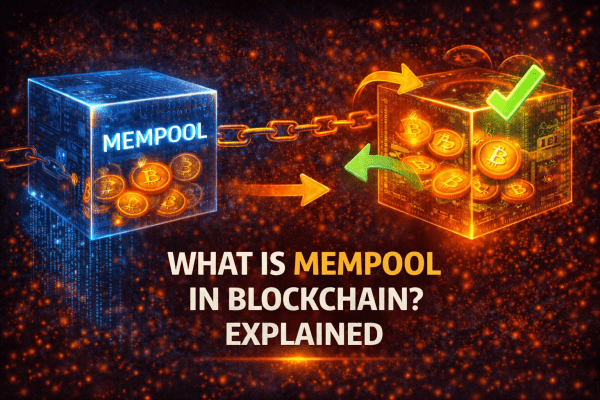
The mempool (memory pool) is the waiting area where all broadcast but unconfirmed transactions temporarily reside before being included in a block by miners or validators. Each node in the blockchain network maintains its own local mempool containing transactions it has received and validated but not yet seen confirmed in a block.
Key mempool characteristics:
Not part of the blockchain:
- Mempool exists in RAM (memory) of each network node
- Temporary storage only—transactions eventually confirmed or dropped
- Each node has slightly different mempool contents (network propagation delays)
- Cleared when transaction confirms or expires
Dynamic size:
- Bitcoin: Typically 1-500 MB depending on congestion
- During extreme congestion (May 2023): 500+ MB, 400,000+ pending transactions
- During quiet periods: <10 MB, 2,000-5,000 pending transactions
- Node operators set maximum mempool size (default: 300 MB Bitcoin Core)
Transaction lifecycle in mempool:
- Broadcast: Wallet sends transaction to network nodes
- Validation: Nodes verify transaction validity (sufficient balance, valid signatures)
- Mempool entry: Valid transaction stored in node mempool
- Propagation: Transaction spread across network (seconds to minutes)
- Priority queue: Miners sort by fee rate (sat/vB for Bitcoin, Gwei for Ethereum)
- Block inclusion: Miner selects highest-fee transactions for next block
- Confirmation: Transaction removed from mempool, added to blockchain
- OR Expiration: If not confirmed within ~72 hours (Bitcoin) or network-specific timeout, dropped from mempool
Why mempool necessary:
Asynchronous processing: Transactions arrive continuously, but blocks mined at fixed intervals (10 minutes Bitcoin, 12 seconds Ethereum). Mempool queues transactions between blocks.
Fee market creation: Limited block space (1-4 MB Bitcoin) + unlimited transaction submissions = competition for inclusion. Users bid via fees; miners maximize profit by selecting highest payers.
Network consensus: Nodes maintain mempools to quickly validate and propagate new blocks. When block arrives, nodes check if included transactions were in their mempool (quick validation).
Double-spend prevention: If conflicting transactions broadcast (spending same inputs), nodes reject later ones. Mempool enforces “first-seen” rule until miner confirms one transaction.
How the Mempool Actually Works: Transaction Flow and Priority Mechanics
Transaction Entry: Broadcast and Initial Validation
Step 1: Wallet creates and signs transaction
User initiates payment:
- Wallet constructs transaction with inputs (UTXOs), outputs (recipients), fee
- Cryptographically signs with private key
- Calculates transaction size in bytes (critical for fee calculation)
Example transaction:
Inputs: 1 (previous UTXO being spent)
Outputs: 2 (recipient + change back to sender)
Size: 226 virtual bytes (vB)
Fee: 11,300 satoshis (0.000113 BTC)
Fee rate: 50 sat/vB (11,300 sats / 226 vB)
Step 2: Broadcast to network nodes
Wallet connects to Bitcoin network peers:
- Sends transaction to 8-10 connected nodes
- Those nodes validate and forward to their peers
- Exponential propagation across network
- Full propagation: 3-15 seconds typically
Step 3: Node validation before mempool acceptance
Each node checks:
- Signature validity: Transaction properly signed by owner of inputs
- Double-spend check: Inputs not already spent in blockchain or mempool
- Sufficient balance: Sum of inputs ≥ sum of outputs + fee
- Fee adequacy: Fee rate above node’s minimum relay fee (default 1 sat/vB Bitcoin)
- Script validity: Transaction scripts execute without errors
- Size limits: Transaction under maximum size (100 KB standard, 400 KB weight units)
If validation passes → mempool acceptance. If fails → transaction rejected and not propagated further.
Mempool Organization: Priority Queues and Fee Sorting
Mempool not simple list—it’s priority queue sorted by fee rate.
Bitcoin mempool structure:
Priority tiers (mempool.space visualization):
- Top tier (>100 sat/vB): ~1-2 MB, confirms next block
- High priority (50-100 sat/vB): ~5-10 MB, confirms within 3 blocks
- Medium priority (20-50 sat/vB): ~20-50 MB, confirms within 6 blocks
- Low priority (10-20 sat/vB): ~50-100 MB, confirms within 24 blocks
- Very low (<10 sat/vB): 100+ MB, may never confirm or wait days
Miner selection algorithm:
When constructing block, miners:
- Sort mempool transactions by fee rate (descending)
- Select transactions starting from highest fee rate
- Pack transactions until block size limit reached (≈4 MB weight units)
- Exclude transactions conflicting with already-selected ones
- Sometimes include lower-fee child transactions to claim high-fee parent (CPFP)
Real mempool snapshot (March 15, 2024, 10:00 UTC):
Total mempool: 150 MB
Pending transactions: 85,000
Fee rate tiers:
  >80 sat/vB: 2,100 txs (~1.5 MB) — next block
  40-80 sat/vB: 8,500 txs (~8 MB) — 1-2 blocks
  20-40 sat/vB: 25,000 txs (~35 MB) — 3-10 blocks
  10-20 sat/vB: 30,000 txs (~60 MB) — 10-50 blocks
  <10 sat/vB: 19,400 txs (~45 MB) — may drop
Transaction selection example:
Block space available: 4 MB (≈4,000,000 weight units)
Miner builds block:
- Selects all 2,100 txs with >80 sat/vB (1.5 MB used, 2.5 MB remaining)
- Selects top ~6,000 txs from 40-80 tier (2.0 MB used, 0.5 MB remaining)
- Selects top ~1,500 txs from 20-40 tier (0.5 MB used, block full)
- Remaining 76,500 transactions wait for next block
Mempool Dynamics: Congestion and Clearance
Mempool fills when:
- Transaction submission rate > block processing capacity
- Example: 7 transactions/second broadcast, but blocks only process 3-4/second average
- Backlog accumulates: 4 txs/sec × 600 seconds = 2,400 pending transactions per block interval
Mempool clears when:
- Transaction rate drops below block capacity
- Users increase fees (higher-fee transactions displace lower-fee ones)
- Large transactions (spam attacks) expire and drop after timeout
Real congestion event (Ordinals inscription spike, May 2023):
Timeline:
- Day 1: Normal mempool 15 MB, fees 10-20 sat/vB
- Day 2: Ordinals inscription rush begins, 50,000 inscriptions/day
- Day 3: Mempool 180 MB, fees spike to 100-200 sat/vB
- Day 4: Mempool peak 420 MB, 350,000 pending transactions
- Day 5: Fee requirement hits 300 sat/vB for next-block confirmation
- Day 7: Inscription demand drops, mempool drains to 80 MB over 24 hours
- Day 10: Return to normal 20 MB, fees stabilize at 30-40 sat/vB
Impact on users:
- Low-fee transactions (<50 sat/vB) stuck 3-7 days
- Users paid $30-100 fees for simple transfers (normally $1-3)
- Many transactions dropped after 72-hour expiration
- Exchanges paused withdrawals due to unpredictable confirmation times
Read: Hot Wallets: Security and Risks
Why Understanding Mempool is Critical for Transaction Success
Fee Optimization: Paying Right Amount at Right Time
Problem without mempool knowledge: User sets “normal” fee of 20 sat/vB based on outdated wallet recommendation. Current mempool shows 100 sat/vB minimum for reasonable confirmation. Transaction stuck for days.
Solution with mempool monitoring: Check mempool.space before sending:
- Current network fee tiers displayed visually
- Recommended fees for target confirmation time (next block, 30 min, 1 hour)
- Real-time mempool size and congestion level
- Estimated blocks until confirmation at different fee levels
Fee calculation strategy:
For time-sensitive transactions:
- Check mempool.space “Next Block” recommendation
- Add 10-20% buffer (mempool can change quickly)
- Set fee accordingly
For non-urgent transactions:
- Check mempool.space “Low Priority” recommendation (1-6 hours)
- Monitor transaction—if not confirming, use RBF to bump fee
- Accept potential multi-hour wait
Example scenario:
Current mempool state:
- Next block: 65 sat/vB
- 30 minutes: 45 sat/vB
- 1 hour: 30 sat/vB
Transaction calculation:
- Urgent payment (need confirmation within 20 minutes): Set 75 sat/vB (65 + 15% buffer)
- Standard payment (1-2 hours acceptable): Set 35 sat/vB
- Low priority (6-12 hours OK): Set 20 sat/vB
Cost difference on 250-byte transaction:
- 75 sat/vB: 18,750 sats (≈$11.63 at $62k BTC)
- 35 sat/vB: 8,750 sats (≈$5.43)
- 20 sat/vB: 5,000 sats (≈$3.10)
Understanding mempool saves $8.53 on this single transaction by avoiding overpayment while ensuring timely confirmation.
Transaction Stuck Prevention and Troubleshooting
Common stuck transaction causes:
Cause #1: Fee too low for current mempool conditions
- Submitted 15 sat/vB when network requires 40+ sat/vB
- Transaction visible in mempool but miners ignore it
- Position: 150,000th in queue of 200,000 transactions
Cause #2: Mempool congestion spike after submission
- Submitted 30 sat/vB when network required 25 sat/vB (seemed safe)
- Sudden congestion event (Ordinals, exchange batch withdrawal, etc.)
- Network requirement jumps to 80 sat/vB within 30 minutes
- Your transaction now far below requirements
Cause #3: Transaction dropped from mempool
- Fee too low + mempool full
- Node mempool size limit reached (300 MB default)
- Nodes drop lowest-fee transactions to make room
- Transaction must be rebroadcast with higher fee
Troubleshooting process:
Step 1: Verify transaction in mempool
- Search TXID on mempool.space
- Check status: “In Mempool” vs “Not Found”
- If “Not Found”: Dropped or never broadcast—resubmit
Step 2: Check fee competitiveness
- Compare your fee rate to current recommendations
- If yours significantly lower (>50% below): Stuck indefinitely
- If close to recommendations: May confirm during low-congestion period
Step 3: Estimate wait time
- Mempool.space shows “Estimated blocks” for confirmation
- Check your position in fee priority queue
- Calculate approximate time: blocks × 10 minutes
Step 4: Decide action
If transaction has RBF enabled:
- Use Replace-By-Fee to create higher-fee replacement
- New transaction same inputs/outputs, increased fee
- Old transaction dropped, new one prioritized
If no RBF and urgent:
- Recipient can use Child-Pays-For-Parent (CPFP)
- Create new transaction spending unconfirmed output
- High fee on child incentivizes miners to include both
- Requires recipient cooperation
If no RBF and not urgent:
- Wait for confirmation (may be hours/days)
- Monitor mempool congestion trends
- If drops after 72 hours, rebroadcast with proper fee
Real case study (February 2024):
Situation: User sent 0.05 BTC to exchange for urgent trade. Fee: 18 sat/vB. Current mempool requirement: 55 sat/vB.
Analysis:
- Transaction position: 180,000 / 220,000 in queue
- Mempool size: 240 MB (very congested)
- Estimated confirmation: 50-80 blocks (8-13 hours)
- Trade opportunity closes in 2 hours
Action taken:
- Transaction had RBF enabled
- Created replacement with 70 sat/vB fee
- Additional cost: (70-18) × 180 bytes = 9,360 sats (≈$5.80)
- Confirmed in next block (12 minutes)
- Saved trade opportunity worth $2,000+
Lesson: $5.80 RBF fee saved $2,000 opportunity. Mempool understanding enables informed decision-making.
Critical Mistakes When Dealing with Mempool and Unconfirmed Transactions
Mistake #1: Trusting Wallet Default Fees Without Mempool Verification
Problem: Many wallets use outdated fee estimation algorithms or conservative defaults that don’t reflect real-time mempool conditions.
Example wallet behaviors:
Bitcoin Core default:
- Estimates fee based on recent blockchain data
- Doesn’t account for sudden mempool changes
- During rapid congestion, recommendations lag by 30-60 minutes
- Suggests 25 sat/vB when network actually requires 80 sat/vB
Mobile wallet defaults:
- Often provide 3 options: “Low,” “Normal,” “High”
- Definitions vary widely between wallets
- “Normal” might be 20 sat/vB in one wallet, 50 sat/vB in another
- No connection to actual current mempool state
Real incident (March 2024):
- Popular mobile wallet “Normal” fee: 30 sat/vB
- Actual mempool requirement for 1-hour confirmation: 75 sat/vB
- 15,000 users submitted transactions with insufficient fees
- Average stuck time: 18 hours
- Many resubmitted with higher fees (paid twice in total fees)
Prevention: ALWAYS check mempool.space or similar real-time explorer before setting fee, regardless of wallet recommendation. Use wallet suggestion as starting point, but verify against current network state.
Read: Fake Crypto Presales: Warning Signs
Mistake #2: Submitting Multiple Transactions Without Understanding Mempool Replacement Rules
Scenario: User submits transaction, doesn’t confirm quickly, panics and submits same transaction again with different fee.
What happens:
If RBF not enabled on original:
- Second transaction conflicts with first (spends same inputs)
- Nodes reject second transaction as double-spend attempt
- First transaction remains stuck with low fee
- User confused why second “higher fee” transaction not visible
If RBF enabled but incorrectly implemented:
- Replacement must increase fee by minimum amount (1 sat/vB + absolute fee increase)
- Must signal RBF in transaction flags
- Must have same outputs (or decrease output to increase fee)
- Incorrect implementation = rejected replacement
Correct RBF process:
- Verify original transaction has RBF flag (BIP 125)
- Create replacement with: same inputs, same/reduced outputs, higher fee
- Fee increase must be: new_fee ≥ old_fee + (tx_size × 1 sat/vB)
- Broadcast replacement—miners accept, original dropped from mempool
Common RBF errors:
Error: Changed recipient address
- Original: Sent 0.1 BTC to Address A
- Replacement attempt: Sent 0.1 BTC to Address B (with higher fee)
- Result: Rejected as invalid replacement (different outputs)
- Correct: Keep Address A, reduce change output to increase fee
Error: Insufficient fee bump
- Original: 10,000 sats total fee
- Replacement: 10,100 sats total fee (only 100 sat increase)
- Transaction size: 220 bytes
- Minimum required increase: 220 sats (1 sat/vB × size)
- Result: Replacement rejected, original remains
Real case (user forum post, January 2024): “I sent transaction with 20 sat/vB. Been stuck 6 hours. I tried to resend with 60 sat/vB but blockchain explorer shows ‘transaction rejected.’ What’s wrong?”
Analysis: User attempted to broadcast entirely new transaction spending same UTXOs. Without RBF flag on original, nodes treated second as double-spend attack and rejected it. Original transaction remained stuck.
Solution provided: Wait for original to either confirm or drop from mempool (72 hours), then rebroadcast with proper fee. Or contact recipient to use CPFP if urgent.
Mistake #3: Not Monitoring Mempool After Submission for Time-Sensitive Payments
Problem: User submits transaction with appropriate fee for current conditions, but mempool changes dramatically in next 30-60 minutes. Transaction becomes stuck.
Timeline of mempool volatility:
10:00 AM: Submit transaction, 40 sat/vB fee
- Current mempool: 80 MB, next-block requirement 35 sat/vB
- Transaction positioned well for confirmation within 2-3 blocks
10:15 AM: Large exchange batch withdrawal (5,000 transactions at 60+ sat/vB)
- Mempool jumps to 120 MB
- Next-block requirement now 55 sat/vB
- Your transaction pushed down priority queue
10:30 AM: Ordinals inscription wave begins
- Mempool 180 MB
- Next-block requirement 85 sat/vB
- Your transaction now 150,000th in queue
10:45 AM: User checks transaction
- Expected confirmation by now (3 blocks passed)
- Still shows “unconfirmed”
- No action taken (assumes will eventually confirm)
2:00 PM: 16 blocks later, still unconfirmed
- Mempool sustained at 200+ MB
- Minimum fee requirement 90+ sat/vB
- Your 40 sat/vB transaction unlikely to confirm for days
Prevention strategy:
For urgent transactions:
- Check mempool status at submission
- Monitor every 20-30 minutes until first confirmation
- If mempool congestion increases significantly, use RBF immediately
- Don’t wait hours to take action
For non-urgent:
- Set fee conservatively (lower end of recommendations)
- Enable RBF as safety mechanism
- Check once or twice daily
- Bump fee only if transaction critical or about to drop
Monitoring checklist: ☐ Bookmark mempool.space with your TXID ☐ Check mempool size trend (growing or shrinking) ☐ Compare your fee rate to current next-block requirement ☐ Note your position in mempool queue ☐ If gap between your fee and requirement growing → take action
Mistake #4: Believing Mempool State is Uniform Across All Nodes
Misconception: “If I see my transaction in mempool on blockchain.com, all miners see it too and will eventually include it.”
Reality: Each node maintains independent mempool with slightly different contents.
Reasons for mempool divergence:
Network propagation delays:
- Transaction broadcast takes 3-30 seconds to reach all nodes
- Some miners may construct blocks before your transaction reaches them
- Result: Your transaction in 90% of node mempools, but mining pool constructing block only has 85% of network transactions
Node configuration differences:
- Minimum relay fee settings (some nodes reject <5 sat/vB, others accept ≥1 sat/vB)
- Mempool size limits (some 300 MB, some nodes run with 500 MB or 100 MB limits)
- RBF policy differences (some nodes relay replacements, others don’t)
Transaction conflicts:
- Two conflicting transactions broadcast simultaneously
- Some nodes receive Transaction A first, others receive Transaction B first
- Each node’s mempool contains only the first-seen transaction
- Whichever gets mined, conflicting one dropped from all mempools
Mempool expiration timing:
- Standard: Drop transactions after 72 hours (2 weeks Bitcoin Core default)
- Some nodes configured for 24 hours, others 1 week
- Your transaction may drop from some node mempools but remain in others
Practical implications:
Implication #1: Don’t rely on single explorer
- Check 2-3 explorers: mempool.space, blockchain.com, blockchair.com
- If transaction missing from one but present in others, some nodes haven’t received it
- Use “Broadcast transaction” tools to push to more nodes
Implication #2: Mining pool mempools differ from public nodes
- Large mining pools run custom mempool software
- May prioritize certain transaction types
- May have private agreements (transaction accelerators for fee)
- Your transaction visible publicly doesn’t guarantee miners have it
Implication #3: Rebroadcasting may help
- If transaction dropped from some nodes but not others
- Wallet rebroadcast pushes to nodes that lost it
- Increases probability miners receive it
- Most wallets rebroadcast automatically every few hours
How to Check Mempool Status and Optimize Your Transactions: Step-by-Step Guide
Using Mempool.space for Real-Time Analysis
Step 1: Access Mempool.space
- Navigate to mempool.space (no registration required)
- Homepage displays real-time Bitcoin mempool visualization
Step 2: Interpret mempool dashboard
Key metrics displayed:
Mempool size:
- Total MB of pending transactions
- Visual blocks showing fee tiers
- Color coding: Purple (high fee) to Blue (low fee)
Example reading:
Mempool Size: 145 MB
Pending Transactions: 82,000
Blocks until clearance: ~35 blocks (6 hours)

Fee tiers:
  Purple (>100 sat/vB): 1.2 MB — Next block
  Red (60-100 sat/vB): 8.5 MB — 1-3 blocks
  Orange (40-60 sat/vB): 25 MB — 3-8 blocks
  Yellow (20-40 sat/vB): 60 MB — 8-20 blocks
  Green (10-20 sat/vB): 35 MB — 20-50 blocks
  Blue (<10 sat/vB): 15 MB — May not confirm
Transaction count by fee:
- Histogram showing distribution
- Identify where most transactions concentrated
- Your target fee should be above concentration for faster confirmation
Incoming transactions:
- Rate of new transactions entering mempool
- If rate > block capacity, congestion worsening
- If rate < block capacity, mempool clearing
Step 3: Get fee recommendations
Mempool.space provides estimates:
- Next Block: Minimum fee for inclusion in next mined block (~10 minutes)
- 30 Minutes: Expected fee for confirmation within 3 blocks
- 1 Hour: Expected fee for confirmation within 6 blocks
- Economy: Low-priority fee (may take 6-24 hours)
Example recommendations (displayed on site):
Next Block: 68 sat/vB
30 min: 52 sat/vB
1 hour: 38 sat/vB
Economy: 18 sat/vB
Step 4: Calculate your transaction fee
Fee calculation formula: Fee (satoshis) = Transaction size (vBytes) × Fee rate (sat/vB)
Estimate transaction size:
- 1 input, 2 outputs (typical): ~220 vBytes
- 2 inputs, 2 outputs: ~370 vBytes
- 1 input, 1 output (no change): ~140 vBytes
- SegWit transactions: ~30-40% smaller than legacy
Example calculation:
- Transaction size: 250 vBytes
- Target: Confirmation within 1 hour
- Current 1-hour rate: 38 sat/vB
- Fee needed: 250 × 38 = 9,500 satoshis (0.000095 BTC ≈ $5.89 at $62k BTC)
Step 5: Monitor your transaction after submission
Search for your TXID:
- Paste transaction ID in mempool.space search
- View transaction details page
Information shown:
Status: Unconfirmed (in mempool)
Fee: 9,500 sats
Fee rate: 38 sat/vB
Size: 250 vBytes
Position in mempool: 28,450 / 82,000
Estimated blocks: 8 blocks (~80 minutes)
First seen: 2024-03-15 14:32:18
Monitoring indicators:
Good signs (likely to confirm soon):
- Fee rate above “Next Block” recommendation
- Position in top 10-20% of mempool
- Mempool size stable or decreasing
- Estimated blocks <6
Warning signs (may be delayed):
- Fee rate below current recommendations
- Position in bottom 50% of mempool
- Mempool size growing rapidly
- Estimated blocks >20
Action based on monitoring:
- If delayed and urgent: Use RBF to increase fee
- If delayed but not urgent: Wait or let drop after 72 hours
- If confirming as expected: No action needed
Advanced: Running Your Own Mempool Explorer (Mempool.space GitHub)
Why run own instance:
- Privacy (don’t expose transactions to third-party server)
- Customization (modify fee estimation algorithms)
- Reliability (no dependence on external service)
- Network analysis (research mempool behavior)
Technical requirements:
- Bitcoin Core full node (synced blockchain, ~600 GB storage)
- Mempool.space backend (Node.js application)
- Frontend (Angular web interface)
- Server: 16 GB RAM minimum, 1 TB SSD recommended
Setup process (condensed):
Step 1: Install Bitcoin Core
bash
# Download Bitcoin Core
wget https://bitcoincore.org/bin/bitcoin-core-26.0/bitcoin-26.0-x86_64-linux-gnu.tar.gz

# Extract and install
tar -xzf bitcoin-26.0-x86_64-linux-gnu.tar.gz
sudo install -m 0755 -o root -g root -t /usr/local/bin bitcoin-26.0/bin/*

# Configure bitcoin.conf
txindex=1
server=1
rpcuser=mempool
rpcpassword=your_secure_password
zmqpubrawblock=tcp://127.0.0.1:28332
zmqpubrawtx=tcp://127.0.0.1:28333
Step 2: Sync blockchain
bash
bitcoind -daemon
# Wait for full sync (24-72 hours on fast connection)
bitcoin-cli getblockchaininfo
Step 3: Clone Mempool.space from GitHub
bash
git clone https://github.com/mempool/mempool.git
cd mempool
Step 4: Install backend dependencies
bash
cd backend
npm install
# Configure mempool-config.json with Bitcoin Core RPC credentials
Step 5: Build and run
bash
npm run build
npm start
# Backend runs on port 8999
Step 6: Frontend setup
bash
cd ../frontend
npm install
npm run build
# Serve via nginx or similar
Step 7: Access your instance
- Navigate to http://localhost (or your server IP)
- Full mempool.space interface with your own data
- All API endpoints available for custom applications
Use cases for self-hosted:
- Trading bots: Real-time mempool data for fee prediction
- Merchants: Monitor customer payment transactions privately
- Researchers: Analyze mempool dynamics, fee market behavior
- Privacy-focused users: No transaction exposure to third parties
Mempool Behavior During Network Congestion: Real Examples and Analysis
Case Study #1: Ordinals Inscription Rush (May 2023)
Background: Bitcoin Ordinals protocol allows inscribing data (images, text) onto individual satoshis. May 2023 saw explosive demand for Ordinals NFT-like inscriptions.
Mempool impact timeline:
May 7, 00:00 UTC:
- Mempool size: 12 MB (normal)
- Pending transactions: 8,500
- Next-block fee: 12 sat/vB
- Median transaction wait: 20 minutes
May 7, 18:00 UTC:
- First major inscription wave
- Mempool: 65 MB
- Pending: 45,000
- Next-block fee: 85 sat/vB
- Users with 15-30 sat/vB transactions stuck
May 8, 12:00 UTC:
- Peak congestion
- Mempool: 425 MB (35x normal)
- Pending: 380,000 transactions
- Next-block fee: 280 sat/vB
- 1-hour confirmation: 180 sat/vB
- Transactions <100 sat/vB delayed 24+ hours
May 9-11:
- Sustained high congestion
- Mempool 250-350 MB
- Fees 150-250 sat/vB
- Simple transactions costing $30-80 (vs typical $1-3)
May 12:
- Inscription demand drops
- Mempool begins draining
- Fees decline to 80-120 sat/vB
May 14:
- Return to near-normal
- Mempool 40 MB
- Fees 30-50 sat/vB
User impacts:
Victim #1: Exchange withdrawal
- Initiated $15,000 withdrawal May 7 evening
- Exchange used fixed 25 sat/vB fee (their standard)
- Stuck unconfirmed for 4 days
- Confirmed May 11 when mempool finally cleared low-fee transactions
- Could not access funds for urgent purchase
Victim #2: Business payment
- Sent 0.2 BTC payment for equipment
- Used wallet “Normal” fee: 40 sat/vB
- Transaction stuck at position 220,000 in queue
- Vendor required confirmation before shipping
- Used RBF to bump to 200 sat/vB after 18 hours
- Additional cost: (200-40) × 225 vB = 36,000 sats ($22.32)
- Confirmed next block after fee bump
Winner: Informed user
- Monitored mempool.space before sending time-sensitive payment
- Saw congestion spike in progress
- Set 250 sat/vB fee despite high cost
- Confirmed in next block (12 minutes)
- Paid premium but ensured transaction success
Lesson: During congestion events, mempool awareness separates successful transactions from stuck ones. Real-time monitoring enables informed fee decisions.
Case Study #2: Exchange Batch Withdrawal Collision (March 2024)
Scenario: Three major exchanges (Coinbase, Binance, Kraken) coincidentally processed large batch withdrawals within 30-minute window.
Mempool behavior:
14:00 UTC: Pre-event
- Mempool: 45 MB
- Next-block: 28 sat/vB
- Stable conditions
14:15 UTC: Coinbase batch (8,000 withdrawals)
- Mempool jumps to 62 MB
- Next-block requirement: 42 sat/vB
- Users with 30-40 sat/vB now borderline
14:30 UTC: Binance batch (12,000 withdrawals)
- Mempool: 95 MB
- Next-block: 58 sat/vB
- Significant fee pressure
14:35 UTC: Kraken batch (5,000 withdrawals)
- Mempool peak: 118 MB
- Next-block: 72 sat/vB
- 25,000 total withdrawals in 35 minutes
Impact duration:
- Elevated fees for 3 hours
- Mempool cleared to normal by 18:00 UTC
- Short but sharp congestion spike
User experience:
Caught off-guard: User submitted transaction at 14:10 with 32 sat/vB (seemed safe at the time). By 14:40, transaction at position 85,000 in queue. Waited 2.5 hours for confirmation as mempool slowly processed backlog.
Prepared user: Monitored mempool, saw exchanges beginning batch processing. Delayed personal transaction 4 hours until congestion cleared. Paid 30 sat/vB at 18:30, confirmed normally.
Lesson: Mempool can spike rapidly due to coordinated activity. Monitoring before submission prevents getting caught in temporary congestion.
Myths About Mempool and Transaction Processing
Myth #1: “Mempool is Central Database All Nodes Share”
Belief: “There’s one mempool that all Bitcoin nodes and miners access.”
Reality: Every node maintains its own independent mempool. Contents vary slightly between nodes due to:
- Propagation delays (transactions reach different nodes at different times)
- Configuration differences (size limits, minimum fees)
- Network topology (some nodes better connected than others)
Implications:
- Your transaction in 95% of node mempools doesn’t guarantee miners have it
- Blockchain explorers show their node’s mempool, not universal state
- Rebroadcasting helps ensure wider mempool presence
Myth #2: “Higher Fee Guarantees Faster Block Confirmation”
Belief: “If I pay 500 sat/vB, my transaction will definitely confirm in next block.”
Reality: Fee affects mempool priority, not block discovery time.
What fee controls:
- Position in mempool queue
- Likelihood of miner selection
- Relative priority vs other transactions
What fee doesn’t control:
- How fast next block is found (probability-based, averages 10 minutes)
- Network hash rate
- Block propagation speed
Example:
- You pay 500 sat/vB (extremely high)
- Next-block requirement: 50 sat/vB
- Both your transaction and 50 sat/vB transaction likely selected by miner
- Both confirm in same block
- Time difference: 0 (both wait same 10 minutes for block)
- You overpaid 10x without time benefit
Smart approach: Pay slightly above next-block requirement (10-15% buffer), not 5-10x higher.
Myth #3: “Stuck Transactions Will Always Eventually Confirm”
Reality: Transactions can drop from mempool and never confirm.
Mempool expiration rules:
- Bitcoin Core default: 72 hours (3 days)
- Some nodes: 336 hours (14 days)
- Custom configurations: 24 hours to indefinite
What happens at expiration:
- Node removes transaction from mempool
- Transaction funds return to “unspent” state in sender’s wallet
- No confirmation, no permanent record
- Sender can create new transaction spending same inputs
Scenarios causing drops:
Scenario #1: Sustained low fee
- Submit transaction with 5 sat/vB
- Network minimum 30+ sat/vB for days
- After 72 hours, transaction expires
- Must resubmit with adequate fee
Scenario #2: Mempool size limit
- Node mempool max: 300 MB
- Network congestion pushes mempool to 400+ MB of pending transactions
- Node drops lowest-fee transactions to stay under limit
- Your transaction expelled if in bottom tier
Scenario #3: Conflicting transaction confirmed
- You (accidentally or via RBF) broadcast replacement
- Replacement confirms
- Original transaction now invalid (inputs already spent)
- Nodes drop original from mempool
Prevention:
- Always enable RBF for ability to replace if stuck
- Monitor mempool to ensure fees remain competitive
- Use reputable wallets that handle rebroadcasting
Myth #4: “Mempool.space Shows All Pending Transactions”
Reality: Mempool.space shows transactions in their specific node’s mempool, which may not include:
Non-standard transactions:
- Some nodes reject transactions with unusual scripts
- Mempool.space may not relay/display these
- Miners running custom software might still accept them
Very low fee transactions:
- Nodes have minimum relay fees (typically 1 sat/vB)
- Transactions below this rejected before mempool entry
- Won’t appear in any public explorer
Recently broadcast:
- Propagation takes 3-30 seconds
- Very new transactions may not have reached mempool.space node yet
- Check multiple explorers if transaction missing
Private transactions:
- Some miners accept transactions directly (not broadcast publicly)
- Pay miners out-of-band for guaranteed inclusion
- Won’t appear in public mempool explorers
Read more:
- Anonymous Fake Crypto Team Warning — verify project founders
- Fake Crypto Investment Funds Guide — avoid recovery & investment traps
- Fake Crypto Exchanges: Warning Signs — protect deposits and withdrawals
- Coinbase Email Scam Guide — fake confirmations explained
- Telegram Crypto Scams Explained — common fraud schemes

Why Most “Free Tokens” Are a Trap — and How the Real Ones Work
You see an announcement in Telegram: “Claim 500 free tokens right now — only for the next 2 hours.” You connect your wallet. The tokens appear in your balance. It feels like free money falling from the sky — but seven days later you open MetaMask and your entire portfolio is gone. ETH, USDC, everything. You signed a transaction you didn’t read, giving a malicious smart contract unlimited access to drain your funds.
This isn’t a hypothetical. In 2023 alone, drainer contracts disguised as airdrop claim pages stole over $300 million from crypto users. The mechanics are simple, the psychological pressure is intense, and the victims are not just beginners — experienced DeFi users get caught too.
But here’s the other side of the story. In September 2020, Uniswap sent 400 UNI tokens to every wallet that had ever swapped through the protocol — worth $1,200 at launch and over $16,000 at peak. In November 2021, ENS distributed tokens worth $5,000 to $80,000+ to users who had simply registered a .eth domain. In March 2023, Arbitrum dropped $1,100 to $11,000+ on 625,000 wallets in a single day.
These are real programs that distributed real money to real users — with no strings attached, no upfront payment, and no seed phrase required.
The difference between a legitimate airdrop and a scam is specific and learnable. This guide covers everything: how airdrops work technically, how to evaluate any airdrop before touching it, how to claim safely, and how to recognize every psychological trick scammers use to make you act before you think.
What Is Airdrop Crypto and Why Do Projects Give Away Free Tokens
An airdrop is the distribution of tokens or NFTs to user wallets without direct payment from the recipient. A project sends tokens either automatically (pushed to qualifying addresses) or on demand — the user calls a claim() function on a smart contract and pulls the tokens to their wallet.
The word “airdrop” comes from the military concept of dropping supplies from the air to people on the ground. In crypto, the metaphor holds: the project distributes value to a dispersed group of people, often without prior announcement, based on criteria defined in advance.
Why Projects Run Airdrops
Understanding the motivation behind legitimate airdrops is the first filter for identifying scams. Real projects airdrop tokens for specific strategic reasons:
Decentralizing governance. Regulators, particularly in the US, scrutinize whether a token functions as a security. One key legal test is decentralization — if thousands of independent holders control the token, it’s harder to classify as a centralized investment contract. Uniswap’s UNI airdrop was partly a legal strategy. By distributing governance rights to 250,000+ wallets before facing regulatory pressure, the protocol strengthened its decentralization argument.
Rewarding early users and bootstrapping network effects. Protocols that launch before their token exists need users to take a risk on an unproven product. The retroactive airdrop is the deferred reward for that early trust. Users who swapped on Uniswap in 2019 when it was a tiny, unaudited DEX took real risk. The UNI airdrop was the payoff.
Marketing and user acquisition. A well-executed airdrop generates enormous organic attention. When Arbitrum dropped $1,100–$11,000 on 625,000 wallets, that story spread across every crypto media outlet and social platform. The cost per acquired user, in terms of attention and wallet creation, was extremely low compared to traditional advertising.
Competing with an established rival. Blur entered a market dominated by OpenSea and used its BLUR airdrop to directly incentivize NFT traders to move volume. This worked — Blur’s market share surpassed OpenSea within weeks of the airdrop. The token distribution was the weapon, not the product.
Building a community with aligned incentives. When users hold a project’s governance token, they have a financial reason to care about its success. They promote it, report bugs, participate in governance votes, and recruit other users. Token distribution creates a community that behaves like part-owners.
How Crypto Air Drop Works: Mechanics From the Inside
Every legitimate airdrop rests on a specific technical foundation. Understanding this foundation makes it immediately obvious when something is wrong.
The Snapshot
A blockchain snapshot is a record of the state of the chain at a specific block height — who owns what, which addresses have interacted with which contracts, what transaction counts look like. Projects analyze this snapshot to determine eligibility. The snapshot typically happens silently, before the airdrop is announced, which is why retroactive airdrops can reward users who had no idea they were being tracked.
When Uniswap took its snapshot in September 2020, no user was specifically farming for UNI. The snapshot captured organic usage. This is why retroactive airdrops based on genuine past activity are the most valuable to participate in — and why manufacturing fake activity across multiple wallets (Sybil farming) is increasingly detected and excluded.
The Merkle Tree
After defining the eligible addresses and amounts, the project encodes this data into a Merkle Tree — a binary tree structure where each leaf node is a hash of an address-amount pair, and parent nodes are hashes of their children. The root of the tree (Merkle Root) is published on-chain in the claim contract.
When a user calls claim(), they submit a Merkle Proof — a set of hashes that proves their specific leaf is part of the tree without revealing the entire list. The contract verifies the proof against the stored root and releases tokens if it’s valid. This is why claiming requires a transaction and gas — you’re triggering on-chain computation.
Types of Airdrops by Mechanics
| Type | How Eligibility Works | What You Need | Scam Risk |
|---|---|---|---|
| Retroactive | Past on-chain activity snapshot | Used the protocol before cutoff | Low |
| Standard | Complete off-chain tasks | Social follows, wallet registration | Medium |
| Holder | Owning a specific token or NFT | Buy and hold the qualifying asset | Medium |
| NFT Airdrop | Holding an NFT collection | NFT in wallet at snapshot | Medium |
| Exclusive / Testnet | Invited or qualified through testing | Bug reports, testnet transactions | Low |
| Lottery | Random selection from participants | Register wallet during period | Medium-High |
The Claim Process Step by Step
- The project announces the airdrop and publishes the claim contract address through official channels
- Users visit the official claim site and connect their wallet (MetaMask, Rabby, etc.)
- The site queries the Merkle Tree to show whether the connected address is eligible and for how much
- The user clicks Claim, which initiates a transaction calling the contract’s
claim()function - The contract verifies the Merkle Proof, checks that the address hasn’t already claimed, and transfers tokens
- Tokens appear in the wallet — the user pays gas for the transaction
Mini-Guide: What You’re Actually Signing When You Claim
When you click Claim, your wallet shows a transaction confirmation. This is not a simple transfer — it’s a contract interaction. Read it carefully:
- To: the contract address you’re calling. Verify this matches the official contract address published by the project.
- Function: should be something like
claim()orclaimTokens(). If you seeapprove(),setApprovalForAll(), ortransferFrom()— stop immediately. - Value: should be 0 ETH unless you’re explicitly paying for something. Any ETH value in a “free airdrop” claim is a scam signal.
- Gas: this is the only legitimate cost. On Ethereum mainnet, $5–$80. On Arbitrum or Optimism, $0.01–$0.50.
The rule: gas is the only thing you spend to claim a legitimate airdrop. Nothing else. Ever.
Why Free Airdrop Crypto Matters: Real Numbers Behind the Hype
The scale of value distributed through legitimate airdrops is large enough to take seriously — and specific enough to learn from.
| Project | Year | Eligible Wallets | Per-Wallet Value at Claim | Peak Per-Wallet Value |
|---|---|---|---|---|
| Uniswap (UNI) | 2020 | ~250,000 | $1,200 | $16,800 |
| 1inch (1INCH) | 2020 | ~52,000 | $800–$2,000 | $4,000+ |
| ENS | 2021 | ~137,000 | $5,000–$30,000 | $80,000+ (early registrants) |
| dYdX (DYDX) | 2021 | ~64,000 | $2,200–$50,000+ | Depended on trading volume |
| Optimism (OP) | 2022 | ~250,000 | $500–$5,000 | $1,500–$15,000 |
| Arbitrum (ARB) | 2023 | ~625,000 | $1,100–$11,000 | Peak on claim day |
| Blur (BLUR) | 2023 | ~47,000 | $500–$10,000+ | NFT volume dependent |
The total value distributed through crypto airdrops between 2020 and 2024 exceeded $5 billion. This is not speculative — these are verified on-chain distributions to real wallets. The users who received the largest allocations weren’t lucky — they were early, consistent, and used the protocols genuinely.
The flip side: tens of millions of dollars in legitimate airdrop tokens were never claimed. Uniswap alone had hundreds of millions of UNI go unclaimed because users didn’t know they were eligible or missed the deadline. Paying attention to projects you use is a skill with measurable financial value.
Where and When Best Crypto Airdrops Happen: Ecosystems and Timing Patterns
Airdrops follow recognizable patterns. Knowing when they happen lets you position in advance.
When Projects Airdrop
- Before a major exchange listing — the project wants a broad, organic holder base before CEX listing, which attracts retail attention
- At governance token launch — every major DeFi protocol that launched governance eventually airdropped: UNI, COMP, AAVE, SUSHI, CRV, ARB, OP, DYDX
- At mainnet launch after a long testnet — users who stress-tested the protocol during testnet get rewarded at mainnet, making testnet participation one of the most consistent airdrop strategies
- To compete aggressively with a market leader — Blur vs OpenSea is the clearest example; token incentives are used as a weapon to redirect user behavior
- As a retroactive reward for early community members — Discord moderators, GitHub contributors, forum participants sometimes receive separate allocations
Ecosystems Most Likely to Produce Upcoming Airdrops
| Ecosystem | Most Active Projects | Best Strategy |
|---|---|---|
| Ethereum L2 | zkSync Era, Scroll, Linea, StarkNet | Bridge ETH, use native DEXes and lending |
| Solana | Projects using Token-2022 standard, new DeFi | Use DEXes, liquid staking, NFT mints |
| Cosmos / IBC | New IBC chains, restaking protocols | Stake ATOM, participate in new chain launches |
| Bitcoin L2 | Stacks, Merlin, BOB, new RGB protocols | Early activity, BTC bridging |
| AI + Crypto | Bittensor subnets, onchain AI agent protocols | Test applications, stake in subnets |
| DePIN | New infrastructure networks | Run nodes, contribute real-world data |
Airdrop Risk Score: A Formula to Evaluate Any Drop Before You Touch It
Before interacting with any airdrop, run this calculation. It takes two minutes and has saved people thousands of dollars.
Risk Score = (Guarantee × Urgency) + (Anonymity × Direct Transfer)
Rate each variable from 0 to 5:
- Guarantee — how certain is the profit framing? (0 = realistic expectations stated, 5 = “100% profit guaranteed, no risk”)
- Urgency — how much time pressure exists? (0 = months to claim, no countdown, 5 = “expires in 10 minutes”)
- Anonymity — how unknown is the team? (0 = fully doxxed, public team with track record, 5 = completely anonymous, no verifiable identity)
- Direct Transfer — are you asked to send crypto to receive crypto? (0 = never, 5 = explicitly required to send ETH/BTC/USDT)
Score interpretation:
- 0–5: Low risk — worth investigating further
- 6–15: Moderate risk — verify contract, team, and official channels before proceeding
- 16–25: High risk — assume scam unless you can independently verify every element
- 26–50: Definite scam — do not interact
Examples With Actual Scores
| Airdrop | Guarantee | Urgency | Anonymity | Direct Transfer | Score | Verdict |
|---|---|---|---|---|---|---|
| Uniswap UNI (2020) | 0 | 0 | 0 | 0 | 0 | Legitimate |
| Arbitrum ARB (2023) | 1 | 1 | 0 | 0 | 1 | Legitimate |
| “Claim 500 USDT now” | 5 | 5 | 5 | 0 | 50 | Scam |
| “Send 0.1 ETH to unlock” | 4 | 5 | 5 | 5 | 45 | Scam |
| New L2 testnet drop | 2 | 2 | 2 | 0 | 8 | Verify carefully |
| Anonymous Telegram drop | 3 | 4 | 5 | 3 | 27 | Scam |
Top Mistakes When Participating in Free Airdrops
Mistake 1: Granting Unlimited Token Approval
When MetaMask shows an Approve prompt, you’re giving a smart contract the right to spend your tokens — potentially up to the maximum possible amount. A legitimate airdrop claim contract never needs unlimited approval to tokens you already hold. If you see an approval request for USDC, ETH, or any existing asset in your wallet as part of an “airdrop claim” — you are interacting with a drainer. Stop immediately, reject the transaction, and revoke any existing approvals at revoke.cash.
Mistake 2: Paying Any Fee to “Unlock” or “Activate” Your Claim
The mechanics of a real airdrop don’t require you to send ETH to a project address, pay a “verification fee,” or “activate” your wallet. The only payment in a legitimate airdrop is the gas fee for your own transaction, which goes to network validators — not to the project. Any request for ETH/USDT/BTC before receiving “free” tokens is the entire scam mechanism. It doesn’t matter how official the site looks.
Mistake 3: Using Your Main Wallet
Your primary wallet — the one holding your savings, long-term positions, and valuable NFTs — should never be connected to an unfamiliar website for any reason. Create a dedicated hot wallet specifically for airdrop farming and new protocol interaction. Fund it with only what you’re willing to lose entirely. If that wallet gets drained, your main assets are untouched. This single habit eliminates the worst-case scenario.
Mistake 4: Missing the Claim Window
Most airdrop claim windows run for 6–12 months after announcement. After the deadline, unclaimed tokens typically return to the project treasury or are burned. This has happened at massive scale — hundreds of millions of dollars in UNI, OP, and other tokens were never claimed by eligible users. If you interact with protocols regularly, set a calendar reminder to check eligibility whenever a project announces a token launch.
Mistake 5: Sybil Farming With Multiple Wallets
Creating 50 or 100 wallets to multiply your airdrop allocation is called a Sybil attack. Projects have developed increasingly sophisticated detection methods. Arbitrum’s Sybil analysis in 2023 excluded over 1 million addresses that showed patterns of artificial activity: same funding source, identical transaction timing, identical amounts, no genuine protocol diversity. The result was zero allocation for all those wallets combined. One wallet with 12 months of genuine, diverse on-chain activity consistently outperforms hundreds of manufactured ones.
Mistake 6: Interacting With Unsolicited Tokens in Your Wallet
If tokens appear in your wallet that you didn’t request or claim, do not try to sell them, swap them, or interact with them in any way. This is a dust attack — scammers send small amounts of tokens or NFTs to active wallets. The token contract is coded so that any interaction (including selling) calls a function that triggers a drainer or steals approvals. The correct response is to hide or ignore the asset entirely.
How to Verify an Airdrop and Claim Free Crypto Airdrops Safely: Step-by-Step
Step 1 — Verify the Project Itself
- Search the project name on CoinGecko or CoinMarketCap — official links to the website, Twitter, and Discord are listed there
- Check whether the smart contract has been audited — look for CertiK, Hacken, Trail of Bits, or OpenZeppelin audit reports published on the official site
- Research the team — are there named founders with verifiable histories? Public conference appearances? GitHub contributions?
- Find the airdrop announcement specifically — it should exist on the official Twitter/X account (look for the verification checkmark and history), official Discord in an announcements channel, and ideally on CoinGecko or CoinMarketCap news
- Search “[project name] scam” and “[project name] airdrop phishing” before proceeding — if there are warnings, read them
Step 2 — Verify the Smart Contract
- Copy the exact contract address from the official announcement — not from any third-party site or DM
- Open Etherscan, Arbiscan, or the relevant explorer for the chain
- Check the Code tab — is the contract verified? Can you read the source code? An unverified contract is a hard stop
- Check the Transactions tab — when was the contract first deployed? A contract deployed days ago for an established project is suspicious
- Look at the Read Contract tab — a legitimate airdrop contract typically has functions like
isClaimed(address),merkleRoot(), andtoken()visible - Check where tokens flow — does the contract hold the tokens it’s distributing, or does it point somewhere external?
Step 3 — Execute the Claim Safely
- Use a dedicated hot wallet with no significant assets — not your main portfolio wallet
- Use Rabby Wallet instead of MetaMask for airdrop claims — Rabby pre-simulates transactions and shows what will actually happen before you sign, including any token transfers out of your wallet
- Read the full transaction details before confirming — check the function being called, the value being sent (should be 0), and the contract address
- After claiming, immediately revoke all contract permissions at revoke.cash — even legitimate contracts don’t need permanent access
- Transfer claimed tokens to cold storage (Ledger, Trezor) if they have meaningful value — don’t leave them in the hot wallet
Safe Airdrop Checklist
- ✅ Project is listed on CoinGecko or CoinMarketCap with verified links
- ✅ Airdrop announced on official Twitter/X with account history
- ✅ Claim contract is verified and readable on block explorer
- ✅ Contract address confirmed against official announcement
- ✅ No ETH/BTC/USDT required to receive tokens
- ✅ No seed phrase requested at any point
- ✅ Using a dedicated hot wallet with no main funds
- ✅ Gas cost is under 30% of token value
- ✅ Risk Score is below 10
- ✅ Rabby Wallet transaction simulation shows no unexpected outflows
Real Cases: How People Received the Best Airdrops (With Numbers)
Case 1: Uniswap UNI — $1,200 for a $5 Swap
September 16, 2020. Uniswap announced UNI, its governance token, with zero prior warning. Every Ethereum address that had made at least one transaction through the Uniswap v1 or v2 contracts before September 1, 2020, received exactly 400 UNI. At launch price of $3, that was $1,200 per wallet. By May 2021, UNI peaked near $42 — making the allocation worth $16,800. Users who paid a $3 gas fee for a $50 swap in 2019 received a 5,000x return on that gas cost. Approximately $400 million in UNI was distributed. Tens of millions went unclaimed.
Case 2: ENS — $5,000 to $80,000+ for a $5/Year Domain
November 8, 2021. Ethereum Name Service launched the ENS governance token with a retroactive airdrop based on two factors: the number of .eth domains an address held, and how far into the future those domains were registered. An address that registered “name.eth” in 2017 for 5 years received dramatically more than one that registered in late 2021. Long-time community members and early registrants received allocations of 10,000–100,000+ ENS. At the peak price of $85 per ENS, a 100,000 ENS allocation was worth $8,500,000. The median recipient received approximately $5,000 for a domain that cost $5 per year to maintain.
Case 3: Arbitrum ARB — The Most Detailed Points System in Airdrop History
March 23, 2023. Arbitrum distributed 11.6% of the total ARB supply — approximately 1.162 billion tokens — across 625,000 eligible wallets. The eligibility criteria used a nine-factor points system: number of transactions, number of distinct weeks active, total value interacted with, whether the user bridged to Arbitrum, whether they used Arbitrum Nova separately, and more. Each factor added points, and points mapped to token tiers. Minimum: 1,125 ARB (~$1,100 at launch). Maximum tier: 10,250 ARB (~$10,000). Some addresses with activity dating to 2021 received 23,000+ ARB. Over 1 million addresses were excluded as Sybil accounts after analysis. The lesson: depth and consistency of usage mattered more than volume alone.
Case 4: Blur — Market Share Captured Through Airdrop Mechanics
February 14, 2023. Blur, an NFT marketplace aggregator that launched in October 2022 with an announced future airdrop, distributed BLUR tokens to traders who had been active on the platform. The allocation was based on trading volume, loyalty points accumulated during the pre-airdrop period, and participation in bid pools. NFT traders who moved meaningful volume to Blur — even if OpenSea had been their primary platform before — received allocations ranging from $2,000 to $50,000+. Within 30 days of the airdrop, Blur held more trading volume than OpenSea for the first time. The BLUR airdrop is the clearest example of using token distribution as a competitive weapon — and of how farming expected airdrops on legitimate platforms can produce real returns.
Comparison: Legitimate Airdrop vs Scam — Every Signal That Matters
| Criterion | Legitimate Airdrop | Scam / Phishing |
|---|---|---|
| Requires sending ETH/BTC | Never | Almost always (“to activate”) |
| Requests seed phrase | Never under any circumstances | Commonly, through “wallet verification” |
| Team identity | Public, named, with verifiable history | Anonymous, or fake names with no history |
| Smart contract | Verified on explorer, audited | Unverified, or deployed hours ago |
| Announcement source | Official Twitter, CoinGecko, CMC, Discord | Telegram DMs, unsolicited emails, fake Twitter |
| Time pressure | Months-long claim window | Countdowns, “expires soon” |
| Approval requests | Only for the airdrop contract itself | Unlimited approval for existing tokens |
| Listing on trackers | AirdropAlert, Earnifi, official trackers | Telegram-only, no independent verification |
| Eligibility basis | Historical on-chain activity or verified holdings | Just connecting a wallet is enough |
| Gas fees | Your transaction gas only | Additional payment to project address |
How Scammers Apply Psychological Pressure: Manipulation Patterns You’ll Encounter
FOMO — Fear of Missing Out
“Only for the first 1,000 participants.” “Timer: 01:47:22 remaining.” “47,382 wallets have already claimed.” Every element of this language is designed to make you act before you think. Legitimate airdrops don’t operate with artificial scarcity — Arbitrum made 625,000 people eligible with months to claim. Any airdrop that creates urgency is manufacturing it for a reason.
Social Proof — Manufactured Evidence
Scam airdrop sites and Telegram channels are filled with “proof”: screenshots of $3,400 deposits, comments from accounts with profile pictures claiming they just received their tokens. These are bots and fake accounts. The screenshots are fabricated or show tokens that cannot be sold. If you want to verify, take any wallet address from the “proof” and check it on Etherscan — look at whether the transaction actually happened and whether the tokens were ever transferred out for real value.
Authority Bias — Impersonating Trusted Brands
“Official Binance airdrop for loyal users.” “Vitalik Buterin ETH distribution — limited time.” “MetaMask security update — verify your wallet.” Scammers clone legitimate websites with pixel-perfect accuracy. They buy domain names that differ by one character. They create Twitter accounts that look identical to official ones. The only defense is checking the URL against official sources and never clicking links from DMs.
Sunk Cost Pressure — “You’ve Already Come This Far”
A sophisticated scam walks you through five legitimate-looking steps: connect wallet, verify eligibility, check allocation amount, confirm identity, then — on step six — “Complete activation by sending 0.05 ETH.” By this point you’ve invested time, you can see your “allocation,” and the loss of walking away feels real. This is engineered. The cost of abandoning the process at step six is zero. The cost of completing it is everything in your wallet.
Reciprocity — “We Already Gave You Something”
The most technically advanced scam pattern: real tokens are deposited into your wallet — often a few hundred dollars in an obscure token. Then: “Your tokens have arrived. To access them, connect your wallet to complete the withdrawal.” When you connect and sign, you’re not withdrawing — you’re signing an unlimited approval for all your existing assets. The tokens they sent you cost the scammer almost nothing. What they’re after is worth far more.
Who Is at Risk: Profiles of Vulnerable Users
| Profile | Risk Level | Primary Vulnerability |
|---|---|---|
| Crypto newcomers (under 6 months experience) | Very high | Don’t understand what Approve actually does |
| Large portfolio holders | High | Use main wallet for new protocol interaction |
| Active NFT traders | High | Accustomed to approving unfamiliar contracts quickly |
| Users in CIS / Southeast Asia / Nigeria | High | Disproportionately targeted by Telegram-based campaigns |
| Long-term holders who rarely transact | Medium | Unaware of current attack mechanics |
| Airdrop farmers | Medium | Interact with many unverified contracts by design |
| DeFi power users | Low-Medium | More likely to verify, but overconfidence creates risk |
When an Airdrop Does NOT Work: Real Limitations
Even legitimate airdrops don’t always produce the expected result:
- The token never reaches a liquid market. You receive tokens, but there’s no DEX pool and no CEX listing. You hold something with no exit. This is common among smaller project airdrops.
- Massive insider and VC unlock at listing. If the tokenomics show 60–80% of supply going to early investors with 6-month vesting, retail airdrop recipients are selling into heavy institutional selling pressure. The token dumps before you can exit.
- Sybil detection removes your eligibility. If your wallet shares a funding source with many others, uses identical transaction patterns, or lacks genuine behavioral diversity, modern Sybil analysis will exclude you. This happened to over a million wallets in the Arbitrum distribution.
- Gas exceeds token value at claim time. During peak Ethereum congestion, gas fees spike to $80–$150 per transaction. If your airdrop allocation is worth $60, claiming costs more than the reward. Waiting for lower gas is the correct move — most windows give you months.
- The project abandons development post-launch. The team distributes the token, it spikes on listing day, and then activity stops. The token depreciates to near zero within 6 months with no working product.
Myths About Airdrops: What Isn’t True
| Myth | Reality |
|---|---|
| “Airdrops are completely free with zero conditions” | Every legitimate airdrop has criteria: past activity, held assets, or completed tasks |
| “All airdrops are scams” | Uniswap, Arbitrum, ENS, dYdX, Optimism — billions distributed to real users |
| “More wallets means more tokens” | Sybil detection eliminates duplicates — one genuine wallet beats 200 manufactured ones |
| “You need to pay to participate” | Gas is the only cost. Any payment to a project address is a scam |
| “AirdropAlert lists every real airdrop” | Databases include outdated and unverified listings — always cross-check independently |
| “NFT airdrops are always worth claiming” | The majority of NFT airdrops hold no liquid value within 6 months |
| “If I got tokens, the airdrop is real” | Scammers send real tokens to lure you into signing a drainer approval |
| “Farming every protocol guarantees income” | Most protocols don’t airdrop, and many retroactive drops aren’t announced in advance |
Frequently Asked Questions (FAQ)
What is airdrop crypto in simple terms?
A free distribution of tokens to your crypto wallet, either for past protocol usage or for completing specific tasks. You pay no money to receive them — the only legitimate cost is the gas fee when you call the claim function on-chain. The tokens come from the project’s allocated treasury, not from other users.
How do I find upcoming airdrops before they’re announced?
Identify protocols that are actively used but have no token yet. Check DeFiLlama for protocols with significant TVL and no native token. Check Dune Analytics dashboards tracking “protocols without tokens.” Follow core developers on Twitter and join official Discord servers. Testnet participation is one of the most consistent signals — if a project runs a public testnet and asks for user feedback, a mainnet launch with retroactive rewards often follows.
Do I always have to pay gas to claim an airdrop?
Yes, in almost all cases. The claim is an on-chain transaction that calls a smart contract function, which requires gas paid in the network’s native token. On Ethereum mainnet, this ranges from $5 to $80+ depending on congestion. On L2 networks like Arbitrum, Optimism, or Base, it costs $0.01 to $0.50. The practical rule: never claim when gas exceeds 30% of the token value. Wait for lower congestion if the claim window allows.
Can I lose money on a legitimate airdrop?
Not directly from the airdrop itself. However: you pay gas to claim, and the token may immediately dump in price after listing. Many governance tokens lose 70–90% of their launch price within 3–6 months as early recipients sell. If you’re uncertain about long-term value, the rational move is to claim and immediately convert to a stablecoin or ETH. You can always buy back in later if the project proves itself.
What is airdrop farming and is it worth doing?
Airdrop farming means deliberately using protocols that don’t yet have tokens, in anticipation of a future retroactive airdrop. You use DEXes, bridge to new L2s, participate in testnet programs, and maintain consistent on-chain activity — not to speculate, but to qualify for future distributions. It works when done with one high-quality wallet showing genuine behavioral diversity. It fails when done with dozens of identical wallets that trigger Sybil detection.
Why did tokens appear in my wallet without me doing anything?
This is almost certainly a dust attack or an NFT scam drop. Scammers send tiny amounts of tokens or NFTs to active wallets. The token contract is coded so that any interaction — including attempting to sell — calls a function that either drains approvals or redirects the transaction. The correct response is to ignore these tokens completely. Mark them as spam in your wallet if that option exists. Do not try to swap, sell, or transfer them.
How do airdrop alert services actually work?
Platforms like AirdropAlert.com, Earnifi, and similar services aggregate announcements from project websites, official social accounts, and community submissions. They rate drops by estimated value and legitimacy, show participation requirements, and track deadlines. They’re useful as a discovery layer but should never be the only verification step. Many listings are outdated, some are paid placements from projects of questionable quality, and user-submitted entries are not always verified. Cross-check every drop against official project channels before touching it.
What is an NFT airdrop specifically?
An NFT airdrop distributes unique digital tokens (non-fungible tokens) to qualifying wallets rather than fungible ERC-20 tokens. These happen when: existing NFT collection holders receive new NFTs (BAYC holders received Mutant Apes this way), when a new NFT project distributes to early community members, or when a DeFi protocol rewards users with NFTs that carry utility or financial value. The scam risk is identical to ERC-20 airdrops — fake claim sites and malicious contracts that use the NFT claim as a vector to drain your real assets.
Are crypto airdrops taxable?
In most jurisdictions with established crypto tax frameworks — the US, UK, Australia, Germany, and others — yes. Tokens received through an airdrop are typically classified as ordinary income at the fair market value on the date you receive them. When you later sell those tokens, any gain or loss from the receipt price is a capital gain or loss. Tax treatment varies significantly by country, and some jurisdictions have specific exemptions or different classifications. Always consult a qualified tax professional in your jurisdiction rather than relying on general guidance.
What’s the difference between a standard airdrop and a retroactive airdrop?
A standard airdrop requires you to complete specific tasks — social follows, retweets, wallet registration — to qualify. You opt in intentionally. A retroactive airdrop rewards past behavior that happened before the airdrop was announced. You didn’t sign up for it; you were using a product, and the snapshot captured your activity. Retroactive airdrops from legitimate projects are generally more valuable and more reliably real — because the eligibility criteria are based on genuine usage, not manufactured engagement.
Conclusion: Three Rules, One Principle, One Hard Criterion
Rule 1. A legitimate airdrop never asks for your money, your seed phrase, or unlimited access to your existing tokens. Any of these is sufficient reason to walk away — regardless of how official the site looks, how large the promised amount is, or how many “other users” have supposedly claimed.
Rule 2. Maintain a strict wallet separation. Your main wallet — the one holding your portfolio — should never connect to an unfamiliar claim site. A dedicated hot wallet for new protocol interaction limits your maximum possible loss to whatever small amount you fund it with.
Rule 3. Calculate the Risk Score before every interaction. Two minutes of evaluation using the formula above will catch the overwhelming majority of scams before you sign anything. If the score exceeds 10, do not proceed until you’ve independently verified every element.
The principle: real airdrops reward past value — genuine, on-chain use of a protocol over time. The projects that run legitimate airdrops are trying to decentralize ownership among people who actually care about the product. If a project is offering significant money to anyone who simply connects a wallet, it is not distributing value. It is extracting it.
The hard criterion: if receiving “free” tokens requires you to send any asset first — ETH, BTC, USDT, anything — that is not an airdrop. That is theft with extra steps.
Read more:
- Ethereum, BSC, Solana Networks: How Not to Send Crypto Wrong — how to choose the correct network and avoid transfer mistakes.
- What Is Market Capitalization and Why It Matters More Than Token Price — why market cap matters more than a cheap-looking token price.
- What Is Mempool in Blockchain? Explained — why transactions get stuck before confirmation.
- Crypto Transaction Confirmations Explained — how confirmed and pending blockchain transactions work.
- Stablecoins Explained: Which Are Actually Safe? — which stablecoins are safer and what depeg risks matter.
Basics
How Interest Rate Swaps Work: Complete Guide to Currency Swaps, Total Return Swaps, and How Swap Rates Actually Function

Your company just secured a $50 million loan at a floating interest rate (LIBOR + 2%), betting rates would stay low. Six months later, the Federal Reserve raised rates three times—your monthly interest payments jumped from $125,000 to $187,500, destroying your budget forecast and threatening quarterly earnings. Meanwhile, your competitor with an identical loan locked in a fixed 4.5% rate through an interest rate swap and pays a predictable $187,500 monthly regardless of Fed actions. Understanding how swaps work—the mechanism that lets parties exchange cash flows to manage risk (interest rate swaps), hedge currency exposure (currency swaps), or gain synthetic asset exposure (total return swaps)—determines whether your financial obligations remain predictable and manageable or become volatile profit-killers that leave you exposed to market movements you can’t control.
What Are Swaps: Derivative Contracts Exchanging Cash Flow Obligations Between Two Parties
Swaps are bilateral financial derivative contracts where two parties agree to exchange (swap) sequences of cash flows over a specified period, with payments calculated based on a notional principal amount that typically never changes hands.
The fundamental structure:
Unlike buying/selling assets outright, swaps exchange only the difference in cash flows:
- Party A pays cash flow calculated one way (e.g., floating interest rate)
- Party B pays cash flow calculated another way (e.g., fixed interest rate)
- Only the net difference is transferred between parties
- The underlying principal (notional amount) is never exchanged in most swap types
Core purpose: Transform existing financial obligations into more desirable forms without modifying underlying loans, bonds, or assets.
Three main swap categories:
1. Interest Rate Swaps (IRS) Exchange fixed-rate interest payments for floating-rate payments (or vice versa) on the same currency principal.
2. Currency Swaps Exchange principal and interest payments denominated in different currencies.
3. Total Return Swaps / Equity Swaps Exchange total return of an asset (capital gains + dividends) for floating interest payments.
Critical distinction from other derivatives:
| Derivative Type | What’s Exchanged | Settlement |
|---|---|---|
| Swap | Periodic cash flows | Multiple payments over contract life |
| Forward/Future | Entire asset at maturity | Single payment at expiration |
| Option | Right (not obligation) to buy/sell | Single payment if exercised |
Why swaps exist:
- Comparative advantage: Parties can borrow in markets where they have better credit terms, then swap to desired exposure
- Risk management: Convert unwanted exposures (floating rates, foreign currency) to preferred forms
- Regulatory arbitrage: Access markets or structures otherwise restricted
- Cost efficiency: Cheaper than refinancing entire debt structures
How Interest Rate Swaps Actually Work: Fixed-for-Floating Exchange Mechanism
Basic Interest Rate Swap Structure
Most common type: “Plain vanilla” interest rate swap
Setup:
- Party A (payer): Pays fixed rate, receives floating rate
- Party B (receiver): Receives fixed rate, pays floating rate
- Notional principal: $100 million (not exchanged, used only for calculation)
- Term: 5 years
- Fixed rate: 4.5% annually
- Floating rate: 3-month LIBOR (reset quarterly)
How payments work:
Quarter 1:
3-month LIBOR = 3.2%

Party A pays: $100M × 4.5% × (90/360) = $1,125,000
Party B pays: $100M × 3.2% × (90/360) = $800,000

Net settlement: Party A pays Party B $325,000
(Only the difference is transferred)
Quarter 2:
3-month LIBOR = 3.8% (rates increased)

Party A pays: $100M × 4.5% × (90/360) = $1,125,000
Party B pays: $100M × 3.8% × (90/360) = $950,000

Net settlement: Party A pays Party B $175,000
Quarter 3:
3-month LIBOR = 5.1% (rates increased further)

Party A pays: $100M × 4.5% × (90/360) = $1,125,000
Party B pays: $100M × 5.1% × (90/360) = $1,275,000

Net settlement: Party B pays Party A $150,000
(Direction reversed - floating now exceeds fixed)
Key mechanics:
Notional principal: The $100M never exchanges hands—it’s purely a calculation reference.
Payment netting: Only the difference between fixed and floating is paid, reducing credit exposure.
Rate reset: Floating rate resets at agreed intervals (monthly, quarterly, semi-annually) based on reference rate (LIBOR, SOFR, Fed Funds).
Real-World Application: Why Companies Enter Interest Rate Swaps
Scenario: Manufacturing company with floating-rate debt
Company situation:
- Outstanding loan: $50 million
- Current rate: LIBOR + 2.5%
- Current LIBOR: 3.5%
- Current interest: 6% = $3 million annually
- Problem: Budget forecasting impossible with rate volatility
Solution: Enter interest rate swap
Swap terms:
- Notional: $50 million (matches loan principal)
- Company pays: 4.5% fixed to swap counterparty
- Company receives: LIBOR from swap counterparty
- Term: 5 years (matches loan maturity)
Combined cash flows:
To bank (loan): LIBOR + 2.5%
To swap counterparty: 4.5% fixed
From swap counterparty: LIBOR

Net cost = (LIBOR + 2.5%) + 4.5% - LIBOR
Net cost = 7% fixed

Annual interest: $50M × 7% = $3.5 million (predictable)
Result: Company converted floating-rate exposure to fixed 7%, eliminating interest rate risk and enabling accurate budgeting.
When this makes sense:
✓ Company expects rates to rise ✓ Company needs predictable cash flows for budgeting ✓ Company’s credit rating allows cheaper floating-rate debt initially ✓ Company can access swap market to convert to fixed
When this backfires:
✗ Rates fall instead—company locked into higher fixed rate ✗ Swap counterparty defaults—company loses hedge ✗ Early termination needed—company pays penalty (mark-to-market settlement)
How Currency Swaps Work: Cross-Border Cash Flow Exchange with Principal Swap
Currency Swap Mechanics
Unlike interest rate swaps, currency swaps exchange principal at inception AND maturity
Setup:
- Party A: US company needing €50 million for European operations
- Party B: European company needing $60 million for US operations
- Exchange rate: 1.20 USD/EUR (€50M = $60M)
- Term: 3 years
Step 1: Initial principal exchange (Day 1)
Party A gives: $60 million to Party B
Party B gives: €50 million to Party A
Step 2: Periodic interest payments (quarterly for 3 years)
Party A pays: €50M × 3.5% / 4 = €437,500 (euro interest)
Party B pays: $60M × 4.0% / 4 = $600,000 (dollar interest)

These are paid in full (not netted) because different currencies
Step 3: Final principal re-exchange (Maturity)
Party A returns: €50 million to Party B
Party B returns: $60 million to Party A

Exchange occurs at original rate (1.20), NOT current market rate
Critical difference from interest rate swaps:
| Feature | Interest Rate Swap | Currency Swap |
|---|---|---|
| Principal exchange | NO – notional only | YES – at start and end |
| Currency | Same currency | Different currencies |
| Payment netting | YES – only difference paid | NO – full payments in each currency |
| FX risk | None | YES – locked at initial rate |
Why Currency Swaps Exist: Real Corporate Use Case
Case: US tech company expanding to Japan
Company needs:
- ¥5 billion ($45 million at 1 USD = 111 JPY) for Japanese subsidiary
- Preference: Borrow in USD (lower rates, better terms due to US credit rating)
- Problem: Yen-denominated revenue to service yen expenses
Without currency swap:
Borrow: ¥5 billion at 2% from Japanese bank
Problem: US parent has weaker credit in Japan = higher rates
Alternative: Borrow $45M in US, convert to yen
New problem: FX risk if yen appreciates
With currency swap:
1. Borrow $45M in US market at 3.5% (best rate due to US credit)
2. Enter currency swap with Japanese bank:
   - Exchange $45M for ¥5B at 111 rate
   - Pay 2% on ¥5B, receive 3.5% on $45M
   - Re-exchange principals at maturity at original 111 rate

Combined result:
- Access to ¥5B at effective 2% cost
- FX risk eliminated (locked exchange rate)
- Better terms than direct yen borrowing
Economic benefit:
- Direct yen loan: 2.5% (worse credit rating in Japan)
- USD loan + swap: 2.0% effective
- Savings: 0.5% = ¥25 million annually = $225,000/year
Key advantages:
✓ Access foreign currency without FX risk ✓ Borrow in market with best credit terms ✓ Lock in exchange rate for entire contract term ✓ Match currency of debt to currency of revenue
How Total Return Swaps and Equity Swaps Work: Synthetic Asset Exposure
Total Return Swap (TRS) Structure
Purpose: Gain full economic exposure to an asset (stock, bond, index) without owning it.
Parties:
- Total return payer: Typically bank/dealer
- Total return receiver: Investor wanting exposure
Setup Example:
- Reference asset: S&P 500 Index
- Notional: $10 million
- Term: 1 year
- Funding rate: LIBOR + 0.75%
Cash flows:
Total return receiver pays:
LIBOR + 0.75% on $10M notional
(Financing cost for synthetic position)
Total return payer pays:
All returns on S&P 500 index:
  + Capital appreciation (if positive)
  + Dividends received
  - Capital depreciation (if negative)
Scenario 1: S&P 500 rises 8%, pays 2% dividends
Quarterly settlement:
Total return receiver receives:
  + $10M × 8% / 4 = $200,000 (capital gain)
  + $10M × 2% / 4 = $50,000 (dividends)
  Total: $250,000

Total return receiver pays:
  LIBOR (assume 3%) + 0.75% = 3.75%
  $10M × 3.75% / 4 = $93,750

Net received: $250,000 - $93,750 = $156,250
Scenario 2: S&P 500 falls 5%, pays 2% dividends
Total return receiver receives:
  - $10M × 5% / 4 = -$125,000 (capital loss)
  + $10M × 2% / 4 = $50,000 (dividends)
  Total: -$75,000

Total return receiver pays:
  $10M × 3.75% / 4 = $93,750

Net paid: $93,750 + $75,000 = $168,750
(Receiver pays both funding AND covers losses)
Why Use Total Return Swaps Instead of Buying Assets Directly
Advantages over direct ownership:
1. Leverage without margin calls
Direct purchase: $10M equity requires $10M capital
TRS: $10M exposure with ~$500k-1M collateral

Leverage: 10-20x vs 2x typical margin
2. No ownership complications
- No voting rights (for entities restricted from ownership)
- No disclosure requirements (for investors above reporting thresholds)
- No custodial fees or transfer taxes
3. Access restricted assets
- Foreign stocks where direct ownership difficult
- Indices (can’t buy S&P 500 directly, only ETFs)
- Illiquid assets where TRS provides synthetic exposure
4. Short exposure
TRS structure: Receive negative returns
Effect: Profit when asset declines
Advantage: Easier than stock borrowing for shorts
Real use case: Hedge fund wanting S&P 500 short
Without TRS:
- Borrow S&P 500 ETF shares (SPY)
- Borrow costs: 0.5-1% annually
- Dividend payments: Must pay to lender
- Margin requirements: 150% collateral
- Reporting: Disclose short position if >5%
With TRS:
- Enter TRS receiving negative total return
- Financing: LIBOR + 0.50% (cheaper)
- Dividends: Built into TRS (pay them)
- Collateral: 10-20% of notional
- No disclosure required
Common Swap Mistakes That Cost Companies Millions
Mistake #1: Entering Swaps Without Understanding Mark-to-Market Risk
Problem: Swaps have market value that fluctuates—early termination can trigger massive cash payments.
Real case: Airline hedging fuel costs (2008)
Setup:
- Airline enters fuel price swap (oil at $100/barrel)
- Notional: $500 million fuel exposure
- Structure: Pays floating oil price, receives fixed $100/barrel
- Goal: Lock in fuel costs at $100
- Term: 3 years
What happened:
Month 1: Oil = $100/barrel → Swap value = $0
Month 6: Oil rises to $140/barrel → Swap gains value
  - Airline paying $100 (via swap)
  - Receiving effective $140 protection
  - Mark-to-market value: +$50M (swap is asset)

Month 12: Oil crashes to $60/barrel → Swap loses value
  - Airline locked into paying effective $100
  - Market price only $60
  - Overpaying by $40/barrel
  - Mark-to-market value: -$80M (swap is liability)
Read: Why bid and ask spreads exist
Crisis point:
Airline needs to raise cash (pandemic hits). Must terminate swap.
Termination cost = Mark-to-market value
Current oil: $50/barrel
Remaining term: 2 years
Notional: $500M

Loss calculation:
($100 - $50) × $500M / 365 × 730 days ≈ $100M

Airline must PAY $100M to exit swap
(This is REAL cash, not just paper loss)
Result: Airline bankruptcy—hedge intended to protect became liability requiring $100M cash payment at worst possible time.
Lesson: Swaps create contingent liabilities. Market movements can force enormous cash payments for early termination.
Mistake #2: Mismatching Swap Notional to Underlying Exposure
Problem: Wrong notional amount creates basis risk—hedge doesn’t match actual exposure.
Case: Company hedging floating-rate debt
Actual debt structure:
- Loan: $50 million
- Rate: LIBOR + 2%
- Amortizing: Reduces by $5M annually
Swap structure (incorrect):
- Notional: $50 million FIXED (doesn’t amortize)
- Pays fixed 4.5%, receives LIBOR
Year 1:
Loan balance: $50M → Perfect match
Swap notional: $50M → Hedge effective
Year 5:
Loan balance: $30M (after $20M repayment)
Swap notional: Still $50M

Over-hedged by: $20M
Result: Exposed to interest rate movements on $20M that's NOT debt
If rates rise to 6%:
Benefit on actual debt: $30M × 2% rise = $600k saved
Loss on excess swap: $20M × 2% rise = $400k paid
Net benefit: Only $200k vs $1M if properly matched
Correction: Should have used amortizing swap where notional matches declining loan balance.
Mistake #3: Ignoring Counterparty Credit Risk
Problem: If swap counterparty defaults, your hedge disappears but your underlying exposure remains.
Case: Corporation hedging with Lehman Brothers (2008)
Pre-crisis:
- Company has $100M floating-rate debt
- Enters swap with Lehman to pay fixed 5%, receive LIBOR
- Perfectly hedged—net cost locked at 7% (LIBOR + 2% loan + 5% swap – LIBOR)
September 2008: Lehman bankruptcy
Swap status:
Lehman declares bankruptcy → Swap terminated
Mark-to-market: Swap was asset (+$15M in company's favor)

Bankruptcy recovery:
Company is unsecured creditor for $15M
Receives: $2M (13% recovery rate)
Loss on swap: $13M

But company STILL has floating-rate debt
Rates are rising → Interest costs increasing
Hedge is GONE but exposure remains
New reality:
Loan: $100M at LIBOR + 2%
No hedge
LIBOR rises from 3% to 5%

Annual interest increases:
Was: $7M (5% + 2% effectively via swap)
Now: $7M baseline + $2M increase = $9M
Additional cost: $2M annually

Over 5 years: $10M extra interest + $13M swap loss = $23M total damage
Prevention:
- Use central clearing (clearinghouse becomes counterparty)
- Require collateral posting (mark-to-market margin)
- Diversify counterparties
- Only transact with highly rated institutions
Step-by-Step: How to Evaluate Whether Your Company Needs a Swap
Pre-Swap Analysis Checklist
Before entering ANY swap, answer these questions:
☐ What specific risk am I hedging?
- Interest rate risk on $X debt
- FX risk on ¥X revenue
- Commodity price risk on X units
☐ Does swap notional match exposure exactly?
- Loan: $50M amortizing → Use amortizing swap
- Revenue: €10M annually → Match exactly (not €12M)
☐ Does swap term match exposure period?
- Debt matures 2027 → Swap should expire 2027
- Shorter swap = unhedged tail risk
- Longer swap = excess hedge becomes speculation
☐ What happens if I need to exit early?
- Calculate potential mark-to-market losses
- Ensure company can survive 20% adverse move
- Have backup plan if termination required
☐ Who is my counterparty?
- Credit rating: A or better
- Centrally cleared: Preferred
- Collateral requirements: Understand fully
☐ What is the all-in cost vs alternatives?
Example: Converting floating to fixed

Option 1: Interest rate swap
  - Current floating: L + 2% = 5%
  - Swap to fixed: 7% all-in
  - Cost: 7%

Option 2: Refinance to fixed-rate debt
  - New fixed loan: 6.5%
  - Prepayment penalty on current: 1%
  - Effective year 1: 7.5%, then 6.5%

Better choice: Depends on term and exit flexibility
Swap Pricing: How Rates Are Determined
Interest rate swap pricing formula:
Fixed Rate = (1 - Final Discount Factor) / Sum of All Discount Factors

Where discount factors derived from zero-coupon yield curve
Simplified example:
Market conditions:
- 1-year zero rate: 3%
- 2-year zero rate: 3.5%
- 3-year zero rate: 4%
2-year swap rate calculation:
Discount Factor Year 1: 1 / (1.03) = 0.9709
Discount Factor Year 2: 1 / (1.035)^2 = 0.9335

Fixed Rate = (1 - 0.9335) / (0.9709 + 0.9335)
Fixed Rate = 0.0665 / 1.9044
Fixed Rate = 3.49% (annualized)
This is the “par swap rate”—where swap has zero value at inception
Key insight: Swap rate ≠ current LIBOR. It’s market’s expectation of AVERAGE LIBOR over swap term.
If 2-year swap rate is 3.49% while current LIBOR is 3%, market expects rates to rise.
Swap Types Comparison: Interest Rate vs Currency vs Total Return
| Feature | Interest Rate Swap | Currency Swap | Total Return Swap |
|---|---|---|---|
| Principal exchange | NO (notional only) | YES (start & maturity) | NO (notional only) |
| Payment frequency | Quarterly/Semi-annual | Quarterly/Semi-annual | Quarterly |
| Typical term | 2-10 years | 3-7 years | 1-3 years |
| Notional | Fixed or amortizing | Fixed | Fixed |
| Primary users | Corporations, banks | Multinationals | Hedge funds, banks |
| Main purpose | Manage rate risk | Manage FX risk | Gain asset exposure |
| Collateral required | 0-10% | 0-5% | 10-25% |
| Credit risk | Moderate | High (principal) | High (asset volatility) |
| Termination cost | Mark-to-market | MTM + FX impact | MTM (can be very high) |
| Accounting treatment | Hedge accounting | Hedge/mark-to-market | Mark-to-market |
Swap Market Risks and When Swaps Don’t Work
Scenario 1: Swap Becomes Bigger Problem Than Original Risk
Case: Company hedges $100M floating debt with swap, then debt gets refinanced.
Original situation:
- Debt: $100M floating at L + 2%
- Swap: Pay 5% fixed, receive LIBOR
- Net: 7% fixed
Year 3: Debt refinanced at 5.5% fixed (favorable terms)
New situation:
Old debt: GONE
New debt: $100M at 5.5% fixed
Swap: STILL EXISTS

Swap mark-to-market: -$8M (rates fell, swap is liability)

Options:
1. Terminate swap: Pay $8M immediately
2. Keep swap: Pay fixed 5%, receive LIBOR
   Net exposure: Pay 5.5% on debt + (5% - LIBOR) on swap
   If LIBOR = 3%: Total cost = 5.5% + 2% = 7.5%
Result: Refinancing should have saved money (7% → 5.5%). Instead costs 7.5% due to swap, OR requires $8M to exit.
Lesson: Swaps create contingent obligations that can prevent beneficial restructuring.
Scenario 2: Basis Risk—Hedge Reference Rate Doesn’t Match Exposure
Case: Company debt based on Prime Rate, hedges with LIBOR swap
Setup:
- Debt: $50M at Prime + 1%
- Swap: Pay 5% fixed, receive LIBOR
Problem: Prime and LIBOR don’t move in lockstep
Scenario: Fed raises rates
  - LIBOR increases: 3.0% → 3.5% (+0.5%)
  - Prime increases: 4.5% → 5.25% (+0.75%)

Debt cost increase: $50M × 0.75% = $375,000
Swap benefit: $50M × 0.5% = $250,000

Net increase: $125,000 (unhedged due to basis risk)
Correct approach: Hedge Prime-based debt with Prime-based swap (if available) or accept basis risk.
Frequently Asked Questions
1. How do interest rate swaps work in simple terms?
Interest rate swaps allow two parties to exchange interest payment obligations—one party pays a fixed rate while receiving a floating rate (like LIBOR or SOFR), and the counterparty does the opposite. The payments are calculated on a notional principal amount (e.g., $100 million) that never actually changes hands. Each period (quarterly or semi-annually), both parties calculate what they owe based on their respective rates applied to the notional amount, then only the net difference is transferred. For example, if Party A owes $1.2M (fixed 4.8%) and Party B owes $900k (floating 3.6%), Party A pays Party B $300k. Companies use these to convert floating-rate debt to fixed (for budget certainty) or fixed to floating (to benefit from falling rates), without refinancing their underlying loans. The swap effectively transforms the economic characteristics of existing debt while the original loan remains unchanged.
2. What is the difference between a currency swap and an interest rate swap?
Currency swaps exchange both principal AND interest in different currencies, while interest rate swaps exchange only interest payments in the SAME currency with no principal exchange. In a currency swap, parties exchange principals at the start (e.g., $60M for €50M), make periodic interest payments in the respective currencies throughout the swap term, then re-exchange principals at maturity at the original exchange rate. This allows companies to access foreign currency funding at better rates and eliminates FX risk. Interest rate swaps have no upfront exchange—parties just swap fixed vs floating interest calculations on a notional amount. Currency swaps carry higher credit risk (because principals are exchanged) and protect against both interest rate AND foreign exchange movements, while interest rate swaps only manage rate risk. Currency swaps are used by multinationals needing foreign currency, while interest rate swaps are used by any entity wanting to change their rate exposure.
3. How do total return swaps work?
Total return swaps (TRS) give investors full economic exposure to an underlying asset (stock, bond, index) without actually owning it. The total return receiver pays a financing spread (typically LIBOR + 0.5-1%) and receives ALL returns from the reference asset—including capital appreciation, dividends, and interest. If the asset declines, the receiver PAYS both the financing spread AND the capital loss. For example, with a $10M TRS on the S&P 500: if the index gains 8% and pays 2% dividends, the receiver gets $1M ($800k capital + $200k dividends) minus financing costs of ~$375k (LIBOR 3% + 0.75% spread), netting $625k. If the index falls 5%, the receiver pays $500k loss PLUS $375k financing = $875k total. TRS provides 10-20x leverage compared to direct ownership, avoids disclosure requirements, and doesn’t require full capital outlay—making them popular with hedge funds for gaining large exposures with minimal capital.
4. How are swap rates determined?
Swap rates are determined by the market’s expectation of future floating rates (like LIBOR/SOFR) over the swap term, derived from the yield curve of zero-coupon government bonds and interbank lending rates. The fixed rate in a swap is set so the present value of expected future floating payments equals the present value of fixed payments—making the swap worth zero at inception (called “at-par”). Market makers price swaps using complex formulas involving discount factors from the zero curve: Fixed Rate = (1 – Final Discount Factor) / Sum of Discount Factors. In practice, dealers quote bid-ask spreads (e.g., 3.47%-3.49% for 5-year swap), and rates change continuously based on expectations of central bank policy, inflation, credit conditions, and supply/demand in the swap market. If the 5-year swap rate is 4% while current LIBOR is 3%, the market expects LIBOR to average higher than 3% over the next 5 years.
5. What are the main risks of entering into a swap?
The primary risks are: (1) Counterparty risk—if your swap counterparty (typically a bank) defaults, your hedge disappears but your underlying exposure remains; Lehman Brothers’ bankruptcy caused billions in losses for companies whose swaps terminated. (2) Mark-to-market risk—swaps gain/lose value as market rates change; early termination can force enormous cash payments (e.g., $50M payment to exit a $200M swap if rates moved against you). (3) Basis risk—if your hedge reference rate (LIBOR) doesn’t perfectly track your exposure (Prime rate debt), you’re still exposed to the difference. (4) Liquidity risk—complex swaps may be impossible to exit without accepting huge discounts. (5) Operational risk—mismatching notional amounts, terms, or payment schedules to your underlying exposure creates unintended speculation. Mitigation: use central clearing, post collateral, match hedge specifications exactly to exposure, and stress-test ability to handle adverse scenarios.
6. Can you lose money on an interest rate swap?
Yes, significantly—through two main mechanisms: (1) Ongoing cash flow losses: If you paid fixed 5% expecting rates to rise, but rates fell to 2%, you’re overpaying by 3% on the notional every period. On $100M notional, that’s $3M annually in unnecessary costs versus just having floating-rate debt. (2) Termination losses: If you need to exit early, you pay the mark-to-market value. Example: $50M swap entered at 4% fixed, current market rate is 2%, 3 years remaining—termination cost could be $3-6M cash you must pay immediately. Unlike derivatives you can let expire worthless, swaps are commitments—you’re obligated to make payments regardless of whether rates move in your favor. Companies have declared bankruptcy partly due to swap losses that required cash payments at the worst possible time. The losses are REAL cash outflows, not just paper losses, making swaps far riskier than many companies realize when entering them.
7. How do currency swaps manage exchange rate risk?
Currency swaps lock in the exchange rate for both principal exchanges AND all interest payments over the entire swap term, eliminating FX risk. At inception, parties exchange principals at the agreed rate (e.g., 1.20 USD/EUR). Throughout the swap, each pays interest in their respective currency at agreed rates—these rates are also locked, not subject to FX fluctuations. At maturity, principals are re-exchanged at the ORIGINAL rate (1.20), regardless of current market rate. Example: US company receives €50M for $60M (1.20 rate) in 2024. By 2027 maturity, market rate is 1.30 (dollar weakened), but company still exchanges €50M for $60M at original 1.20 rate—protected from the 8% dollar depreciation. This is unlike spot FX conversions where you’re exposed to rate changes. However, you also can’t benefit if rates move favorably—if dollar strengthened to 1.10, you’re still locked at 1.20. The swap provides certainty but removes both upside and downside.
8. Who typically uses equity swaps and total return swaps?
Hedge funds use TRS for leveraged exposure to stocks/indices (10-20x leverage vs 2x margin on direct ownership), avoiding disclosure requirements (can build large synthetic positions without filing 13F/13G), and shorting hard-to-borrow stocks (receive negative total return instead of stock borrowing). Investment banks use TRS to offer structured products to clients while hedging exposure. Pension funds use equity swaps to gain international equity exposure without dealing with foreign custody, settlement, and tax complications. Private equity firms use TRS to gain exposure to public companies they’re researching for potential acquisition without triggering disclosure. Retail investors generally DON’T use TRS (minimum $10M+ notionals, sophisticated counterparties only). Family offices use TRS to diversify from concentrated stock positions without triggering capital gains—they can swap away economic exposure while retaining voting rights. The common thread: sophisticated investors wanting asset exposure with more flexibility, leverage, or confidentiality than direct ownership provides.
9. How do I calculate the value of my existing swap?
Swap value equals the present value of future cash flows you’ll receive MINUS present value of cash flows you’ll pay. For a fixed-receiver swap: (1) Calculate all remaining fixed payments you’ll receive (e.g., 4.5% on $100M for 3 years = $4.5M annually). (2) Calculate expected floating payments you’ll pay based on current forward rates (not current LIBOR—use forward curve). (3) Discount both streams to present value using current zero-coupon rates. (4) Subtract: PV(fixed received) – PV(floating paid) = swap value. Example: You receive 5% fixed, pay LIBOR on $50M, 2 years left. Current 2-year swap rate is 3%. Your swap receives 2% more than market (5% vs 3% market), so it’s valuable. Approximate value: $50M × 2% × 2 years = $2M (simplified—actual calculation uses discount factors). Online swap calculators or your swap dealer can provide exact MTM values. Mark-to-market changes daily as rates move—track regularly to understand termination cost if needed.
10. What happens if I default on a swap agreement?
If you default (miss a payment or breach covenant), the non-defaulting party can immediately terminate the swap and demand the mark-to-market value. If the swap is in your favor (you’re owed money), you lose that asset and receive only partial recovery through bankruptcy proceedings—typically 10-40 cents on the dollar after years of litigation. If the swap is against you (you owe money), you must immediately pay the full mark-to-market value PLUS penalties. Example: $100M swap with $8M negative MTM—you owe $8M immediately, plus potential additional damages. Your default also triggers cross-default clauses in other debt agreements, potentially causing complete financial collapse. Credit rating agencies downgrade you, increasing borrowing costs on all debt. Counterparties can seize collateral (if posted) and pursue company assets. For corporate swaps, directors may face personal liability for entering swaps without proper authorization or risk management. Unlike defaulting on a loan where you can negotiate, swap defaults trigger immediate termination and payment—there’s rarely opportunity for workout or forbearance.
Conclusion: 3 Rules, 1 Principle, 1 Hard Criterion
Three Unbreakable Rules:
Rule #1: Never Enter a Swap with Notional Amount, Term, or Payment Schedule That Doesn’t EXACTLY Match Your Underlying Exposure—Mismatches Convert Hedging into Speculation
Every swap should be a mirror image of the exposure you’re hedging. If your floating-rate debt is $75M amortizing over 5 years with quarterly LIBOR resets, your swap must be: exactly $75M notional, amortizing on the identical schedule, 5-year term, quarterly payments tied to same LIBOR tenor. Mismatches create basis risk or outright speculation: $100M swap on $75M debt = $25M speculative position. Fixed notional swap on amortizing debt = growing mismatch as debt pays down. SOFR-based swap on LIBOR debt = basis risk if rates diverge. Different terms (3-year swap on 5-year debt) = unhedged for final 2 years. Real consequence: Company hedged $200M debt with $250M swap because “we might borrow more”—rates rose, hedge OVER-protected by $50M, company paid $2M annually on phantom exposure. The extra $50M wasn’t debt, just a directional bet they lost. Proper hedging requires surgical precision—match every specification exactly or accept you’re partly hedging, partly gambling. Document the matching logic and stress-test what happens if underlying exposure changes (refinancing, early repayment, business sold).
Rule #2: Calculate Maximum Mark-to-Market Loss Under 200-300 Basis Point Rate Move Before Entering—Ensure Company Can Survive Termination at That Value Without Bankruptcy
Before signing, model: “If rates move 300bps against me and I MUST terminate, can I pay the MTM cost?” For interest rate swap paying 4% fixed on $100M over 5 years: If rates fall to 1%, swap MTM could be -$12M (you’re locked into paying 3% above market). Can your company write a $12M check tomorrow without threatening solvency? If not, you’re over-leveraged on the swap. Currency swap: $50M USD/EUR swap with exchange rate locked at 1.20—if EUR/USD moves to 1.35 (dollar weakens 12.5%), MTM loss could be $6M+. Total return swap: $20M equity exposure with 30% market decline = $6M loss PLUS accumulated financing charges. The MTM calculation must include: (a) adverse rate/price movement, (b) remaining term (longer = bigger MTM), (c) current bid-ask spread (termination at market maker’s bid), (d) potential credit value adjustment. Once calculated, scenario test: 2008 crisis (300-400bps moves), COVID (instant volatility), 1994 (250bps Fed tightening in 12 months). If ANY plausible scenario forces bankruptcy due to swap termination, don’t enter the swap or reduce notional by 50-70%.
Rule #3: Only Transact Swaps with Central Clearing or Tier-1 Bank Counterparties Requiring Daily Collateral Exchange—Counterparty Default Risk Is Unhedgeable and Often Underestimated
Lehman Brothers bankruptcy taught brutal lesson: Swap counterparty default = your hedge vanishes instantly but exposure remains. Companies had perfectly hedged positions become totally unhedged overnight, with only 13-40% recovery as unsecured creditors years later. Prevention requires: (1) Central clearing: Use clearinghouses (LCH, CME) that become counterparty and manage default risk via margin. Clearing mandatory for standardized interest rate swaps, optional for others—always choose cleared when available. (2) Collateral agreements: Require daily mark-to-market collateral posting (CSA agreements). If swap gains $500k in your favor today, counterparty posts $500k cash/securities. If swap loses $400k tomorrow, you post $400k. This caps exposure to 1-day market movement. (3) Counterparty limits: Only transact with A-rated or better banks, maximum $50M notional per counterparty. Diversify: 5 banks at $50M each vs 1 bank at $250M. (4) Right to offset: Ensure master agreements (ISDA) allow offsetting all swaps with same counterparty—if you have 3 swaps in your favor (+$10M) and 2 against (-$8M), net exposure is $2M, not $18M gross. Post-crisis regulations require clearing for most swaps, but bespoke structures remain bilateral—these carry maximum counterparty risk. Never enter bilateral swap without daily margin unless you can afford counterparty’s complete default.
One Core Principle:
Principle of Economic Purpose Clarity: Every Swap Must Have a Precisely Defined Economic Exposure It’s Hedging—Never Enter Swaps for Speculative Gain, Tax Arbitrage, or “Yield Enhancement” Marketed by Banks
The ONLY valid reason to enter a swap: You have an economic exposure (floating-rate debt, foreign currency revenue, commodity price risk) that creates business uncertainty, and the swap converts that uncertain exposure into a certain one aligned with your business model. Everything else—”this swap could save you money if rates fall,” “enhance your returns with this structure,” “this swap has tax advantages”—is speculation dressed as hedging. The test: Can you draw a line directly from the swap to a specific balance sheet item or cash flow, showing how the swap eliminates a defined risk? “We have $100M floating-rate debt at L+2%; this swap pays fixed 5%, receives LIBOR, creating synthetic 7% fixed debt” = valid economic purpose. “We think rates will fall so we’re receiving fixed at 4.5%” = speculation (you’re betting, not hedging). “The bank showed us this complex cross-currency basis swap that captures spread differentials” = speculation (if you can’t explain it simply, you don’t understand the risk). Banks are counterparties, not advisors—they profit from swaps whether you win or lose. Their “structured solutions” often embed hidden fees (50-150bps embedded in pricing), create exit penalties, or contain optionality favoring the bank. Consequence of violating this principle: Procter & Gamble lost $157M on “leveraged interest rate swaps” that were speculative bets marketed as hedges. Orange County California bankruptcy from reverse repos disguised as yield enhancement. These weren’t bad luck—they were speculation mischaracterized as hedging. If you can’t explain the economic purpose in one sentence without financial jargon, don’t sign.
One Hard Criterion:
If Your CFO, Treasurer, or Financial Controller Cannot Independently Calculate the Swap’s Fair Value, Mark-to-Market Position, and Termination Cost at Any Time Without Relying on the Counterparty Bank, Do Not Enter the Swap—Opacity Equals Unmanageable Risk
You must have in-house capability to value your swaps daily using yield curves, discount factors, and market data available from Bloomberg/Reuters. If your only source of swap value is the monthly statement from the bank who sold you the swap, you’re flying blind. The bank’s incentive: Understate your termination cost (if you want to exit), overstate their termination cost (if they want to exit), embed fees in pricing you can’t see. Real case: Company discovered their 5-year swap’s true MTM was -$22M when they sought competitive exit quotes, despite bank showing -$15M on monthly statements for 18 months. The $7M discrepancy was bid-ask spread and “administrative fees” never disclosed. Required in-house capabilities: (1) Yield curve data: Subscribe to Bloomberg or use Fed H.15 data for Treasury/swap curves. (2) Discount factor calculation: Understand present value math—finance team should be able to manually discount cash flows. (3) Forward rate derivation: Know how to extract implied forward rates from yield curve for floating leg valuation. (4) Stress testing: Model MTM under ±300bps rate scenarios in spreadsheet. If your team lacks these skills, either hire someone who has them or don’t use swaps. “Our bank handles the valuation” = you’ve outsourced risk management to your counterparty, which is insane. The bank’s models are sophisticated, but the CONCEPT is understandable—if it seems like black magic, you don’t understand what you own. This criterion eliminates 90% of structured swap disasters because it forces internal comprehension before commitment. Exception: Standard cleared swaps under $10M where termination cost is published daily by clearinghouse—but even then, understand WHY it has that value.
Read more:
- Crypto bridges explained — moving tokens between different blockchains
- Crypto trading spread explained — why bid and ask prices differ
- Crypto funding rate explained — how funding fees work in futures
- Stablecoins safety guide — how stablecoins maintain their value
- Market vs limit vs stop orders — how trading orders work
Basics
Token Approval Checker: How to Revoke ERC20 Approvals on Etherscan, BSCScan and Prevent Unlimited Access to Your Wallet

You connected your wallet to a new DeFi protocol three months ago to try a $500 yield farming pool. You approved the smart contract to spend your USDC “for convenience,” checked the “unlimited approval” box without reading, and forgot about it. Today, that protocol was exploited—hackers gained access to the compromised smart contract and drained $3.2 million from users who had given unlimited token approvals. Your wallet held $15,000 USDC. When you check your balance: $0. The hacker used your old approval to withdraw everything without needing your signature, password, or private keys. Understanding how ERC20 token approvals work (permission to spend tokens on your behalf), how to check active approvals using Etherscan token approval checker and BSCScan token approval tools, and why unlimited approvals create permanent backdoors into your wallet determines whether your assets remain under your exclusive control or become accessible to any exploited contract you interacted with months ago.
What Are Token Approvals: Smart Contract Permissions to Spend Your ERC20 Tokens
Token approvals (also called token allowances) are on-chain permissions that grant smart contracts the authority to transfer ERC20, ERC721 (NFT), or other token standard assets from your wallet without requiring your signature for each individual transaction.
The fundamental mechanism:
When you interact with DeFi protocols (Uniswap, Aave, Curve, etc.), they need permission to move tokens from your wallet to execute trades, provide liquidity, or perform other operations. Instead of requesting your signature every time, you grant the contract an “allowance”—a pre-approved spending limit.
Technical implementation:
Every ERC20 token contract contains an approve() function:
solidity
function approve(address spender, uint256 amount) public returns (bool)
```

**Parameters:**
- `spender`: Smart contract address receiving permission
- `amount`: Maximum tokens the contract can spend

**When you click "Approve" in MetaMask or other wallets:**
```
Transaction sent to: USDC token contract (not the DeFi protocol)
Function called: approve(0xUniswapRouter, 115792089237316195423570985008687907853269984665640564039457584007913129639935)
Result: Uniswap Router can now spend up to that amount of your USDC
```

**The number `115792089237316195423570985008687907853269984665640564039457584007913129639935` = 2^256 - 1**

This is "unlimited approval"—the maximum possible value in Ethereum's uint256 data type, effectively infinite.

**Critical distinction from normal transactions:**

- **Normal transaction**: You sign → Tokens move immediately → One-time action
- **Approval**: You sign once → Contract CAN move tokens anytime → Permanent permission until revoked

**Two types of approvals:**

**1. Limited Approval**
```
Approve: 1,000 USDC
Contract can spend: Up to 1,000 USDC
After 1,000 used: Permission automatically exhausted
```

**2. Unlimited Approval** (Default on most DeFi platforms)
```
Approve: 2^256 - 1 USDC (effectively infinite)
Contract can spend: All current and future USDC you receive
After use: Permission remains active forever
```

**Why unlimited approvals exist:**

From a UX perspective:
- One approval = interact with protocol unlimited times
- No repeated approval transactions (saves gas fees)
- Seamless trading/farming experience

From a security perspective:
- One approval = permanent attack vector
- Compromised contract = total wallet drain
- Forgotten approval = future vulnerability

## How ERC20 Token Approvals Actually Work: On-Chain Allowance Mechanism

### Approval Lifecycle

**Step 1: User Initiates DeFi Interaction**

You want to swap 500 USDC for ETH on Uniswap.

**Uniswap interface prompts:**
"Approve Uniswap to spend your USDC"

**Step 2: Approval Transaction Sent**
```
From: Your wallet (0xYourAddress)
To: USDC token contract (0xA0b86991c6218b36c1d19D4a2e9Eb0cE3606eB48)
Function: approve(address spender, uint256 amount)
Data:
  spender: 0xUniswapV2Router (Uniswap's router contract)
  amount: 115792089...935 (unlimited)
Gas cost: ~$5-15 depending on network congestion
Step 3: On-Chain State Change
The USDC contract updates its internal mapping:
solidity
mapping(address => mapping(address => uint256)) private _allowances;

// After your approval:
_allowances[0xYourAddress][0xUniswapV2Router] = 115792089237316195423570985008687907853269984665640564039457584007913129639935
Read: How the transaction queue works in blockchain
Step 4: Contract Can Now Spend Your Tokens
When you execute the swap, Uniswap’s router calls:
solidity
function transferFrom(address from, address to, uint256 amount) public returns (bool)
```

The USDC contract checks:
```
Does Uniswap have allowance from YourAddress? YES (unlimited)
Is amount <= allowance? YES (500 < unlimited)
Execute transfer: Move 500 USDC from YourAddress to Uniswap
Update allowance: Still unlimited (unlimited - 500 = still unlimited)
```

**Critical security implication:**

This transfer happens **without your signature**. Uniswap (or anyone who controls the Uniswap contract) can call `transferFrom()` at any time.

### Approval vs Transaction: What You're Actually Signing

**Approval transaction (what you think you're doing):**
"Let Uniswap swap my 500 USDC for ETH"

**Approval transaction (what you're actually doing):**
"Let Uniswap (and anyone who hacks/controls Uniswap) take unlimited USDC from my wallet forever, including USDC I receive in the future"

**Subsequent swap transaction:**
- Requires your signature: NO
- Can be executed by: Anyone with access to approved contract
- Notification to you: NONE
- Ability to prevent: NONE (once approved)

### How Approvals Become Attack Vectors

**Scenario 1: Protocol Exploit**

**March 2023: Euler Finance Hack ($197M stolen)**

Mechanism:
1. Users had approved Euler contracts to spend their USDC, DAI, WETH
2. Hacker exploited vulnerability in Euler's smart contract
3. Hacker used `transferFrom()` to drain all tokens from users who had active approvals
4. Users who had NEVER interacted with Euler recently still lost funds (old approvals active)

**Your old approval = hacker's withdrawal permission**

**Scenario 2: Malicious Contract**

You approve what you think is a legitimate DeFi protocol.
```
Website: "uniswap-rewards.com" (fake)
Contract: 0xMaliciousContract
Your action: Approve unlimited USDC
Result: Contract immediately drains wallet
```

**Scenario 3: Upgraded Contract Exploit**

Protocol upgrades smart contract (common in DeFi).
```
Original approval: Compound V2 (legitimate)
Compound upgrades: To Compound V3
Original approval: STILL ACTIVE on V2 contract
If V2 exploited: Your funds drained despite "migrating" to V3
```

## Why Checking and Revoking Token Approvals Is Critical for Wallet Security

### Real Losses from Forgotten Approvals

**Case Study #1: BadgerDAO Exploit (December 2021) - $120 Million**

**Attack vector:** Compromised frontend injected malicious approval requests

**User experience:**
1. Users visited legitimate BadgerDAO website
2. Website compromised, showed fake approval prompts
3. Users approved malicious contract thinking it was normal protocol interaction
4. Hours later, attacker drained wallets using approved permissions

**Victim profile:**
- Active BadgerDAO user with $45,000 in various tokens
- Had approved multiple contracts (BadgerDAO, Curve, Uniswap, Sushi)
- Didn't notice one additional "approval" was malicious
- Woke up to $0 balance across all approved tokens

**What would have prevented loss:**
- Checking approvals daily/weekly
- Using limited approvals (not unlimited)
- Revoking unused approvals immediately after use

**Case Study #2: Multichain Approval Drain (July 2023)**

After Multichain bridge collapsed, users forgot they had approved Multichain contracts to spend tokens.

**Timeline:**
- 2021-2022: Users bridge assets via Multichain, approve contracts
- July 2023: Multichain shuts down, CEO disappears
- Weeks later: Residual approvals exploited by unknown actor
- Result: Users who hadn't used Multichain in MONTHS lost funds

**Specific victim:**
- Last Multichain interaction: January 2023
- Approval given: Unlimited USDC to Multichain router
- Attack date: August 2023 (7 months later)
- Amount stolen: $8,300 USDC
- User's awareness: Zero (didn't know approval still existed)

### The Unlimited Approval Trap

**Why unlimited approvals persist:**

**From user's perspective:**
- Convenient (one-time approval)
- Saves gas (no re-approval needed)
- Default option (most DeFi platforms pre-select unlimited)

**Actual consequences:**

| Approval Type | Gas Saved | Risk Exposure |
|---------------|-----------|---------------|
| **Unlimited** | ~$5-15 once | Infinite, permanent |
| **Limited** (per transaction) | $0 (re-approve each time) | Limited to transaction amount, temporary |
| **Exact amount** | ~$5-15 per approval | Minimal (only approved amount at risk) |

**Calculate the trade-off:**
```
Unlimited approval:
One-time cost: $10 gas
Risk exposure: 100% of token holdings + future receipts
Duration: Forever (until manually revoked)

Limited approval (1,000 USDC):
Per-transaction cost: $10 gas
Risk exposure: Maximum 1,000 USDC
Duration: Until 1,000 USDC spent, then auto-expires
```

**For a user interacting 10 times:**
- Unlimited: $10 total gas, unlimited risk
- Limited: $100 total gas, capped risk

**Is $90 worth unlimited permanent risk to your entire wallet?**

## Where Token Approvals Are Used and When They Become Dangerous

### Common DeFi Operations Requiring Approvals

**1. Decentralized Exchanges (DEXs)**

**Uniswap, SushiSwap, PancakeSwap:**
- Swap tokens → Approve input token
- Add liquidity → Approve both tokens in pair
- Example: Swap USDC for ETH → Approve Uniswap to spend USDC

**2. Lending/Borrowing Protocols**

**Aave, Compound, MakerDAO:**
- Deposit collateral → Approve protocol to transfer tokens
- Example: Deposit 10 ETH to borrow DAI → Approve Aave to spend ETH

**3. Yield Farming/Staking**

**Curve, Yearn, Convex:**
- Stake LP tokens → Approve staking contract
- Example: Farm USDC on Curve → Approve Curve gauge contract

**4. NFT Marketplaces**

**OpenSea, Blur, LooksRare:**
- List NFT for sale → Approve marketplace to transfer NFT
- Use ERC721 `approve()` or `setApprovalForAll()`

**5. Bridge Protocols**

**Multichain, Synapse, Across:**
- Bridge tokens cross-chain → Approve bridge contract
- Example: Bridge USDC Ethereum → Polygon → Approve bridge router

### When Approvals Become High-Risk

**Red flag scenarios:**

**1. Interacting with new/unaudited protocols**
```
Protocol age: <3 months
Audit status: None
TVL: <$1M
Risk: EXTREME - likely rug pull or unintentional exploit
```

**2. Approving contracts you don't understand**
```
Approval request from: Unknown contract address
Source: Clicked ad, Discord link, airdrop website
Verification: None (didn't check Etherscan)
Risk: HIGH - likely phishing/malicious
```

**3. Unlimited approvals to old protocols**
```
Last interaction: 6+ months ago
Still active: YES (unlimited approval persists)
Protocol status: Unknown (could be abandoned, exploited)
Risk: MEDIUM - forgotten attack vector
```

**4. Bulk approval requests**
```
Website requests: 5+ approvals in sequence
For action: Simple swap (should need 1 approval)
Explanation: Vague ("Approve tokens to continue")
Risk: HIGH - likely draining multiple token types
```

## Common Token Approval Mistakes That Cost Users Millions

### Mistake #1: Approving Unlimited Instead of Exact Amounts

**Problem:** Default approval amounts are unlimited, creating permanent vulnerability.

**Real example:**

User wants to provide $10,000 USDC liquidity to Curve pool.

**What they should approve:** 10,000 USDC (exact amount needed)

**What they actually approved:**
```
Amount: 115792089237316195423570985008687907853269984665640564039457584007913129639935
Meaning: Unlimited USDC (all current + future holdings)
```

**6 months later:**
- Curve contract exploited
- Hacker drains all wallets with active approvals
- User's balance: $35,000 USDC (had received more since initial approval)
- Amount stolen: $35,000 (not just the original $10,000)

**Cost of mistake:**
```
Gas saved by unlimited approval: $10 (one-time)
Extra funds at risk: $25,000 (funds received after approval)
Total loss: $35,000
Net cost: $34,990 (could have spent $10 more for exact approval)
```

**How to fix:**

**Before approving, manually change amount:**

In MetaMask approval screen:
1. Click "Edit" next to amount
2. Select "Custom"
3. Enter exact amount needed (e.g., 10000 for 10,000 USDC)
4. Approve

**This creates limited approval that auto-expires after use.**

### Mistake #2: Never Checking or Revoking Old Approvals

**Problem:** Approvals persist forever until manually revoked.

**Average DeFi user approval history:**
```
Active approvals: 47 contracts
Last interaction with each:
  - 3 contracts: This week
  - 8 contracts: This month
  - 15 contracts: 3-6 months ago
  - 21 contracts: 6+ months ago (FORGOTTEN)
```

**Those 21 forgotten approvals = 21 potential attack vectors**

**Case: Approval archaeology reveals danger**

User checks Etherscan token approvals for first time:

**Discoveries:**
1. Approved SushiSwap Router (2021) - unlimited USDC - **STILL ACTIVE**
2. Approved unknown contract (0x742d...) - unlimited DAI - **Never used, unknown origin**
3. Approved Multichain bridge (2022) - unlimited WETH - **Protocol defunct**
4. Approved fake "Uniswap V4" (phishing, 2023) - unlimited all tokens - **MALICIOUS**

**Immediate actions taken:**
- Revoked all 4 approvals
- Prevented potential future exploits
- Gas cost for revoking: $40 total

**If hadn't checked:**
- Multichain exploit (August 2023) would have drained WETH
- Unknown malicious contract could drain wallet anytime
- Fake Uniswap contract waiting for right moment to attack

**Recommended checking frequency:**

| User Type | Check Frequency | Reason |
|-----------|----------------|--------|
| **Active DeFi trader** | Weekly | High interaction rate, new approvals constantly |
| **Occasional DeFi user** | Monthly | Moderate risk, limited new approvals |
| **NFT trader only** | Monthly | ERC721 approvals less common but equally dangerous |
| **Rarely interacts** | After each interaction | Low frequency = easy to track |

### Mistake #3: Approving Contracts Without Verification

**Problem:** Clicking "Approve" without checking what contract you're actually approving.

**Phishing technique: Domain spoofing**

**Legitimate:**
```
Website: app.uniswap.org
Contract: 0x68b3465833fb72A70ecDF485E0e4C7bD8665Fc45 (Uniswap Router)
Verified: ✓ Etherscan shows "Uniswap V3 Router"
```

**Malicious:**
```
Website: app-uniswap.org (notice the dash)
Contract: 0x1234... (unknown contract)
Verified: ✗ Etherscan shows "Contract not verified"
```

**User mistake flow:**
1. Google "Uniswap"
2. Click sponsored ad (malicious)
3. Connect wallet (seems normal)
4. Approve USDC (trusts interface)
5. Check transaction: Shows approval to 0x1234... (didn't verify)
6. Wallet drained immediately

**Victim count from this specific attack (Q1 2024):** 127 users, $2.3M stolen

**How to verify before approving:**

**Every single time, check:**
```
Step 1: Look at approval transaction in wallet
Step 2: Copy contract address (the "To" address)
Step 3: Open Etherscan.io
Step 4: Paste contract address, search
Step 5: Verify:
  - Contract name matches expected protocol
  - Contract verified (green checkmark)
  - Creation date reasonable (not created yesterday)
  - Contract has significant transaction volume
Step 6: If anything suspicious → REJECT approval
5 seconds of verification prevents 100% of phishing approval attacks.
Mistake #4: Using “Approve All” for NFT Collections
Problem: ERC721 setApprovalForAll() grants permission to transfer ALL NFTs in collection, not just one.
How it works:
Option 1: Approve specific NFT
solidity
approve(address to, uint256 tokenId)
// Grants permission to transfer ONE specific NFT (#4583)
Option 2: Approve all NFTs
solidity
setApprovalForAll(address operator, bool approved)
// Grants permission to transfer ALL NFTs you own in this collection
```

**Real incident: Bored Ape owner loses $300k**

**Setup:**
- User owns: 3 Bored Ape NFTs (#2847, #5923, #8103)
- Wants to: List BAYC #2847 for sale on OpenSea

**What should have happened:**
```
Call: approve(0xOpenSeaContract, 2847)
Result: OpenSea can transfer ONLY #2847
Risk: Limited to 1 NFT
```

**What actually happened:**
```
User clicked: "Approve OpenSea" (default setting)
Call: setApprovalForAll(0xOpenSeaContract, true)
Result: OpenSea can transfer ALL 3 Bored Apes
Risk: All 3 NFTs (worth $300k combined)
```

**Weeks later:**
- OpenSea exploited (rare but possible)
- OR malicious listing bot with OpenSea access
- All 3 Bored Apes transferred out
- User only listed 1, lost 3

**How to prevent:**

When listing NFT:
1. Check if platform asks for `setApprovalForAll`
2. If yes, switch to single-NFT approval if available
3. If only `setApprovalForAll` available:
   - List NFT immediately
   - Complete sale
   - IMMEDIATELY revoke `setApprovalForAll`
4. Never leave `setApprovalForAll` active long-term

## Step-by-Step: How to Check Token Approvals on Etherscan and BSCScan

### Method 1: Etherscan Token Approval Checker (Ethereum)

**Step 1: Access Etherscan**
```
Navigate to: etherscan.io
```

**Step 2: Go to Token Approval Checker**
```
Top menu: More → Tools → Token Approvals
OR direct link: etherscan.io/tokenapprovalchecker
```

**Step 3: Enter Your Wallet Address**
```
Input field: Paste your wallet address (0xYour...)
Click: "Search"
```

**Step 4: Review Approvals**

Etherscan displays table with columns:

| Token | Spender (Contract) | Approved Amount | Last Updated |
|-------|-------------------|-----------------|--------------|
| USDC | Uniswap V3 Router | Unlimited | 45 days ago |
| DAI | Curve Pool | Unlimited | 123 days ago |
| WETH | SushiSwap Router | 10.5 WETH | 12 days ago |

**Step 5: Identify Risk Approvals**

**High risk indicators:**
- ✗ Unlimited approval
- ✗ Last updated >90 days
- ✗ Spender contract unverified
- ✗ Unknown/suspicious contract name
- ✗ Token you no longer hold (but approval persists)

**Step 6: Revoke Dangerous Approvals**
```
For each risky approval:
1. Click "Revoke" button next to approval
2. MetaMask opens with transaction
3. Review gas cost (~$3-10)
4. Confirm transaction
5. Wait for confirmation
6. Approval removed from list
```

### Method 2: BSCScan Token Approval Checker (Binance Smart Chain)

**Process identical to Etherscan:**
```
Navigate to: bscscan.com/tokenapprovalchecker
Enter: Your BSC wallet address
Review: BEP-20 token approvals (BSC equivalent of ERC20)
Revoke: Same process, lower gas fees (~$0.50-2)
```

**Key difference:** BSC gas fees significantly cheaper for revoking

### Method 3: Using Revoke.cash (Multi-Chain)

**Supports:** Ethereum, BSC, Polygon, Arbitrum, Avalanche, Optimism, Fantom
```
Navigate to: revoke.cash
Connect: MetaMask wallet
Auto-loads: All approvals across all chains
Interface shows:
  - Token name
  - Approved spender
  - Approved amount
  - Last activity
  - Risk level (auto-calculated)

Actions available:
  - Revoke individual approval
  - Revoke all unlimited approvals (batch)
  - Update to limited approval (reduce amount)
Advantage over Etherscan:
- Multi-chain support in one interface
- Risk scoring built-in
- Batch revoke功能 (revoke multiple at once)
Disadvantage:
- Requires wallet connection (slight risk)
- Third-party tool (trust assumption)
Method 4: Etherscan API for Automated Monitoring
For technical users:
python
import requests

API_KEY = "your_etherscan_api_key"
ADDRESS = "0xYourWalletAddress"

# Get all ERC20 token transfer events
url = f"https://api.etherscan.io/api?module=account&action=tokentx&address={ADDRESS}&apikey={API_KEY}"

response = requests.get(url)
transactions = response.json()['result']

# Filter for approval transactions
approvals = [tx for tx in transactions if tx['functionName'].startswith('approve')]

# Check current allowances
for approval in approvals:
    token_address = approval['contractAddress']
    spender = approval['to']
    # Call token contract's allowance() function
    # Compare with your risk tolerance
```

**Use case:** Set up automated alerts when new approvals exceed threshold

## Token Approval Safety Checklist and Risk Score Model

### Pre-Approval Security Checklist

Before clicking "Approve" on ANY transaction:

☐ **Verify website URL** (exact match to official site, not phishing)
☐ **Check contract address** on Etherscan (verified, matches protocol)
☐ **Review approval amount** (change unlimited to exact amount needed)
☐ **Understand what you're approving** (which token, which contract, why)
☐ **Verify protocol is audited** (check official docs for audit reports)
☐ **Check protocol TVL and age** (>$10M TVL and >6 months operation preferred)
☐ **Confirm you trust this contract permanently** (approval lasts forever until revoked)
☐ **Set calendar reminder** to revoke approval after use (if temporary interaction)

### Token Approval Risk Score Model

**Formula:**
```
Risk Score = (Approval Amount × Time Since Last Use × Contract Uncertainty) / (Protocol Reputation × User Control)

Where:
- Approval Amount: 1 (limited) to 10 (unlimited)
- Time Since Last Use: Days / 30 (capped at 10)
- Contract Uncertainty: 1 (verified, audited) to 10 (unknown, unverified)
- Protocol Reputation: 10 (Uniswap, Aave) to 1 (unknown)
- User Control: 10 (active use) to 1 (forgotten)
```

**Example calculations:**

**Low Risk Approval:**
```
Token: USDC
Spender: Uniswap V3 Router
Amount: 1,000 USDC (limited)
Last use: 2 days ago
Contract: Verified, audited, TVL $4B

Risk Score = (1 × 0.067 × 1) / (10 × 10) = 0.00067
Rating: SAFE
```

**High Risk Approval:**
```
Token: DAI
Spender: Unknown Contract (0x742d...)
Amount: Unlimited
Last use: 180 days ago
Contract: Unverified, no audit

Risk Score = (10 × 6 × 10) / (1 × 1) = 600
Rating: CRITICAL - REVOKE IMMEDIATELY
```

**Medium Risk Approval:**
```
Token: WETH
Spender: Curve Pool (legitimate)
Amount: Unlimited
Last use: 95 days ago
Contract: Verified, audited

Risk Score = (10 × 3.17 × 1) / (9 × 3) = 1.17
Rating: MODERATE - Consider revoking or limiting
```

**Risk Score Interpretation:**

| Score | Risk Level | Action Required |
|-------|------------|-----------------|
| <0.1 | Very Low | Monitor monthly |
| 0.1-1 | Low | Monitor weekly |
| 1-10 | Medium | Review and consider revoking |
| 10-100 | High | Revoke within 24 hours |
| >100 | Critical | Revoke immediately |

### Automated Approval Hygiene Routine

**Weekly (5 minutes):**
1. Visit revoke.cash or Etherscan approval checker
2. Check for new approvals since last check
3. Revoke any approvals to contracts you don't recognize

**Monthly (15 minutes):**
1. Full review of all active approvals
2. Revoke approvals unused for >60 days
3. Convert unlimited approvals to limited where appropriate
4. Check approval status of high-value tokens (USDC, WETH, DAI)

**After each DeFi interaction:**
1. If one-time use → Revoke approval immediately after
2. If ongoing use → Set limited approval, not unlimited
3. Document why approval needed (for future reference)

## Token Approval Myths vs Reality

### Myth #1: "Approvals Only Risk the Amount I'm Currently Trading"

**Reality:** Unlimited approvals risk ALL current and future holdings of that token.

**Common misconception:**

"I approved Uniswap to swap 100 USDC, so only 100 USDC is at risk."

**Actual risk exposure:**
```
What you traded: 100 USDC
What you approved: Unlimited USDC
At risk: Your entire USDC balance (current + future)

Example:
- Approval date: January 2023, balance 100 USDC
- Today: March 2024, balance 25,000 USDC
- If Uniswap exploited: All 25,000 USDC at risk (not just 100)
```

**Why this matters:**

Your USDC balance grows over time (salary, trades, transfers). The approval doesn't care about your balance at time of approval—it gives access to whatever balance exists when the contract executes `transferFrom()`.

### Myth #2: "Revoking Approvals Costs Too Much in Gas Fees"

**Reality:** Revocation gas cost is tiny compared to potential loss.

**Cost-benefit analysis:**
```
Gas cost to revoke (Ethereum): $5-15 per approval
Gas cost to revoke (BSC): $0.50-2 per approval
Gas cost to revoke (Polygon): $0.10-0.50 per approval

Potential loss if not revoked: 100% of token holdings
Read: Why confirmations matter in crypto transfers
Real scenario:
User has 10 old unlimited approvals for tokens worth $50,000 total.
Option A: Don’t revoke
- Cost: $0
- Risk: $50,000 (if any 1 of 10 contracts exploited)
- Probability of exploit: ~5% annual for average DeFi protocol
Option B: Revoke all
- Cost: $100 (10 approvals × $10 gas each)
- Risk: $0 (approvals removed)
- Expected value: Save $2,500 (5% × $50,000)
ROI of revoking: 2,400% ($2,500 expected savings / $100 cost)
Myth #3: “Audited Protocols Don’t Need Approval Revocation”
Reality: Even heavily audited protocols get exploited regularly.
Major audited protocol exploits:
| Protocol | Auditor | TVL Before Hack | Amount Stolen | Year |
|---|---|---|---|---|
| Euler Finance | Multiple | $200M | $197M | 2023 |
| Cream Finance | PeckShield | $1.5B | $130M | 2021 |
| Poly Network | Multiple | $600M | $611M | 2021 |
| Wormhole | Neodyme | $4B | $325M | 2022 |
All were:
- Audited by reputable firms
- Operating for months/years
- Considered “safe” by community
- Still exploited due to complex attack vectors audits missed
Lesson: Audits reduce risk but don’t eliminate it. Revoke approvals to abandoned/unused protocols regardless of audit status.
Frequently Asked Questions
1. What is a token approval and why is it needed?
A token approval is an on-chain permission that allows a smart contract to transfer ERC20 or other token standard assets from your wallet without requiring your signature for each transaction. Approvals are necessary because DeFi protocols (Uniswap, Aave, Curve, etc.) need to move tokens from your wallet to execute operations like swaps, liquidity provision, or lending. Instead of signing a transaction every time, you grant the protocol a pre-approved “allowance” specifying the maximum amount it can spend. This approval is recorded on the blockchain in the token contract’s allowance mapping and persists until you manually revoke it. While approvals improve user experience by eliminating repeated confirmations, they create security risks because the approved contract can transfer tokens anytime without further permission—meaning if that contract is exploited or malicious, your tokens can be stolen without any additional signature from you.
2. How do I check my token approvals on Etherscan?
Visit etherscan.io and navigate to More → Tools → Token Approvals, or go directly to etherscan.io/tokenapprovalchecker. Enter your wallet address in the search field and click “Search.” Etherscan will display a comprehensive table showing all your active token approvals, including which tokens you’ve approved, which contracts (spenders) have permission, the approved amount (often “Unlimited”), and when each approval was last updated. Each row has a “Revoke” button that lets you remove the approval by sending a transaction setting the allowance to zero. For Binance Smart Chain, use bscscan.com/tokenapprovalchecker with the same process. Alternative tools include revoke.cash (supports multiple chains) and Cointool.app. Checking regularly is critical because approvals persist indefinitely—even contracts you haven’t interacted with in months still retain permission to spend your tokens until explicitly revoked.
3. What does unlimited token approval mean?
Unlimited token approval means you’ve granted a smart contract permission to spend the maximum possible amount of a specific token from your wallet: 2^256 – 1 (115792089237316195423570985008687907853269984665640564039457584007913129639935), which is effectively infinite in Ethereum’s uint256 data type. This is the default setting on most DeFi platforms because it allows unlimited interactions without re-approval, saving gas fees. However, it creates permanent risk because the approved contract can withdraw ALL of that token you currently hold PLUS any future amounts you receive—not just the amount you intended to trade. Example: you approve unlimited USDC to swap 100 USDC, then later receive $50,000 USDC. If that contract is exploited, hackers can drain all $50,000, not just the original 100. Unlimited approvals never expire unless manually revoked and remain active even if you stop using the protocol, creating a permanent attack vector that persists for months or years after your last interaction.
4. How do I revoke token approvals?
Use Etherscan’s token approval checker (etherscan.io/tokenapprovalchecker): enter your wallet address, find the approval you want to revoke in the list, and click the “Revoke” button next to it. This opens a transaction in your wallet (MetaMask, etc.) that sets the approval amount to zero. Confirm the transaction and pay the gas fee ($5-15 on Ethereum, $0.50-2 on BSC). Once confirmed, that contract can no longer spend your tokens. For batch revocations across multiple chains, use revoke.cash which lets you revoke multiple approvals simultaneously and supports Ethereum, BSC, Polygon, Arbitrum, and more. You should revoke approvals when: (1) you’re done using a protocol and won’t interact again, (2) you haven’t used a protocol in 3+ months, (3) the protocol has been exploited or shut down, (4) you don’t recognize the approved contract, or (5) you see “unlimited” approvals to anything you don’t actively use. Regular revocation (monthly for active users) is the single most effective way to prevent approval-based theft.
5. Can someone steal my crypto through token approvals?
Yes, token approvals are one of the most common theft vectors in crypto. If you approve a malicious contract (via phishing site, fake airdrop, or compromised website), that contract can immediately drain all approved tokens from your wallet without any further action from you. Even legitimate protocols become dangerous if they’re later exploited—hackers who gain control of a compromised contract can use your old approvals to steal tokens months or years after you last interacted. Real example: Multichain bridge users who approved the bridge in 2022 lost funds in 2023 when the bridge collapsed and residual approvals were exploited. BadgerDAO users lost $120M when the website was compromised to inject malicious approval requests. The key danger: once approved, the contract has permanent permission until you revoke it, and the transfer happens WITHOUT your signature, password, or any notification to you—making it impossible to prevent once the malicious transaction is broadcast.
6. What’s the difference between approve and transferFrom in ERC20?
approve(address spender, uint256 amount) is the function YOU call to grant permission to a contract, while transferFrom(address from, address to, uint256 amount) is the function the APPROVED CONTRACT calls to actually move your tokens. The workflow: (1) You call approve() on the token contract, specifying which contract gets permission (spender) and how much (amount). This updates the on-chain allowance mapping. (2) Later, when you interact with the DeFi protocol, IT calls transferFrom() to move tokens from your wallet to wherever needed. The critical distinction: approve() requires your signature and happens once; transferFrom() does NOT require your signature (the approved contract calls it) and can happen multiple times or even never. This is why approvals are dangerous—after you sign approve(), the contract can call transferFrom() at any point in the future without asking you again. Your approval is essentially a signed check with the amount blank that someone else can fill in and cash whenever they want.
7. Should I use unlimited or limited token approvals?
Use LIMITED approvals for maximum security, even though unlimited is more convenient. Limited approval workflow: approve only the exact amount needed for your immediate transaction (e.g., approve 1,000 USDC to swap 1,000 USDC). This means re-approving before each interaction (costs $5-15 gas per approval on Ethereum), but limits risk to only the approved amount and approvals auto-expire once spent. Unlimited approval workflow: approve maximum possible amount (2^256-1), interact unlimited times with no re-approval, but creates permanent unlimited risk to all current and future holdings. Best practice compromise: (1) For protocols you use FREQUENTLY (Uniswap, Aave) and TRUST (heavily audited, years of operation, high TVL): unlimited approval is acceptable due to convenience. (2) For protocols you use ONCE or RARELY: always use limited/exact amount approvals. (3) For NEW or UNKNOWN protocols: never approve at all—avoid entirely. (4) Regardless of choice: revoke ALL approvals when done using a protocol. The $10 gas cost of occasional re-approval is trivial insurance against the unlimited permanent risk of approved contract exploitation.
8. How do I check token approvals on BSCScan?
The process for BSCScan (Binance Smart Chain) is identical to Etherscan: visit bscscan.com/tokenapprovalchecker, enter your BSC wallet address (same address as Ethereum if using MetaMask), and click Search. BSCScan displays all BEP-20 token approvals (BSC’s equivalent of ERC-20) including approved amounts, spender contracts, and last update times. Click “Revoke” next to any approval to remove it. Key advantage of BSC: gas fees for revoking are 10-20x cheaper than Ethereum (~$0.50-2 vs $5-15), making regular approval hygiene more affordable. Important note: BSC approvals are SEPARATE from Ethereum approvals—if you use both chains, you must check and revoke approvals on BOTH. Your same wallet address can have completely different approvals on Ethereum vs BSC vs Polygon, etc. Use tools like revoke.cash to check all chains simultaneously rather than visiting each block explorer individually.
9. What are the risks of ERC721 approvals for NFTs?
ERC721 (NFT) approvals are RISKIER than ERC20 approvals because of setApprovalForAll(), which grants permission to transfer ALL NFTs you own in that collection, not just one. Unlike ERC20’s per-token approval, ERC721 offers: (1) approve(address to, uint256 tokenId) – approves transfer of ONE specific NFT, or (2) setApprovalForAll(address operator, bool approved) – approves transfer of ALL NFTs in collection. Most NFT marketplaces (OpenSea, Blur) request setApprovalForAll by default for convenience, but this means if you own multiple valuable NFTs (e.g., 3 Bored Apes worth $300k), approving the marketplace to list ONE gives them permission to take ALL THREE if exploited. Real risks: marketplace hacks, rogue employees with database access, smart contract exploits, or phishing sites that request approval then immediately drain your entire collection. Best practice: only use setApprovalForAll when absolutely necessary, revoke it IMMEDIATELY after completing the transaction (listing/sale), and prefer platforms that support single-NFT approvals when possible. Check NFT approvals same as tokens on Etherscan or revoke.cash.
10. Can old token approvals still drain my wallet months later?
Yes, token approvals persist indefinitely until manually revoked and remain fully active even if you haven’t interacted with the protocol in months or years. Real scenario: you approved Compound in January 2022 to deposit 1 ETH, withdrew everything and never used it again. That approval still exists today (March 2024) at full unlimited permission. If Compound is exploited in 2025, hackers can drain your wallet using that 3-year-old approval even though you haven’t touched Compound since 2022. This is exactly what happened with Multichain bridge users—people who bridged tokens in 2021-2022 lost funds in 2023 when dormant approvals were exploited after the bridge collapsed. The blockchain doesn’t track “last use” or “user activity”—approvals are permanent smart contract permissions that execute whenever called, regardless of time passed. Prevention: audit your approvals monthly, revoke anything unused for 90+ days, and treat every approval as a permanent security risk until explicitly removed. Your “forgotten” approvals are a hacker’s favorite target because users aren’t monitoring them.
Conclusion: 3 Rules, 1 Principle, 1 Hard Criterion
Three Unbreakable Rules:
Rule #1: Never Approve Unlimited Token Access—Always Manually Change Approval Amounts to Exact Needed Values Before Confirming Transactions
Unlimited approvals (2^256-1) are the default on 95% of DeFi platforms, but they create permanent unlimited risk to your entire token balance plus all future receipts. The difference between limited and unlimited: if you approve 1,000 USDC to swap 1,000 USDC, only 1,000 is at risk and approval auto-expires after use. If you approve unlimited USDC, your entire balance (even if it grows to $100,000 later) remains permanently accessible until manually revoked. Real cost-benefit: unlimited saves $10 in gas (one approval vs re-approving each time), but risks 100% of holdings forever. Every major DeFi exploit (Euler $197M, BadgerDAO $120M, Multichain billions) drained users via unlimited approvals they forgot existed. Before clicking approve in MetaMask: (1) Click “Edit” next to approval amount, (2) Select “Custom spending cap,” (3) Enter exact amount needed for current transaction, (4) Confirm. This single action reduces your risk exposure from infinite-permanent to limited-temporary. The $10-20 in extra gas you’ll pay over time for re-approvals is the cheapest insurance in crypto against catastrophic total-wallet-drain attacks. Never trust any protocol enough to give unlimited permanent access—even Uniswap could theoretically be exploited.
Rule #2: Audit Token Approvals Monthly Using Etherscan/BSCScan Checker and Revoke Everything Unused for 90+ Days—No Exceptions for “Trusted” Protocols
Your approval list is a growing attack surface that expands with each DeFi interaction. Average active user has 30-50 active approvals at any time; many don’t even remember half of them. These forgotten approvals are permanent backdoors into your wallet that persist for years until manually closed. Monthly hygiene routine: (1) Visit etherscan.io/tokenapprovalchecker or revoke.cash, (2) Review ALL active approvals, (3) Revoke anything unused in 90+ days (even “trusted” protocols—Compound, Aave, Curve unused = revoke), (4) Revoke anything you don’t recognize (if you don’t remember approving it, it’s dangerous), (5) Convert unlimited to limited where you need ongoing access. Cost: $50-100 in gas monthly to revoke 5-10 old approvals. Benefit: eliminates 90% of approval-based attack vectors. Real prevention: Multichain collapse (July 2023) only affected users with active approvals—those who had revoked old bridge approvals lost nothing despite bridge failing. Monthly auditing is the ONLY way to know your actual security posture; your memory is not reliable for tracking approvals from months ago. Set a recurring calendar reminder: first of every month, spend 15 minutes checking and revoking approvals. This habit alone prevents more theft than any other security practice.
Rule #3: Immediately Revoke Token Approval After Completing One-Time DeFi Interactions—Don’t Leave Permissions Active “In Case You Use It Again Later”
The moment you complete a DeFi interaction you don’t plan to repeat (bridging tokens, claiming airdrop, one-time swap on new DEX, temporary yield farm), revoke the approval in the same session. Leaving approvals active “just in case” for future convenience creates unnecessary permanent risk. Workflow: (1) Approve limited amount, (2) Execute intended transaction (swap, bridge, stake), (3) IMMEDIATELY after confirmation, visit approval checker, (4) Revoke that specific approval (costs $5-15 gas), (5) Done—zero ongoing risk. This applies especially to: new/unaudited protocols you’re testing, cross-chain bridges (bridge once = revoke immediately), short-term yield farms you’re trying, airdrops requiring token approval to claim, any protocol you don’t trust long-term. The psychological trap: “I might use this again soon, why waste gas revoking?” Reality: you rarely use it again, protocol could be exploited tomorrow, and your “might use it later” approval is a live attack vector the entire time. Gas cost to revoke: $10. Potential loss if not revoked: 100% of token holdings. Expected value of revoking: positive in 99% of cases. Make revocation the FINAL step of every DeFi interaction, as automatic as confirming the original transaction. If you later need that protocol again, re-approving costs $10—a trivial price for eliminating months of unnecessary exposure.
One Core Principle:
Principle of Approval Minimalism: Every Active Token Approval is a Loaded Gun Pointed at Your Wallet—Minimize Count, Minimize Amount, Minimize Duration
Token approvals are fundamentally anti-security: they’re permanent permissions that allow external parties to take your money without asking. The secure state is ZERO active approvals; every approval above zero increases attack surface. Yet DeFi requires approvals to function, creating an unavoidable tradeoff between usability and security. Optimal strategy: treat approvals like loaded firearms—necessary tools that demand constant respect, careful handling, and immediate securing when not in active use. Minimize COUNT: keep <10 active approvals at any time (audit and revoke monthly), reject any interaction requiring multiple approvals (likely scam), prefer protocols with fewer approval requirements. Minimize AMOUNT: default to exact-needed amounts (never unlimited), only use unlimited for protocols you interact with daily (Uniswap if you’re active trader), treat every unlimited approval as 10x more dangerous than limited. Minimize DURATION: revoke immediately after one-time uses, set calendar reminders to revoke periodic-use approvals (e.g., farm for 30 days → revoke on day 30), never let approvals persist to “forgotten” status (90+ days inactive). The meta-principle: every approval decision should answer “What’s the minimum permission needed to accomplish this specific task?” not “What’s most convenient?” Convenience in crypto usually equals permanent security holes. Users who follow approval minimalism typically have 3-5 active approvals (all limited, all to protocols used weekly) versus typical users with 40+ approvals (mostly unlimited, mostly forgotten). The difference in hack risk: ~50x. Your approval list should be actively managed like your investment portfolio, not passively accumulated like browser cookies.
One Hard Criterion:
If You Cannot Explain What a Contract Does, Who Controls It, and Why It Needs Token Approval, Reject the Transaction Immediately—Zero Exceptions for “Urgent” or “Limited Time” Opportunities
Every approval should pass this three-part test BEFORE signing: (1) What does this contract do? (Swap router, lending pool, staking contract—specific function, not vague “DeFi protocol”). (2) Who controls it? (Uniswap Labs, Aave governance, verifiable team—not anonymous devs or unverified deployer). (3) Why does it need approval? (To execute the swap I initiated, to move collateral I’m depositing—direct connection to your intended action, not generic “protocol functionality”). If you can’t confidently answer all three with specifics, REJECT. This eliminates: 100% of phishing approvals (you don’t know what contract does), 100% of rugpull tokens (you don’t know who controls it), 100% of social engineering attacks (you don’t understand why approval needed). Real-world application: “Uniswap Liquidity Mining Phase 2” popup appears promising 40% APY if you approve token. Test: (1) What does contract do? “Liquidity mining”—vague, no specifics. FAIL. (2) Who controls it? Address is 0x1234… created 2 days ago, no verification. FAIL. (3) Why needs approval? “To participate in rewards”—generic, doesn’t explain token movement. FAIL. Verdict: 100% SCAM, reject immediately. Contrast with legitimate: (1) Uniswap Router V3 for executing USDC-ETH swap. PASS—specific. (2) Controlled by Uniswap DAO, deployed 2021, verified Etherscan. PASS—identifiable. (3) Needs approval to transfer your USDC into pool for swap. PASS—direct connection. Verdict: Safe to approve (limited amount). This criterion requires 30 seconds of thinking before each approval but prevents 99% of malicious approvals that cost users millions daily. “Urgent,” “limited time,” “exclusive access” are psychological pressure tactics designed to bypass this critical thinking. Legitimate DeFi never pressures you to approve immediately without understanding. If you feel rushed, it’s a scam. Always take time to verify all three questions—your tokens depend on it.
Token Approval Checker
Read more:
- Mempool in blockchain — how transactions wait before confirmation
- Crypto transaction confirmations — how blockchain confirmations work
- Stablecoins explained — how stablecoins maintain the $1 peg
- Crypto trading spread — how bid and ask prices affect trades
- Market vs limit vs stop orders — understanding exchange order types
 Security Hub1 month ago
Crypto Scam Red Flags: How to Spot a Fake Project (Before You Lose Money)
- Security Hub1 month ago
Rug Pull Explained: How Liquidity Scams Work in Crypto
- Security Hub1 month ago
Technical Scam Signs in Token Code: Red Flags Guide
- Security Hub1 month ago
Honeypot Tokens Explained: How to Avoid Fake Coins
- Security Hub1 month ago
Crypto Project Verification Checklist (Step-by-Step)
- Security Hub1 month ago
How to Find a Token Contract and Avoid Fake Copies
- Security Hub1 month ago
No Liquidity Lock: How to Spot a Crypto Scam Early
- Security Hub1 month ago
Dangerous Smart Contract Functions: how scammers trap investors