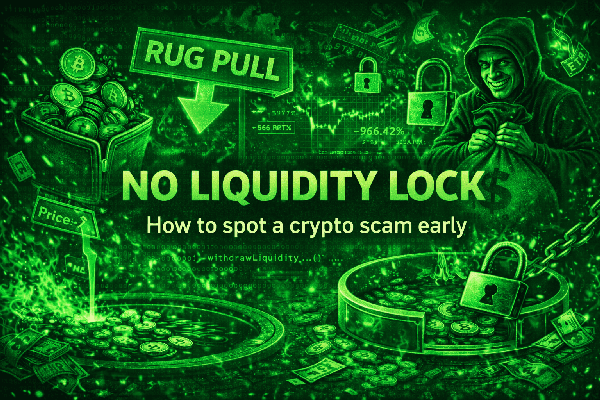
No Liquidity Lock: How to Spot a Crypto Scam Early

Liquidity is one of the most important things in crypto — and also one of the easiest things for scammers to abuse.
A token can look “legit” on the surface:
✅ website
✅ Telegram group
✅ trending on DEXTools
✅ influencers shilling it
✅ price going up fast
But the reality is simple:
If a project does not lock liquidity, the developers can often remove the liquidity at any moment, crashing the price and leaving buyers stuck with worthless tokens.
This is one of the classic ingredients behind rug pulls, especially in meme coins, low-cap launches, and “fair launch” tokens.
In this guide, you’ll learn:
- what liquidity lock really means (in simple language)
- why it matters for beginners
- how scammers exploit unlocked liquidity
- how to check if liquidity is locked (step-by-step)
- what “fake lock” tricks exist
- what warning signs to treat as a hard stop before buying
Read more: Rug Pull Explained: How Liquidity Scams Work in Crypto
Short from author
I’ve seen too many “promising” tokens collapse in minutes because liquidity wasn’t locked. If you learn only one safety rule in crypto, make it this: no lock = high risk.
1) What is liquidity in crypto?
Liquidity is the pool of funds that allows people to buy and sell a token.
On decentralized exchanges (DEXs) like Uniswap or PancakeSwap, most tokens trade using a liquidity pool, typically:
- Token / ETH
or - Token / USDT
or - Token / BNB
When you buy a token on a DEX, you’re swapping your ETH/BNB/USDT into the token using that pool.
So if the pool is small or unstable:
- price moves violently
- you may not be able to sell
- slippage becomes huge
- whales can manipulate the market easily
Liquidity is the “engine” that makes trading possible.
2) What does “liquidity lock” mean?
A liquidity lock means the project cannot instantly withdraw the liquidity from the pool.
In practice, it means:
- the team deposits liquidity (LP tokens)
- then locks it in a smart contract or third-party locker
- for a specific period (e.g., 30 days, 6 months, 1 year)
If liquidity is locked, it’s harder (not always impossible, but harder) for the team to rug pull instantly.
✅ Locked liquidity = more trust
❌ Unlocked liquidity = the team can dump and run
3) Why scammers hate locking liquidity
Because it limits their ability to execute the easiest scam strategy:
The classic “DEX rug pull” plan:
- Launch token
- Create hype
- Let people buy
- Price pumps fast
- Remove liquidity
- Token collapses to near zero
- Buyers can’t exit
If liquidity is not locked, this plan becomes extremely fast.
Sometimes the entire token’s life is under 2 hours.
4) “But the token is pumping — doesn’t that mean it’s real?”
Not at all.
A pump is often the bait.
A scam token can pump because:
- early insiders bought cheap
- bots are trading for volume
- the team controls supply
- marketing attracts new buyers
- whales manipulate the chart to trigger FOMO
When you see:
“This coin is up 300% today!”
you should ask:
✅ Can I sell later?
✅ Is liquidity locked?
✅ Who controls the liquidity?
Because the most dangerous trap in crypto is:
You bought successfully… but selling is impossible.
That’s why liquidity lock matters even more than price.
Read more: Pump & Dump in Crypto: How It Works and How to Avoid It
5) What happens when liquidity is not locked?
Let’s break the risk down clearly.
🔥 Scenario A: Instant liquidity removal
The team withdraws all ETH/BNB/USDT from the pool.
Result:
- token price drops 95–100%
- sells fail or return nothing
- chart looks like a vertical cliff
⚠️ Scenario B: Partial liquidity drain
They remove liquidity slowly to avoid panic.
Result:
- chart bleeds slowly
- victims keep “buying the dip”
- liquidity dries up
- exit becomes harder each hour
🎭 Scenario C: Liquidity moved to another pool
They migrate liquidity or create a new pair to confuse traders.
Result:
- fake stability
- users trade wrong pool
- massive losses from slippage
🧠 Scenario D: Liquidity is “owned” by a single wallet
Not locked, just controlled by one address.
Result:
- one click = rug pull
- “community token” becomes a trap
6) How long should liquidity be locked?
There is no perfect number, but here’s a simple rule:
✅ Good sign: 6–12 months+
⚠️ Medium: 1–3 months
❌ Weak: 7–14 days
🚨 Scam-level: No lock at all
A lock for 7 days is often marketing.
It’s enough for hype, but not enough for long-term trust.
7) Where liquidity locks usually happen
Liquidity can be locked using:
- third-party LP lockers
- token launch platforms
- custom time-lock contracts
Common examples in the crypto world:
- Unicrypt
- Team Finance
- PinkLock
- DxLock
(Scammers can still fake “locks”, so verification matters.)
8) How to check if liquidity is locked (simple checklist)
Here’s how you can check liquidity lock even as a beginner:
✅ Step 1: Find the pair address
Go to a DEX explorer (or the token page) and find the liquidity pair:
- Token / ETH
- Token / BNB
- Token / USDT
✅ Step 2: Look at LP token holders
You want to know:
Who owns the LP tokens?
Good sign:
- LP tokens held by a known locker contract address
Bad sign:
- LP tokens held by a normal wallet (EOA)
- LP tokens held by the token deployer address
✅ Step 3: Confirm lock expiration
A real lock should show:
- lock amount (percentage)
- unlock date (timestamp)
- locker platform
If expiration is tomorrow, it’s basically not locked.
✅ Step 4: Check if liquidity is 100% locked
Sometimes a team locks only 20–40%.
That still allows a “soft rug pull”.
Best case:
✅ 90–100% locked
9) The “fake lock” tricks you must know
Scammers learned that people check liquidity locks.
So now they fake it.
Here are common manipulation techniques:
🎭 Trick 1: Locking only a tiny amount
They lock $5k LP for show, while controlling $100k unlocked.
They will claim:
“Liquidity locked ✅”
But the unlocked part is enough to rug.
🎭 Trick 2: Locking liquidity in a useless pool
They lock liquidity in:
- Token / random stable
- Token / dead chain
- Token / fake pair
But the real trading pair remains unlocked.
🎭 Trick 3: “Burned liquidity” marketing lies
Some projects claim liquidity is “burned”, but it’s unclear or unverifiable.
Or they burn LP tokens but still have:
- mint function
- tax + siphon
- blacklist
- manual swap controls
So liquidity isn’t the only risk — but it’s a major one.
🎭 Trick 4: Lock expires during launch hype
Lock set for 3 days, then removed during peak FOMO.
🎭 Trick 5: A locker contract that is not trustworthy
A lock only matters if the locker itself is legit and immutable.
10) Liquidity lock vs honeypot: what’s the difference?
Both are deadly, but different.
Liquidity not locked:
You can buy and sell… until they rug the pool.
Honeypot token:
You can buy, but selling is blocked or heavily taxed.
A project can be BOTH:
- unlocked liquidity
- honeypot sell restriction
That’s why you need multiple checks.
11) Other red flags that often come with no liquidity lock
If liquidity is not locked, check if these appear too:
- anonymous team with no history
- no audit, no documentation
- contract not verified
- no clear tokenomics
- huge “marketing wallet”
- aggressive shilling in Telegram
- “Don’t miss your chance” pressure tactics
- fake influencer promotions
- comments disabled on social media
- website looks copied or rushed
A safe project usually doesn’t rely on fear and hype.
12) What “legit” projects do differently
Real projects that want long-term trust usually do:
✅ Lock liquidity for 6–12 months+
✅ Publish the locker link
✅ Explain token distribution
✅ Provide audit or security review
✅ Keep contract verified
✅ Show multi-sig treasury
✅ Communicate clearly and consistently
✅ Avoid unrealistic profit promises
Most importantly, legit projects understand:
Trust is built slowly — and destroyed instantly.
13) A realistic example (different from RU version)
Imagine a token called CLEANPEPE launches on a DEX.
You check the chart:
- it’s up +250% in 2 hours
- people spam “next 100x”
- liquidity looks “healthy”
But then you check LP holders and see:
- 92% LP tokens are owned by a wallet address
- no locker contract
- the deployer owns that wallet
That means the owner can remove liquidity in seconds.
Even if the token looks good today, tomorrow it can become a rug pull.
In such a case, the right decision is simple:
✅ Don’t buy
✅ Or treat it as a pure gamble, not investment
14) What to do if you already bought a token with no liquidity lock
If you already entered such a token, don’t panic — but act rationally:
✅ Step 1: Stop averaging down
“Buying the dip” works in strong markets, not in scam setups.
✅ Step 2: Try to exit when liquidity is still there
If you can sell — consider doing it before the rug.
✅ Step 3: Avoid emotional decisions
Scammers rely on:
- hope
- greed
- sunk cost fallacy
✅ Step 4: Document the contract and wallets
If you lost money, save:
- contract address
- deployer address
- liquidity pair address
- tx hashes
It helps you learn + report.
15) Is liquidity lock a 100% guarantee of safety?
No.
Liquidity lock is a strong trust indicator, but scams can still happen with:
- huge taxes (slow drain)
- hidden minting function
- blacklist & whitelist traps
- proxy upgradeable contracts
- backdoor owner controls
So liquidity lock is necessary, but not sufficient.
Think of it like a seatbelt:
It doesn’t prevent accidents — but it improves survival.
16) The safest beginner rule: “No lock = no buy”
If you want a simple strategy that avoids the majority of rug pulls:
✅ Don’t buy tokens without locked liquidity
✅ Don’t buy tokens with extremely short locks
✅ Don’t trust screenshots — verify the locker yourself
And always remember:
Missing an opportunity is normal. Losing your deposit is painful.
Quick checklist before buying any new token
✅ Liquidity locked for 6+ months
✅ Lock can be verified publicly
✅ LP tokens not controlled by a normal wallet
✅ Contract verified and readable
✅ No blacklists / suspicious owner powers
✅ Taxes are reasonable and transparent
✅ Team communication feels real
✅ No aggressive “buy now” pressure
If 2–3 items fail → skip.
✅ Read more:
👉 Crypto Scam Red Flags: Full Beginner Checklist
👉 Honeypot Tokens: Why You Can Buy But Can’t Sell
👉 Fake Presales & Launchpads: How Scammers Trap Users
Security Hub
Crypto Recovery Scam: How Fake Recovery Companies Steal Money After You’ve Already Been Scammed
You lost $85,000 in a Binance phishing scam. Google “crypto recovery services,” and within hours a “recovery specialist” contacts you: “We’ve recovered $2.3M for clients. 85% success rate. $5,000 upfront fee.” You pay, provide wallet details, wait three weeks—then silence. The recovery company vanishes. You’ve now lost $90,000 total. Recovery scams specifically target vulnerable victims who already suffered cryptocurrency theft, exploiting their desperation to get money back. These secondary scams often steal more than the original fraud because victims, already traumatized and financially damaged, become less cautious when offered hope of recovery.
What Are Cryptocurrency Recovery Scams and Why They Target Previous Victims
Cryptocurrency recovery scams are fraudulent schemes where scammers pose as legitimate recovery companies, investigators, or blockchain experts claiming ability to retrieve stolen crypto funds—for a fee. Unlike original crypto scams (phishing, fake exchanges, rug pulls), recovery scams are secondary victimization: targeting people who’ve already lost money and are desperately searching for solutions.
Three primary recovery scam types:
- Fake recovery companies — Professional-looking websites advertising “crypto asset recovery,” “blockchain forensics,” “scam fund retrieval” requiring upfront fees ($1,000-$10,000+)
- Impersonation of authorities — Scammers posing as FBI, Interpol, exchange security teams, or “government recovery programs” requesting payment to “release” frozen funds
- Hacker-for-hire services — Offering to “hack back” stolen funds or “reverse blockchain transactions” through fake technical services
Why recovery scams are particularly effective:
Emotional vulnerability: Victims experience:
- Financial desperation (lost life savings, retirement funds)
- Shame and embarrassment (don’t want to admit being scammed)
- Hope-seeking behavior (grasping at any possibility of recovery)
- Reduced skepticism (already made one bad decision, cognitive bias toward action)
Search behavior exploitation: Within 24-48 hours of losing funds, victims Google:
- “recover scammed cryptocurrency”
- “get back stolen bitcoin”
- “crypto recovery expert”
- “blockchain fund recovery”
Scammers dominate these search results through SEO, paid ads, fake review sites, creating illusion of legitimacy.
How Crypto Recovery Scams Operate: The Complete Fraud Cycle
Stage 1: Victim Identification and Initial Contact
Scammer sourcing methods:
Search engine advertising: Scammers bid on keywords like “crypto scam recovery” — ads appear above legitimate results. Example ad: “Recovered $45M for Crypto Scam Victims | 89% Success Rate | Free Consultation”
Social media targeting: Monitor crypto forums, Reddit (r/CryptoScams, r/Bitcoin), Twitter for posts like “I was scammed for 5 BTC, what can I do?” Reply with: “I used [Company] to recover 80% of my funds. DM me for details.”
Data breach exploitation: Purchase lists of scam victims from dark web (leaked from exchanges, previous scams). Cold call/email: “We’re tracking down perpetrators of [specific scam name]. You may be eligible for recovery.”
Romance scam databases: Target victims of pig butchering scams who lost to fake investment platforms. These victims already transferred funds willingly, making them prime targets for secondary scams.
Stage 2: Building False Credibility
Professional website indicators:
Scam recovery sites include:
- Official-looking domain: crypto-recovery-experts.com, blockchain-forensics-international.org
- Stock photos of “team members” with fabricated credentials
- Fake case studies: “Recovered $2.3M from Binance hack victim”
- Fabricated testimonials with AI-generated profile photos
- “Certifications” from non-existent organizations: “Licensed Blockchain Forensic Investigator”
- Live chat (actually scammer pretending to be different people)
Authority impersonation tactics:
Fake government programs: “FBI Cryptocurrency Victim Recovery Initiative — If you lost >$10k, you qualify for our recovery program. Process fee: $3,500 to initiate investigation.”
Exchange security impersonation: Email from “coinbase-recovery-dept.com” (not coinbase.com): “We’ve identified your stolen funds. To release them, verify identity with $1,200 processing fee.”
Legal firm facade: “Smith & Associates International Law — We specialize in crypto theft recovery. Contingency fee: 25% of recovered funds + $5,000 retainer.”
Stage 3: The Fee Collection
Common fee structures:
Upfront fees ($1,000-$10,000):
- “Investigation initiation fee”
- “Blockchain forensic analysis”
- “Smart contract deployment costs”
- “International legal filing fees”
Staged payments: “We’ve traced your funds to mixer address 0x7a3b… To proceed with recovery:
- Phase 1: Forensic analysis – $2,500
- Phase 2: Legal injunction filing – $4,000
- Phase 3: Fund release coordination – $3,500 Total: $10,000″
Victim pays Phase 1. Scammer shows fake “progress report” with blockchain explorers, technical jargon. Requests Phase 2 payment. Cycle continues until victim runs out of money or realizes scam.
Percentage-based (seems safer but isn’t): “No upfront costs! We only charge 30% of recovered funds.” Seems legitimate until:
- “We recovered $50,000. Before transfer, pay $2,000 tax processing fee.”
- “Funds are in escrow. Pay $5,000 release fee to receive.”
- Fees requested but no funds ever recovered.
Stage 4: Exploitation Deepening
If victim shows hesitation:
Urgency tactics: “Your stolen funds are being mixed right now. If we don’t act within 48 hours, they’ll be untraceable forever.”
Authority pressure: “Our legal team has court order to freeze assets. Processing expires in 72 hours. After that, perpetrators can move funds offshore.”
Sunk cost exploitation: “You’ve already invested $7,500 in recovery. We’re 80% complete. Just $2,500 more to finish.”
If victim questions legitimacy:
Fake verification: “Check our TrustPilot rating” (scammers create fake review sites) “Call our verification line” (another scammer answers as “independent verifier”) “Here’s our license number” (fabricated or stolen from legitimate business)
Stage 5: Final Extraction or Ghosting
Maximum extraction scenario: Victim pays total $15,000-$50,000 in staged fees. Scammer continues creating obstacles:
- “Unexpected international banking complications – $3,000 additional fee”
- “Government anti-money laundering hold – $5,000 clearance charge”
- “Final wire transfer tax – $2,500”
Eventually victim either:
- Runs out of money (scammer ghosts)
- Realizes it’s scam (scammer blocks contact)
- Demands proof (scammer vanishes)
Ghosting: After collecting initial fees ($5,000-$10,000), scammer provides no updates, stops responding to emails/calls, website goes offline.
Case Example (2024): Victim lost $120,000 in fake investment scam. Found “CryptoFunds Recovery Ltd” via Google ad. Paid:
- $8,500 “forensic investigation”
- $12,000 “international legal fees”
- $6,500 “blockchain reversal technology” Total additional loss: $27,000
Recovery company vanished after final payment. Domain expired. Phone disconnected. No funds recovered.
Why Recovery Scams Are More Damaging Than Original Scams
Compounded Financial Loss
Original scam statistics: Average cryptocurrency scam loss (FBI IC3 2024): $87,000
Recovery scam addition: Average secondary loss to fake recovery: $15,000-$35,000 Total victim loss: $102,000-$122,000
Why victims pay more:
- Sunk cost fallacy: “I’ve already lost $87k, what’s another $10k if there’s chance of recovery?”
- Desperation: Willing to risk additional funds for possibility of getting original loss back
- Reduced savings: Original scam depleted emergency funds, so victims borrow or liquidate remaining assets for recovery fees
Psychological Trauma Multiplication
Primary scam impact:
- Financial stress
- Shame/embarrassment
- Anger at perpetrators
Secondary scam addition:
- Compounded shame (“I got scammed twice”)
- Complete loss of trust (can’t distinguish legitimate help from fraud)
- Depression/hopelessness (no real avenue for recovery exists)
- Isolation (afraid to tell anyone about second scam)
2023 study data: Victims of recovery scams are 4.2x more likely to experience clinical depression than victims of only original scam.
Elimination of Actual Recovery Options
Real recovery paths (limited but exist):
- Law enforcement reporting: FBI IC3, local police (enables prosecution, potential fund seizure)
- Exchange cooperation: If scammer used centralized exchange, freeze account possibility
- Blockchain analysis: Real forensic firms (CipherTrace, Chainalysis) work with authorities, not individual victims
- Legal action: Actual attorneys for large cases ($500k+) with identifiable perpetrators
How recovery scams interfere:
Financial depletion: Victim spends remaining funds on fake recovery, can’t afford real legal help if it becomes available.
Evidence contamination: Scammer requests wallet details, private keys, transaction history. Victim shares sensitive info, potentially:
- Compromising remaining assets
- Providing data scammer uses for identity theft
- Destroying chain of custody for evidence in real investigation
Time loss: Victim spends 3-6 months dealing with recovery scam. By then:
- Real scammer has moved funds through mixers (untraceable)
- Statute of limitations issues for some jurisdictions
- Victim motivation/energy exhausted
Recovery Scam Risk Score Formula
Assessment Model
Scam Risk Score = (Guaranteed Recovery Claims × 0.30) + (Upfront Fees × 0.25) + (Unsolicited Contact × 0.25) + (Technical Impossibilities × 0.20)
Each factor rated 1-10 (1 = legitimate warning sign absent, 10 = definite scam indicator)
Guaranteed Recovery Claims (30%):
- 1-2: “We’ll investigate and report findings” (no promises)
- 3-4: “High success rate in certain situations”
- 5-7: “80-90% success rate” (unrealistic for crypto)
- 8-9: “We recover funds in most cases”
- 10: “100% money-back guarantee” or “We will definitely recover your funds”
Reality: Legitimate recovery rare (<5% for crypto scams). Anyone guaranteeing success is lying.
Upfront Fees (25%):
- 1-2: Free consultation, contingency only if recovery successful
- 3-4: Small retainer ($500-$1,000) with clear deliverables
- 5-7: $2,000-$5,000 “investigation fees”
- 8-9: $5,000-$10,000+ upfront
- 10: Staged payments totaling $15,000+ before any results
Legitimate firms: Either contingency-based or transparent hourly rates with detailed invoices.
Unsolicited Contact (25%):
- 1-2: You found them through verified source (attorney referral, verified review)
- 3-4: Appeared in search but verified credentials independently
- 5-6: Found via paid ad in search results
- 7-8: Contacted you via DM after posting about scam
- 9-10: Cold call/email claiming to know about your specific loss
Real recovery firms don’t cold contact victims. If they contact you first = scam.
Technical Impossibilities (20%):
- 1-3: Honest about blockchain limitations
- 4-6: Vague about methods
- 7-8: Claims about “reversing transactions”
- 9-10: Promises to “hack the blockchain” or “undo transfers”
Blockchain transactions are irreversible by design. Anyone claiming otherwise is scammer.
Calculation Examples
Scenario A: Legitimate law firm consultation
- Guaranteed recovery: 2 (honest about difficulty)
- Upfront fees: 3 ($1,000 consultation retainer with invoice)
- Unsolicited: 2 (found via verified legal directory)
- Technical impossibilities: 2 (explains blockchain limits) Score = (2×0.30) + (3×0.25) + (2×0.25) + (2×0.20) = 0.6 + 0.75 + 0.5 + 0.4 = 2.25 (LOW RISK)
Scenario B: Fake recovery company from Google ad
- Guaranteed recovery: 9 (“95% success rate, money-back guarantee”)
- Upfront fees: 8 ($7,500 “forensic investigation fee”)
- Unsolicited: 6 (found via paid ad)
- Technical impossibilities: 8 (“proprietary blockchain reversal technology”) Score = (9×0.30) + (8×0.25) + (6×0.25) + (8×0.20) = 2.7 + 2.0 + 1.5 + 1.6 = 7.8 (HIGH RISK – SCAM)
Scenario C: Cold contact from “recovery specialist”
- Guaranteed recovery: 10 (“I recovered $2M for clients, will definitely get your funds back”)
- Upfront fees: 9 ($12,000 in staged payments)
- Unsolicited: 10 (DM’d you on Reddit after scam post)
- Technical impossibilities: 10 (“I can hack into scammer’s wallet and retrieve BTC”) Score = (10×0.30) + (9×0.25) + (10×0.25) + (10×0.20) = 3.0 + 2.25 + 2.5 + 2.0 = 9.75 (DEFINITE SCAM)
Scale interpretation:
- 0-3: Possibly legitimate (still verify independently)
- 3-5: Suspicious (deep verification required)
- 5-7: Likely scam (avoid)
- 7-10: Definite scam (report and block)
Critical Mistakes Victims Make When Seeking Recovery
Mistake #1: Googling “Crypto Recovery Services” and Clicking First Results
Problem: Scammers dominate these search results through:
- Paid Google Ads (appear above organic results)
- SEO optimization for desperation keywords
- Fake review websites ranking high
Real example: Search “recover stolen bitcoin” returns:
- [AD] Bitcoin Recovery Experts – 94% Success Rate
- [AD] Crypto Fund Recovery International
- [AD] Blockchain Asset Retrieval Services 4-10. Fake review sites listing these same scam companies
Real recovery options (law enforcement, legitimate attorneys) don’t advertise this way.
Prevention: NEVER use recovery services found via Google search. If you need help:
- Report to FBI IC3 (ic3.gov)
- Contact local law enforcement
- Consult licensed attorney through state bar association
- If funds >$500k, contact actual blockchain forensics firms that work with law enforcement (they don’t advertise to individuals)
Mistake #2: Paying Upfront Fees Before Seeing Results
Common justifications victims tell themselves:
- “They need money to start investigation”
- “Forensic analysis costs money”
- “Legal filing fees are standard”
Reality: Legitimate recovery scenarios:
Real law firms:
- Charge hourly rates ($300-$600/hour) with detailed time entries
- Retainer goes into trust account, billed against
- Provide itemized invoices
- Licensed and verifiable through state bar
Legitimate forensic firms:
- Work with law enforcement, not individuals
- Don’t charge victims directly
- Cases come through official channels
Contingency arrangements: Only take payment if recovery successful—but crypto recovery success rate is <5%, so legitimate contingency firms almost don’t exist for crypto.
Red flag: Any company requesting $2,000+ upfront for “investigation” before you’ve seen licensed credentials, detailed service agreement, and independent verification.
Mistake #3: Sharing Wallet Details and Private Information
What scammers request:
- Wallet addresses (seem harmless)
- Transaction IDs (seem necessary)
- Private keys or seed phrases (NEVER legitimate)
- Copies of ID documents (for “verification”)
- Email passwords (to “investigate phishing”)
- Bank statements (to “prove losses”)
Why dangerous:
Private keys/seed phrases: Gives scammer access to ANY remaining funds in wallet. Common tactic: “We need your private key to reverse the transaction.” IMPOSSIBLE. Private keys can only send funds OUT, never retrieve.
Personal information: Used for identity theft:
- Open credit cards in victim’s name
- File fraudulent tax returns
- Create accounts for money laundering
- Sell complete identity package on dark web ($50-$500)
Case example (2024): Victim lost $45,000 in romance scam. Hired “recovery company,” provided:
- Wallet private key
- Driver’s license copy
- Bank statement
- Social security number “for legal filing”
Result:
- “Recovery company” stole remaining $8,000 from wallet
- Opened 3 credit cards in victim’s name (additional $22,000 debt)
- Filed fake tax return claiming $15,000 refund
- Total additional damage: $45,000
Protection: NEVER share private keys or seed phrases with anyone. Legitimate help never requires this.
Mistake #4: Believing Technical-Sounding Jargon
Common scammer claims:
“We use proprietary blockchain reversal algorithms to trace and recover funds.” Reality: Blockchain transactions cannot be reversed. Algorithm won’t change this.
“Our quantum computing network can crack wallet encryption.” Reality: Private keys for wallets you don’t control are effectively uncrackable. Quantum computing threat is theoretical and not available to “recovery companies.”
“We’ve deployed smart contract exploit detection protocols to identify vulnerabilities.” Reality: Even if vulnerability exists, scammer already moved funds. This doesn’t enable recovery.
“Our team has direct relationships with exchanges to freeze accounts.” Reality: Exchanges freeze accounts only for law enforcement with proper warrants, not private companies.
Why victims fall for jargon:
- Sounds sophisticated (must be real experts)
- Victim doesn’t understand crypto deeply (can’t distinguish real from fake technical claims)
- Desperate to believe solution exists
Protection: Any claim about “reversing,” “undoing,” or “hacking back” blockchain transactions = automatic scam. Blockchain immutability is fundamental—legitimate experts acknowledge this.
How to Actually Respond After Crypto Scam (Step-by-Step Guide)
Immediate Actions (First 24 Hours)
Hour 0-1: Stop All Contact with Scammer
- Do NOT send more money (“processing fees,” “taxes,” “release costs”)
- Do NOT continue communication hoping to recover
- Block scammer on all platforms
- Screenshot all conversations before blocking
Hour 1-3: Document Everything
Create folder with:
- All wallet addresses involved (yours and scammer’s)
- Transaction IDs (TXIDs) for all transfers
- Screenshots of conversations (emails, texts, dating app messages, Telegram)
- Website URLs where scam occurred
- Any real names, phone numbers, email addresses used
- Timeline of events (dates, amounts, what was promised)
Hour 3-6: Official Reporting
FBI Internet Crime Complaint Center (IC3):
- File report at ic3.gov
- Include all documentation
- Get complaint number for reference
Local law enforcement:
- File police report (get case number)
- Needed for insurance claims, credit freeze, identity theft protection
FTC:
- Report at reportfraud.ftc.gov
- Helps track scam patterns
Exchange (if scammer used centralized exchange):
- Report to compliance department
- Provide scammer’s deposit address
- Small chance of account freeze
Days 2-7: Asset Protection
If you shared personal information:
Credit freeze:
- Contact Equifax, Experian, TransUnion
- Place security freeze on credit reports
- Prevents new account opening
Bank/financial accounts:
- Alert banks to potential fraud
- Change online banking passwords
- Enable fraud alerts
Email/passwords:
- Change passwords on ALL accounts
- Enable 2FA everywhere (use authenticator app, not SMS)
- Check for unauthorized login sessions
If you shared crypto private keys:
Remaining assets:
- IMMEDIATELY create new wallet
- Transfer any remaining crypto to new address
- Old wallet is permanently compromised
Weeks 2-4: Realistic Recovery Assessment
Can funds realistically be recovered?
Scenario where recovery is possible (rare):
- Scammer used centralized exchange
- You reported immediately (within hours)
- Exchange freezes account before withdrawal
- Law enforcement gets warrant for account details
- Scammer identified and prosecutable
Success rate: ~2-5%
Scenario where recovery is impossible:
- Funds sent to private wallet
- Funds mixed through Tornado Cash or similar
- More than 48 hours passed
- Sent through multiple hops
Success rate: <0.1%
What TO do:
If loss >$100,000: Consult licensed attorney specializing in cryptocurrency fraud. Find through:
- State bar association referral
- Verify license at state bar website
- Check reviews from verified sources (not Google)
- Initial consultation should be free or low-cost (<$500)
If loss $10,000-$100,000:
- Continue cooperation with law enforcement
- Monitor case through FBI IC3
- Accept that recovery unlikely but prosecution helps prevent future victims
If loss <$10,000:
- Law enforcement will file report but unlikely to actively investigate
- Focus on asset protection and moving forward
- Consider loss permanent for mental health purposes
What NOT to do:
- Pay any “recovery company” found via Google
- Respond to unsolicited recovery offers
- Send more money to anyone promising to get original funds back
- Share private keys or sensitive information with anyone
Legitimate vs Scam Recovery Services Comparison
| Characteristic | Legitimate Help | Recovery Scam |
|---|---|---|
| How you find them | State bar referral, law enforcement recommendation | Google ads, unsolicited contact, forum spam |
| Success rate claims | Honest: “Recovery rarely successful for crypto, but we can assist investigation” | Guaranteed: “85-95% success rate” |
| Upfront fees | Transparent hourly ($300-$600/hr) or small retainer with invoice | Large upfront ($5,000+) with vague services |
| Credentials | Licensed attorney (verifiable state bar number), law enforcement agency | Fake certifications, unverifiable claims |
| Technical claims | Honest about blockchain limitations | Promises to “reverse transactions” or “hack blockchain” |
| Contact method | You contact them through verified channel | They contact you via DM, cold call, email |
| Information requests | Legal documents, public blockchain data | Private keys, seed phrases, passwords |
| Payment methods | Bank transfer, check, credit card (traceable) | Cryptocurrency, wire transfer, gift cards (untraceable) |
| Contract | Detailed written agreement, scope of work | Vague or no written contract |
| Communication | Professional office, regular business hours | WhatsApp, Telegram, burner phones |
| Reviews | Verifiable on Yelp, Google (with real names, details) | Only on their website or fake review sites |
| Timeline | Realistic: “Investigation takes 3-6 months” | Unrealistic: “Recovery in 2-3 weeks” |
| Outcome | Usually: Report filed, investigation conducted, low recovery chance | Always: Fees collected, no recovery, eventual ghosting |
Psychological Pressure Tactics in Recovery Scams
Tactic #1: False Hope Injection
Script: “I’ve reviewed your case. Good news—your funds went to address 0x7a3b… which we’ve successfully recovered from before. You have very strong chance of getting money back.”
Why it works:
- Victim wants to believe recovery possible
- Specific details (actual blockchain address) create credibility
- Word “before” implies proven track record
Reality: Scammer looked up victim’s transaction on public blockchain explorer (anyone can do this). The address means nothing regarding recoverability.
Tactic #2: Artificial Urgency
Script: “Your funds are currently in mixing process. We have 72-hour window before they become permanently untraceable. We need to act NOW.”
Why it works:
- Creates panic (must decide immediately)
- Prevents victim from researching or seeking second opinion
- Leverages sunk cost (already lost money, can’t afford to lose chance)
Reality: If funds already went through mixer, they’re already untraceable. Arbitrary deadline is fabricated.
Tactic #3: Authority Leveraging
Script: “We’re working with Interpol on several cases. Our lead investigator is former FBI cybercrime division. We have direct lines to exchange security departments.”
Why it works:
- Authority figures command trust
- Credentials sound impressive
- Victim assumes professionals wouldn’t lie
Reality: All fabricated. Real law enforcement doesn’t partner with private “recovery companies.” Former FBI agents do exist in private sector, but not at scam companies.
Tactic #4: Sunk Cost Exploitation
Script: “You’ve already invested $8,500 in recovery process. We’re 85% complete. Walking away now means losing that investment AND your original funds. Just $3,500 more to finish.”
Why it works:
- Sunk cost fallacy: “I’ve come this far, can’t quit now”
- Made victim complicit (already paid, harder to admit mistake)
- Creates obligation to continue
Reality: All previous fees were scam. Additional fees also scam. Stopping now prevents further loss.
Who Is at Maximum Risk for Recovery Scams
Risk Group #1: High-Value Original Loss Victims ($50k+)
Why targeted:
- Larger original loss = more money available for “recovery fees”
- High net worth individuals may have additional accessible funds
- More desperate due to significance of loss
Scammer approach: “We primarily handle high-value cases. Your $85,000 loss qualifies for our premium recovery service.”
Protection: Higher loss doesn’t mean higher recovery probability. If anything, large losses already dispersed through mixers.
Risk Group #2: Romance/Pig Butchering Scam Victims
Unique vulnerability:
- Emotional trauma (betrayed by “loved one”)
- Shame prevents seeking legitimate help
- Often sent funds willingly over time (harder to accept as theft)
- Desperate to believe recovery possible to validate relationship wasn’t entirely fake
Scammer exploitation: “I understand how painful this is. You trusted someone and they betrayed you. Let me help you get justice.”
Statistics: Romance scam victims are 3.2x more likely to fall for recovery scams than other fraud victims.
Risk Group #3: Elderly Victims (65+)
Factors:
- Less familiar with cryptocurrency (don’t understand blockchain immutability)
- Higher trust in authority claims
- May have retirement savings accessible for “recovery fees”
- Less likely to verify credentials independently
Targeting methods:
- Phone calls (preferred communication method for elderly)
- Posing as government agencies (IRS, FBI)
- Using complex jargon (victim too embarrassed to admit confusion)
Risk Group #4: Repeat Scam Victims
Psychology: Once someone falls for scam, databases track them as “proven buyers”—people who’ve demonstrated willingness to send money based on promises.
Scammer sharing: Dark web forums sell “sucker lists”—contact information of previous scam victims. Recovery scammers buy these lists.
Layered exploitation: Victim loses to scam #1 → Pays recovery scam #2 → Offered “guaranteed recovery” scam #3 → Cycle continues until funds exhausted.
When Legitimate Recovery Actually Doesn’t Work
Limitation #1: Blockchain Immutability Is Fundamental
What victims hope: “There must be SOME way to reverse the transaction.”
Reality: Blockchain consensus mechanisms make transaction reversal technically impossible without:
- 51% attack on network (costs millions, won’t happen for individual case)
- Every node agreeing to rollback (never happens for individual thefts)
- Controlling destination private key (if you don’t have it, impossible)
Even legitimate authorities can’t reverse blockchain transactions. FBI, Interpol, exchanges—no one has this power.
Limitation #2: Mixer Services Create Permanent Untracability
What they do: Combine multiple users’ crypto, then redistribute to new addresses. Original source-destination link destroyed.
Once funds through Tornado Cash:
- No forensic analysis can track
- Even knowing scammer identity doesn’t help (funds in different wallet)
- Probability of recovery: 0%
Timeline: Scammers typically mix within 24-48 hours of receiving funds.
Limitation #3: International Jurisdiction Barriers
Scenario:
- Victim in USA
- Scammer in Nigeria
- Funds sent through exchange in Seychelles
- Mixed through servers in Russia
- Withdrawn in Vietnam
Legal reality:
- No single jurisdiction has authority
- International cooperation takes years
- Most countries don’t prioritize crypto fraud
- Even successful prosecution rarely results in asset recovery
Limitation #4: Anonymous Nature of Cryptocurrency
Scammer identity unknown: Can see wallet address bc1q7a… on blockchain. Can’t see:
- Real name
- Location
- Bank details
- Any identifiable information
Without identity, legal action impossible.
Myths About Crypto Scam Recovery
Myth #1: “Crypto Recovery Companies Can Reverse Transactions”
Belief: “They have special technology or exchange relationships to reverse blockchain transfers.”
Reality: Blockchain transactions are cryptographically immutable. No technology, no relationship, no authority can reverse confirmed transaction. Laws of mathematics, not just policy.
If someone claims this: 100% scam, no exceptions.
Myth #2: “High Success Rate Proves Legitimacy”
Belief: “They show 87% success rate on website, must work.”
Reality: Success rate completely fabricated. No verification possible. Actual recovery rate for cryptocurrency scams: <5% (and those through law enforcement, not private companies).
If success rate >50%: Definitely lying.
Myth #3: “Paying in Crypto Makes It Safe”
Belief: “They accept Bitcoin, so it’s legit crypto business.”
Reality: Scammers prefer crypto payment because:
- Irreversible (no chargebacks)
- Anonymous (can’t identify receiver)
- Untraceable (mix immediately)
Legitimate services: Accept credit cards, bank transfers, checks (traceable payment methods).
Myth #4: “Former Law Enforcement Background Means Legitimate”
Belief: “Their investigator is ex-FBI, must be real.”
Reality:
- Completely unverifiable claim
- Even if true, doesn’t mean company is legitimate
- Real former law enforcement work for actual security firms, not scam recovery operations
Verification: If they claim law enforcement background, ask for badge number and supervisor reference. They won’t provide because it’s fake.
Myth #5: “They Only Get Paid If Recovery Successful”
Belief: “Contingency arrangement means they must believe they can recover funds.”
Reality: Scam involves requesting “processing fees,” “taxes,” or “release costs” BEFORE final payment. Victim never sees contingency payment because funds never recovered.
Pattern: “Great news! We recovered your $50k. Before we transfer, pay $5,000 government release fee.” Victim pays $5,000. Never hears from company again.
Frequently Asked Questions
1. Can any company legitimately recover stolen cryptocurrency?
Extremely rare (<5% cases). Only scenarios where recovery possible: (1) Scammer used centralized exchange AND you reported within hours AND exchange froze account before withdrawal, (2) Scammer identifiable AND in jurisdiction with crypto-friendly legal system AND has recoverable assets. Private “recovery companies” advertising services = 99.9% scams. Legitimate help comes from law enforcement, not Google ads.
2. How much should I pay for crypto recovery services?
ZERO upfront for investigation. Legitimate attorneys: transparent hourly rates ($300-$600/hr) with itemized invoices OR contingency (only paid if successful). Any company requesting $2,000+ “investigation fee” before verified credentials = scam. Real recovery (when possible) happens through law enforcement (free) or licensed attorneys with verifiable bar membership.
3. What if recovery company shows me blockchain evidence of my funds?
Anyone can view public blockchain. Showing your transaction on Etherscan/blockchain explorer proves nothing about recovery ability. Scammers use this to seem credible. Real question: Can they access private keys of destination wallet? If no (they can’t), funds aren’t recoverable regardless of what blockchain shows.
4. Should I trust recovery company with 5-star reviews?
No. Scammers create fake review sites or post fake reviews on legitimate platforms. Verify reviews are real: (1) Check reviewer profiles (real people with history vs. generic AI-generated), (2) Look for specific details in reviews vs. generic praise, (3) Check complaints on BBB, FTC, state attorney general sites. Most recovery scam sites only have fake positive reviews.
5. What about companies that don’t ask for upfront payment?
Still verify legitimacy. Scam tactic: “No upfront fees!” Then later: “We recovered funds but need $X for processing/taxes/release.” These “fees” are scam—no funds exist. Or they request sensitive info (private keys, personal data) for identity theft. Free consultation ≠ legitimate. Verify credentials independently before sharing ANY information.
6. Can I hire a hacker to get my crypto back?
“Hacker for hire” services = 100% scams. Claims about “hacking into scammer’s wallet” are impossible without private key. Even if possible (it’s not), advertising illegal services openly = obvious scam. Real ethical hackers work for security firms, don’t advertise to individuals, and can’t reverse blockchain transactions anyway.
7. What should I do immediately after realizing I’ve been scammed?
(1) STOP all contact with scammer, (2) Document everything (wallet addresses, TXIDs, conversations), (3) Report to FBI IC3 (ic3.gov), local police, FTC, (4) If shared personal info: credit freeze, change passwords, enable 2FA, (5) If shared private keys: immediately create new wallet, transfer remaining assets, (6) Do NOT pay any “recovery company” found via Google. Accept low recovery probability, focus on asset protection and moving forward.
8. How to find legitimate help if I lost large amount?
For losses >$100,000: (1) Contact licensed attorney through state bar association (verify license at state bar website), (2) Initial consultation should be free or <$500, (3) Attorney should be honest about low recovery probability, (4) Fee structure: hourly with invoices OR contingency if recovery happens. Never pay large upfront “investigation fees.” If attorney guarantees recovery = not legitimate attorney.
9. Are there any real blockchain forensic companies?
Yes: Chainalysis, CipherTrace, Elliptic—but they work with law enforcement and large institutions, not individual victims. They don’t advertise “recovery services” to public. If you see ads for “blockchain forensics for scam victims” = fake company impersonating real forensic firms. Real forensics help prosecute, rarely help recover for individuals.
10. What if recovery company asks for my private keys?
NEVER share private keys or seed phrases with ANYONE for ANY reason. Private keys only allow SENDING funds out, cannot retrieve funds. Requesting private keys = scam attempting to steal remaining assets in wallet. Legitimate help NEVER needs private keys. If asked = immediate red flag, block and report.
Conclusion: 3 Rules, 1 Principle, 1 Hard Criterion
Three Unbreakable Rules:
Rule #1: Zero Upfront Fees for “Investigation” Legitimate help doesn’t require $5,000+ upfront “forensic analysis” before showing credentials. Real attorneys: transparent hourly rates with invoices OR contingency only if recovery successful. Any company requesting thousands upfront before verified credentials = scam. Protect remaining assets—don’t send more money chasing lost money.
Rule #2: Independently Verify All Credentials If company claims licensed attorney, verify at state bar website. If claims law enforcement background, verify through official channels. If claims exchange relationships, verify directly with exchange. NEVER trust credentials shown on company’s own website. Scammers create fake verification sites. Use only official verification sources.
Rule #3: Understand Blockchain Immutability Reality Transactions cannot be reversed. Anyone claiming to “undo,” “reverse,” or “hack back” blockchain transfers = automatic scam. Real recovery (rare <5%) happens through: (1) Exchange account freezing before withdrawal, (2) Legal action against identifiable perpetrator with recoverable assets. No technology exists to reverse confirmed blockchain transactions. Accept this truth to avoid recovery scams.
One Core Principle:
Principle of Desperation Exploitation Recognition Recovery scammers exclusively target emotional vulnerability. They offer hope when you’re desperate, claim success when you’re grieving financial loss, create urgency when you’re exhausted from trauma. Recognize this pattern: legitimate help acknowledges difficulty and low probability. Scams guarantee success and rush you to pay. When someone offers exactly what you desperately want to hear (guaranteed recovery, high success rate, quick timeline) → it’s specifically designed to exploit your emotional state. Pause, verify independently, consult trusted person not emotionally involved.
One Hard Criterion:
If found through Google search/ads OR contacted you unsolicited = do not engage (zero exceptions)
Legitimate recovery help doesn’t advertise “crypto recovery services” on Google or contact victims directly. Real paths: (1) FBI IC3 reporting (free, official), (2) Licensed attorney found through state bar referral (verified credentials), (3) Law enforcement channels (official agencies only). Any service that appears in search results for “recover stolen crypto” or messages you offering help = scam. This criterion alone prevents 95% of recovery scams.
Read more:
- Coinbase Email Scam Guide — phishing & fake support tactics
- Fake Crypto Exchanges: Warning Signs — how scam platforms operate
- Telegram Crypto Scams Explained — common fraud schemes
- Crypto Security Checklist — protect your assets properly
Security Hub
Can’t Withdraw Crypto: How Binance and Coinbase Withdrawal Scams Block Your Money When Cashing Out
You click “Withdraw” on Binance to transfer $85,000 to your bank account for a house down payment. Status shows “Processing” for three hours. You Google “Binance withdrawal delay,” call the first number in results, and a helpful “support agent” asks for verification codes. Within 15 minutes your account is empty—not from a technical issue, but because scammers intercepted your moment of panic. Withdrawal scams don’t just block access to money—they attack at the exact moment when you’re most vulnerable, using fake support lines, phishing emails claiming “withdrawal frozen,” and malware that switches wallet addresses.
What Are Cryptocurrency Withdrawal Scams and Why They Target Cash-Out Moments
Cryptocurrency withdrawal scams are schemes designed to steal funds at the precise moment users attempt to move assets from exchanges (Binance, Coinbase, Kraken) to external wallets or bank accounts. Unlike general phishing targeting login credentials, these attacks strike during high-stakes moments when users actively move large amounts of money.
Three primary attack mechanisms:
- “Withdrawal frozen” phishing — Fake emails claiming withdrawal blocked due to “security review” redirecting to credential-harvesting sites
- Support impersonation during stuck withdrawals — Scammers posing as exchange support when users search for help with pending/failed withdrawals
- Technical manipulation during execution — Malware replacing destination addresses, fake apps intercepting 2FA codes, clipboard hijacking
Critical vulnerability window: Average time between initiating large withdrawal and falling victim to related scam: 47 minutes (Chainalysis 2024 data). This window exists because:
- Users are anxious during processing delays
- Large sums create urgency and fear
- Technical problems trigger panic-driven Google searches
- Victims actively expect communications from exchange
How Withdrawal Blocking Scams Work: Attack Mechanics Step-by-Step
Scenario #1: Phishing After Bank Wire Initiation
Hour 0:00 — User initiates $180,000 withdrawal from Coinbase to business account for property closing in 5 days.
Hour 0:18 — Email arrives from security-alerts@coinbase-compliance.com (fake domain): “Your wire transfer of $180,000 suspended by AML compliance system. To prevent account freeze and fund seizure, complete verification within 24 hours: [link]”
Hour 0:22 — Victim clicks link, lands on coinbase-secureauth.com (perfect interface clone):
- Identical Coinbase UI
- SSL certificate (https://)
- “Re-authentication” form
Victim enters email, password, 2FA code. Meanwhile, scammer’s bot simultaneously attempts login to real Coinbase, intercepts entered credentials.
Hour 0:24 — Account compromised:
- Scammer changes email to their own
- Disables all protections
- Adds withdrawal address
- Withdraws funds to their wallet
- Distributes through mixer across 15 addresses
Hour 4:00 — Discovery. Victim cannot login, sees “Email Changed” notification from real Coinbase.
Result: Loss $180,000 + failed deal = $205,000 total damage.
Scenario #2: Fake Support Number from Google Ad
Day 1, 2:00 PM — Retiree, 67, attempts $100,000 withdrawal from Binance. Status “Processing” for 4 hours.
Day 1, 2:05 PM — Googles “Binance withdrawal time,” clicks paid ad (purchased by scammer): “Binance Support 24/7 – 1-888-XXX-XXXX”
Day 1, 2:10 PM — Calls, reaches professional scammer call center: “Binance Withdrawal Department, this is Michael, code B-7732. Your email?”
Agent “sees account,” explains $100,000 withdrawal flagged by security system. To unlock: “I’ll send verification code to your phone, read it to me.”
What happens: Scammer simultaneously attempts login with provided email. Binance sends real 2FA SMS. Victim reads code to “agent” — scammer completes login.
Day 1, 2:13 PM — Full takeover:
- Email changed
- 2FA switched to scammer’s Google Authenticator
- Canceled $100,000 withdrawal
- Entire $340,000 balance converted to BTC
- Withdrawn through ChipMixer, distributed across 50+ wallets
Result: $340,000 retirement savings lost forever.
Scenario #3: Clipboard Malware + Fake Error
Week 1 — Trader downloads “Crypto Tax Calculator Pro” from suspicious site. Installs clipboard monitoring malware.
Week 2, 3:03 PM — Withdrawing 470,000 USDT from Coinbase to Ledger:
- Generates address on Ledger: 0x742d35Cc…Bc9e7595f0bEb
- Copies to clipboard
- Malware substitutes with: 0x742d35Cc…ATTACKER…f0bEb (first 10 and last 10 characters match)
- Pastes into Coinbase, checks only beginning/end — matches
- Confirms withdrawal
3:05 PM — Malware displays fake error: “Transaction Failed: ETH Network Congestion. Try again in 15-30 minutes.”
3:06 PM — Real transaction successfully processed — 470,000 USDT sent to attacker’s address.
3:45 PM — Discovery: Ledger shows 0 USDT. Etherscan shows funds at different address. Already untraceable through Tornado Cash.
Result: $470,000 lost due to incomplete address verification.
What to Do If You Sent Crypto to the Wrong Network
Why Withdrawal Scams Are Critically Dangerous
Irreversibility and No Insurance Coverage
Impact Statistics:
| Scam Type | Average Loss | Recovery Rate | Discovery Time |
|---|---|---|---|
| Login phishing | $3,200 | 8% | 12-48 hours |
| Withdrawal scam | $87,000 | <1% | 1-6 hours |
| Exchange hack | $12,000 | 15% (insurance) | Minutes |
Why recovery is impossible:
- Blockchain finality — Transactions irreversible after confirmation (10 min BTC, 3-7 min ETH)
- Mixers — Funds through Tornado Cash in 15-60 minutes = untraceable
- International distribution — 20+ wallets across jurisdictions immediately
- Exchange compliance — “Access with correct credentials and 2FA” = officially not hack
- Law enforcement — <1% recovery for individual cases <$500k
Cascade of Secondary Losses
Total cost of $100k withdrawal scam:
- Direct loss: $100,000
- Missed deal penalties: $15,000-25,000
- Identity theft cleanup: $5,000-15,000
- Legal costs: $8,000-25,000
- Psychological treatment: $3,000-10,000
- Total: $131,000-$175,000
Withdrawal Scam Risk Score Formula
Risk Assessment Model
Risk Score = (Urgency × 0.35) + (Communication Channel × 0.30) + (Data Requests × 0.25) + (Origin × 0.10)
Each factor: 1-10 (1 = safe, 10 = scam)
Urgency (35%):
- 1-2: 14+ days or no deadline
- 3-4: 72 hours
- 5-7: 24 hours
- 8-9: 2-6 hours
- 10: “Immediate” or <1 hour
Communication Channel (30%):
- 1-2: In-app/dashboard notification
- 3-4: Email from @coinbase.com, verifiable in account
- 5-6: Email from similar domain
- 7-8: Phone from Google search
- 9-10: Unsolicited call/DM
Data Requests (25%):
- 1-2: Document upload through dashboard
- 3-4: Email code
- 5-6: Password re-entry
- 7-8: 2FA codes via phone
- 9-10: Backup codes, seed phrases, QR scanning
Origin (10%):
- 1-2: You logged into site and saw
- 3-5: Email after your withdrawal
- 6-7: Email without your action
- 8-9: After Googling help
- 10: Unsolicited contact referencing amount
Calculation Examples
Legitimate Kraken KYC: Urgency: 2 (14 days) × 0.35 = 0.7 Channel: 3 (@kraken.com) × 0.30 = 0.9 Requests: 2 (upload via dashboard) × 0.25 = 0.5 Origin: 3 (after withdrawal) × 0.10 = 0.3 Score = 2.4 (LOW RISK)
Phishing After Problem: Urgency: 10 (immediate) × 0.35 = 3.5 Channel: 9 (Google number) × 0.30 = 2.7 Requests: 9 (2FA codes) × 0.25 = 2.25 Origin: 8 (Googling) × 0.10 = 0.8 Score = 9.25 (SCAM)
Scale: 0-3 safe | 3-6 verify | 6-8 likely scam | 8-10 definite scam
Telegram Crypto Scams Explained
Critical Mistakes During Crypto Withdrawal
Mistake #1: Searching Support Through Google
Problem: Scammers buy ads for “Coinbase support number” appearing ABOVE official results.
Statistics: 67% of victims found fake support via Google. Scammers spend $50k-200k/month on such ads.
Prevention:
- NEVER Google support numbers
- Bookmark official site BEFORE problems
- Use only contacts from official site (usually email tickets/chat)
Mistake #2: Sharing 2FA Codes with “Agents”
Misconception: “Support needs my code for verification.”
Reality: 2FA codes are for YOU to prove identity to system. Support doesn’t need them—they have backend access.
How exploited:
- Fake agent asks for email
- Scammer attempts login with it
- Real exchange sends SMS code
- “Agent”: “Read the code to confirm”
- Victim reads → scammer logs in
SMS explicitly warns: “Don’t share this code with anyone”
Yet 91% of phone scam victims share when asked.
Rule: Legitimate support NEVER asks for passwords, 2FA, backup codes, seed phrases, QR codes.
Mistake #3: Clicking Links in Withdrawal Emails
Tactic: Email immediately after withdrawal: “Your withdrawal of [EXACT AMOUNT] suspended. Click to verify.”
Why victims click:
- Amount matches (scammer monitors blockchain)
- Timing seems logical (just withdrew)
- Looks like real exchange email
Deception technique:
- From: security@coinbase.com (spoofed in header)
- Link text: https://coinbase.com/verify
- Actual URL: https://coinbase-verify.com
Protection:
- DON’T click withdrawal email links
- Manually type exchange URL in new tab
- Check dashboard for notifications
- No notification = email fake
Mistake #4: Partial Address Verification
Critical vulnerability: Checking only first/last characters of address.
Real address: bc1qxy2kgdygjrsqtzq2n0yrf2493p83kkfjhx0wlh
Malware substitutes: bc1qxy2kgdygjrsqtzq2ATTACKER3p83kkfjhx0wlh
Victim checks “bc1qxy…” ✓ and “…x0wlh” ✓ — doesn’t notice substituted middle.
Statistics: 89% of malware victims verified only first 6 + last 6 characters. Average verification time: 3 seconds (proper: 20-30 sec).
Protocol:
- First 8 characters
- Middle 10 (positions 15-25)
- Last 8 characters
- Test transaction $50-100
- Confirm receipt
- Only then full amount
Step-by-Step Scam Protection Protocol
Phase 1: Preparation (Before Withdrawal)
Step 1: Research Processing Times (10 min)
- Bitcoin: 30-90 minutes
- Ethereum: 5-30 minutes
- Wire transfer: 1-3 days
- ACH: 3-5 days
Step 2: Bookmark Support Page (5 min)
- Visit official site (type URL manually)
- Find Support/Contact page
- Add to bookmarks
- Test bookmark works
Step 3: Maximum Security (30 min)
- Hardware 2FA (Yubikey) > App > SMS
- Withdrawal address whitelist
- Email confirmation for withdrawals
- Anti-phishing code
Step 4: Decision Rules (5 min) Write: “Won’t seek help until [X hours] after withdrawal. If help needed—only bookmark from Step 2.”
Phase 2: Execution
Step 5: Address Verification (2 min) For crypto withdrawals:
- Generate address on target wallet
- Write on paper: first 8, middle 10 (from position 15), last 8
- Paste into withdrawal form
- Compare with written ALL three sections
- For hardware wallets—verify on device screen
Step 6: Test Transaction (mandatory >$10k)
- $50-100 first
- Wait for confirmation (even 30 minutes)
- Verify receipt
- Only then full amount
Test cost: $100. Cost of skipping if error: $10,000-500,000.
Step 7: Documentation (2 min)
- Screenshot form (amount, address, network)
- Record transaction ID
- Save confirmation
- Note time
Phase 3: Monitoring
Step 8: Status After 15 Minutes “Processing”/”Pending” = NORMAL. Do nothing.
Step 9: Blockchain After 30 Minutes
- Get transaction ID
- Check in explorer (mempool.space, etherscan.io)
- Check confirmations
- Verify recipient address = YOURS
Step 10: Check Schedule Hour 2, Hour 6, Hour 24. Between—DON’T Google, DON’T call, DON’T click.
Step 11: When to Seek Help ONLY if:
- 24 hours + exceeded normal times
- Status “Error”/”Failed”
- Funds debited but no transaction
How: Bookmark → Ticket → Documentation → Wait 24-48 hours.
Psychological Pressure Tactics
Tactic #1: Manufactured Urgency
Scripts:
- “Account locked in 2 hours”
- “Funds seized in 30 minutes”
- “Cancellation + 90-day freeze”
Mechanism: Urgency triggers fight-or-flight → prefrontal cortex shuts down → decision quality drops 40-60%.
Defense: “Any request <24 hours = suspicious. Will verify independently even if miss deadline.” Real deadlines wait. Fake ones evaporate.
Tactic #2: Authority Escalation
Scenario: “Transferring to supervisor Sarah, ID B-9472.”
Why works: Illusion of corporate structure + more authority = more trust.
Reality: Same scammer or partner. “Transfer” = pause with hold music.
Defense: During “transfer” → “Let me call back at official number” → Hang up → Site → Official contact.
Tactic #3: Reciprocity
Approach: 15 minutes helping, being friendly, useful tips. Then: “Now verification code…”
Principle: Human feels obligation to return favor.
Counter-tactic: Separate helpfulness from legitimacy. Scammers are TRAINED to be helpful. Proves nothing.
Maximum Risk Groups
Risk #1: First Large Withdrawal
Profile: Never withdrew >$10k. Don’t know normal times. Anxious.
Vulnerability: No baseline for “normal” → panic at delay → seek help → scammers.
Statistics: First withdrawals $50k+ have 8.3x higher risk.
Protection: Study times BEFORE withdrawal. Join exchange forum. Mental prep for 24-hour delay.
Risk #2: Older Adults (55+)
Factors: Higher trust in authority. Less phishing familiarity. Often withdrawing retirement = high stakes.
Data: 60+ = 41% victims, but only 12% crypto users.
Protection: Involve family. Never act on calls. Write: “Exchange WON’T call.”
Risk #3: Data Breach Victims
Exploitation: Scammers buy databases (emails, phones, partial data) → personalized phishing + SIM swapping.
Self-check: haveibeenpwned.com
Protection: Change passwords. Hardware 2FA. New email for crypto.
When Protection Doesn’t Work
Limitation #1: 2FA Doesn’t Stop Social Engineering
67% of victims had 2FA. Didn’t help—they GAVE codes away.
Bypasses:
- Real-time phishing (code on fake site → bot on real within 30 sec)
- Phone (read code to “agent”)
- QR trick (added scammer’s authenticator)
Additional protection:
- Address whitelist (even with hack, funds only to approved addresses)
- Email confirmation for withdrawals
- Hardware key (more phishing-resistant)
Limitation #2: Insurance Doesn’t Cover User Error
Coinbase $255M insurance covers:
- Coinbase system hacks
- Employee theft
Doesn’t cover:
- User phishing
- Voluntary fund sending
- Credential theft
Agreement 3.4: “You’re responsible for securing credentials.”
Reality: 99.7% of victims get $0 compensation.
Limitation #3: Blockchain Explorers Don’t Reverse
Can SEE: hash, address, amount, confirmations.
CANNOT: reverse, freeze, return, get central authority help.
Even identifying wallet → funds through mixer in 15-45 minutes → untraceable.
How to Secure Your Crypto Wallet
Withdrawal Security Myths
Myth #1: “Exchange Will Warn in Time”
Reality: Alerts arrive AFTER action. Withdrawal email = funds already in blockchain. By time you check email (15-60 min) = transaction confirmed.
Average time from hack to loss: 8-40 minutes. Email checking: every 30-60 minutes. = Too late.
Myth #2: “Fake Site Looks Fake”
Modern clones: pixel-perfect, SSL, professional design, no typos.
Only difference: Domain. coinbase-secure.com ≠ coinbase.com
Most don’t check carefully.
Myth #3: “I’m Too Smart”
Data:
- 73% victims considered themselves “tech-savvy”
- 41% had college degrees
- 28% worked in tech/finance
Why fall: Stress > intelligence. Urgency disables pattern recognition. Social engineering attacks psychology, not just knowledge.
Healthy mindset: “Anyone can be scammed. I MUST verify every request.”
Frequently Asked Questions
1. Can exchange reverse withdrawal if scam reported?
No. After blockchain broadcast (status “Sent”) — irreversible. Even within minutes exchange cannot recall. Exception: status “Processing” (not in blockchain) + immediate contact = 10-15% recovery success.
2. Is delay normal or scam?
Normal: BTC 30-90 min, ETH 5-30 min, wire 1-3 days, ACH 3-5 days. Large amounts $50k+ = 12-24 hour review. Scam signs: email with external link, unsolicited call, 2FA/password request. Check ONLY through official site.
3. What if gave 2FA code to “support”?
Act within minutes: (1) Login via official site, (2) Change password, (3) Disable/reinstall 2FA, (4) Check withdrawals/sessions, end all, (5) If can’t login—ticket from different device, (6) Check banks/email, (7) Enable fraud alerts. Time critical—theft in 20-40 minutes.
4. Are there real Coinbase/Binance phone numbers?
Very limited. Coinbase: no general support (only Coinbase One premium). Binance: no in most countries. Kraken: limited callback. Number from Google = 95%+ scam. Legitimate: tickets/chat on site. Unsolicited call = 100% scam.
5. Can stolen crypto be recovered?
Track yes (explorer). Recover no. Scammers → mixer in 15-60 min → untraceable. No central authority for seizure. Law enforcement: <1% recovery for cases <$500k. Consider loss permanent.
6. How do scammers know withdrawal amount?
Blockchain is public. See exchange address → amount → time → email within minutes: “Your withdrawal of 2.5 BTC ($155k) flagged.” Personalization = convincing. Email <30 min after withdrawal = RED FLAG (blockchain monitoring).
7. Is Google Authenticator safe or need hardware key?
Authenticator > SMS, but vulnerable. Bypasses: malicious QR (add their authenticator), real-time phishing (30 sec window). Hardware key: physical device, phishing-resistant, can’t be socially engineered. For >$50k—hardware key recommended.
8. How to verify email legitimacy?
(1) Domain exactly @coinbase.com (not -secure.com), (2) Login independently → check dashboard (real alerts there), (3) Hover over links—check URL, (4) Anti-phishing code (your phrase in settings), (5) Grammar/urgency (real don’t give 24-hour deadlines). Doubts = ignore email, check via site.
9. Whitelist vs regular withdrawal difference?
Whitelist = pre-approved addresses. Add → wait 24-48 hours → withdraw. Benefit: even with hack scammer can’t withdraw to their address (not whitelisted). Delay gives time to notice addition. For >$10k—critical protection.
10. What if sent to wrong address?
Permanent loss if: (1) Address is someone else’s (control keys), (2) Doesn’t exist but valid format (void). Recovery: (1) Another exchange agrees to return (<5% success), (2) Unconfirmed in mempool (double-spend, <10%), (3) Your other wallet (just move). One mistake = loss without appeals.
Conclusion: 3 Rules, 1 Principle, 1 Criterion
Three Unbreakable Rules:
Rule #1: Verify Through Independent Channel Email about problem → DON’T click → new browser → type URL manually → check dashboard. Call → hang up → site → official contact. 2FA request → stop. Every withdrawal communication = verification through method YOU initiate on official site.
Rule #2: Google = Path to Scammers Scammers buy ads → appear ABOVE official results. 67% victims found scam via Google. Habit: BEFORE problems bookmark support. During problem—only bookmark. NEVER Google “Binance support” or similar. 30 seconds bookmark = $100k protection.
Rule #3: Urgency = Danger, Slowdown = Safety Legitimate: 7-30 days. Scam: “2 hours or freeze.” Any request <24 hours = suspicious. Rule: “Even with ‘1 hour deadline’—will take 24 hours to verify.” Real deadlines wait. Fake evaporate when verified. Urgency is weapon against you. Neutralize by slowing.
One Principle:
Separation of Functions Principle Support SOLVES problems (backend access, resets, escalation, information). Support NEVER REQUESTS sensitive (passwords, 2FA, backup codes, seed phrases, QR scans, IDs via email/phone). If “support” requests what you’d use to login yourself—they’re scammer. Legitimate agents have system access. Scammers need your credentials.
One Hard Criterion:
Action outside official site dashboard = scam (no exceptions)
Real withdrawal problems: (1) Login to site, (2) Dashboard/help, (3) Upload documents THERE, (4) Tickets. NEVER: click email links, call numbers, download apps, QR scans, external “verification portals.” This criterion prevents 90%+ scams. Automatic reflex: request outside dashboard = instant reject.
Read more:
- What to Do If You Sent Crypto to the Wrong Network — recovery steps explained
- Telegram Crypto Scams Explained — common fraud tactics
- How to Secure Your Crypto Wallet — essential protection tips
Security Hub
Coinbase Scam: How to Recognize Phishing Emails, Fake Apps, and Account Takeover Schemes in 2026
You receive an email from “Coinbase Security Team” warning that your account will be locked in 24 hours unless you verify your identity. The link looks legitimate, the logo is perfect, even the sender address includes “coinbase.com”. You click, enter your credentials, and within minutes — $15,000 disappears from your account. Coinbase phishing scams have evolved beyond simple fake emails: scammers now use deepfake videos, cloned mobile apps, and AI-generated support calls that sound exactly like real Coinbase representatives.
What Are Coinbase Scams and Why They’re the #1 Crypto Theft Method
Coinbase scams are fraudulent schemes that impersonate Coinbase — the largest US cryptocurrency exchange with 108+ million users — to steal login credentials, private keys, or directly drain funds from victim accounts. Unlike blockchain exploits or smart contract hacks, Coinbase scams target the human element through social engineering, phishing, and impersonation.
Three primary Coinbase scam categories:
- Email and SMS phishing — fake security alerts, account suspension warnings, or promotional offers that redirect to credential harvesting sites
- Fake apps and browser extensions — malicious software mimicking legitimate Coinbase applications to capture login data and 2FA codes
- Direct contact scams — impersonators posing as Coinbase support via phone, Telegram, or email to trick users into revealing sensitive information
Critical distinction from exchange hacks: When Coinbase itself is hacked (extremely rare due to their security infrastructure), users are typically protected by insurance. In scams, users voluntarily provide credentials or send funds, which makes recovery nearly impossible and places full liability on the victim.
Why Coinbase Is Prime Scam Target
Market dominance statistics:
- 108M+ verified users globally
- $130B+ in assets under custody (Q4 2024)
- 50M+ active monthly users
- 90% of US crypto retail investors have Coinbase account
Scammer perspective: High user base = maximum phishing campaign ROI. One successful phishing email campaign targeting 100,000 Coinbase users with 0.1% conversion rate yields 100 compromised accounts. At average balance of $5,000, that’s $500,000 stolen in single campaign.
How Coinbase Phishing and Impersonation Scams Work
Attack Vector #1: Email Phishing with Urgent Security Alerts
Standard phishing workflow:
Step 1: Mass email distribution Scammers send emails to millions of addresses, knowing statistical probability that 10-15% are Coinbase users.
Step 2: Psychological trigger Subject lines create panic:
- “URGENT: Unusual activity detected on your Coinbase account”
- “Action Required: Verify your identity within 24 hours”
- “Your account has been temporarily suspended”
- “You’ve received 2.5 ETH – Claim now”
Step 3: Credential harvesting Email contains link to fake login page (examples: coinbase-verify.com, coinbase-security.net, secure-coinbase.com) that perfectly replicates real Coinbase interface.
Step 4: Real-time relay attack Advanced scams use “reverse proxy” phishing:
- Victim enters credentials on fake site
- Scammer script automatically enters same credentials on real Coinbase
- Real Coinbase sends 2FA code to victim
- Victim enters 2FA code on fake site
- Scammer script immediately uses code on real site
- Account compromised in <60 seconds
Technical sophistication level: Modern phishing kits cost $200-500 on dark web, include:
- SSL certificates for “https://” lock icon
- Real-time Coinbase interface cloning
- Automatic 2FA bypass functionality
- Geolocation blocking (hide from security researchers)
Attack Vector #2: Fake Coinbase Mobile Apps
Discovery methods scammers use:
Google Play / App Store infiltration: Despite review processes, fake apps appear temporarily. Tactics:
- Similar names: “Coinbase Wallet Pro”, “Coinbase – Buy Bitcoin”, “Coinbase Secure”
- Cloned UI with legitimate screenshots
- Fake reviews (bot-generated 4.5+ star ratings)
- Developer names mimicking official: “Coinbase Inc”, “Coinbase Technologies”
Third-party app stores: Android allows sideloading APK files. Scammers distribute via:
- Telegram crypto groups
- YouTube video descriptions
- Reddit posts disguised as “tutorials”
- Fake crypto news sites
What fake apps do:
- Capture login credentials when user attempts to sign in
- Display fake balance (showing user’s real balance pulled from Coinbase API using stolen credentials)
- When user attempts withdrawal, app redirects funds to scammer’s wallet
- Some sophisticated versions actually function for small transactions to build trust before stealing large amounts
Attack Vector #3: Fake Customer Support (Phone, Telegram, Email)
Scenario 1: User reaches out for help User posts “I can’t access my Coinbase account” on Twitter/Reddit. Within minutes, multiple accounts reply:
- “@CoinbaseSupport” (fake verified checkmark)
- “Coinbase_Help” via Telegram DM
- Phone call from “Coinbase Security Department”
Scammer tactics:
- Ask user to “verify” account by providing email, phone, 2FA codes
- Request “screen sharing” session via AnyDesk/TeamViewer to “fix issue”
- Send link to “secure form” to update account details
- Request “test transaction” to verify account ownership
Scenario 2: Proactive scammer contact Cold calls to phone numbers scraped from data breaches:
- “This is Coinbase Fraud Prevention. We detected unauthorized access attempt on your account”
- Caller ID spoofed to show real Coinbase number
- Professional phone tree with music on hold
- Agent with corporate tone, knowledge of user’s email address
Red flag most victims miss: Real Coinbase NEVER initiates phone calls to customers and NEVER asks for passwords, 2FA codes, or private keys.
Why Coinbase Scams Are Critically Dangerous Beyond Financial Loss
Immediate Consequences
1. Irreversible cryptocurrency theft Unlike credit card fraud where banks can reverse charges, cryptocurrency transactions are final. Average Coinbase scam victim loss: $5,000-$25,000 based on 2024 FBI IC3 reports.
2. Complete account takeover Once scammer has credentials + 2FA bypass:
- Changes email address (locks victim out)
- Disables security features
- Adds new withdrawal addresses
- Drains all assets across multiple wallets
- Time from compromise to empty account: 5-30 minutes
3. Identity theft cascade Compromised Coinbase account gives scammer:
- Full legal name
- Residential address
- Phone number
- SSN or ID documents (from KYC verification)
- Bank account details (if linked)
This data enables secondary attacks: tax fraud, credit card applications, SIM swapping for other exchange accounts.
Long-term Impact
Financial recovery near-impossible:
- Coinbase User Agreement: “You are responsible for securing your account credentials”
- Insurance covers exchange-level breaches, not user credential theft
- Law enforcement recovery rate: <5% for crypto fraud cases
- Even with scammer wallet address identified, funds typically moved through mixers within hours
Credit and identity damage: Victims spend average 100-300 hours and $1,000-$5,000 resolving identity theft consequences over 1-3 years.
Psychological impact: Trust erosion in cryptocurrency and digital finance. 40% of scam victims report avoiding crypto entirely after incident.
Read how to check a crypto website for scam
Where Coinbase Scams Appear and When Users Are Most Vulnerable
High-Risk Touchpoints
1. Email inbox after exchange activity Scammers monitor blockchain for large Coinbase deposits/withdrawals, then send targeted phishing within 24-48 hours when users are already thinking about their accounts.
2. Google search for “Coinbase support” Paid ads for fake support sites appear above legitimate results. Example scam sites:
- coinbase-support.com
- help-coinbase.net
- coinbase-customer-service.com
Google removes these but new ones appear daily.
3. Social media crisis moments When real Coinbase has service outage (trending on Twitter), scammers flood hashtags with:
- Fake “@CoinbaseSupport” replies
- “Use this backup link to access your account”
- Phishing sites disguised as status pages
4. App store searches during market volatility Bitcoin price spike → new users rush to download Coinbase → fake apps capitalize on urgency and lack of verification.
5. SMS during major crypto news “Your Coinbase account qualified for $500 Bitcoin bonus – claim now” messages sent during bull markets when users expect promotions.
Temporal Vulnerability Patterns
Highest scam success rates occur:
Time of day:
- 6-9 PM local time (users check accounts after work, tired, less vigilant)
- Weekend mornings (relaxed state, lower guard)
Market conditions:
- Bitcoin +20% in 24 hours → FOMO-driven rushed decisions
- Major crash → panic, desperation to “save” funds
Personal circumstances:
- Tax season (expect IRS-related Coinbase communications)
- After user posts about crypto on social media
- Following data breaches at other services (credential stuffing attacks)
Coinbase Scam Risk Score Formula
Risk Assessment Model
Risk Score = (Urgency × 3) + (Credential Request × 4) + (Communication Channel × 2) + (Verification Difficulty × 1)
Where each parameter rated 1-10.
Urgency (weight 3):
- 1-3: General information, no time pressure
- 4-6: “Within 48 hours” language
- 7-9: “Immediate action required”, “24 hours”
- 10: “Within 1 hour or account closed”
Credential Request (weight 4):
- 1-2: No credentials requested
- 3-5: Email verification only
- 6-8: Login credentials requested
- 9-10: Password + 2FA code + private keys
Communication Channel (weight 2):
- 1-3: Official app notification, Coinbase.com dashboard message
- 4-6: Email from @coinbase.com domain
- 7-8: Email from similar domain, SMS
- 9-10: Cold call, social media DM, third-party site
Verification Difficulty (weight 1):
- 1-3: Can verify via official Coinbase app/website independently
- 4-7: Requires external verification
- 8-10: Impossible to verify (generic claims)
Example Calculations
Scenario 1: Email “Your account will be suspended in 2 hours – verify now”
- Urgency: 9 × 3 = 27
- Credential Request: 9 × 4 = 36 (asks for password + 2FA)
- Channel: 7 × 2 = 14 (email from coinbase-security.net)
- Verification: 8 × 1 = 8
Risk Score = 85/100 (Extreme danger)
Scenario 2: Email “New feature announcement – read more”
- Urgency: 2 × 3 = 6
- Credential Request: 1 × 4 = 4 (no credentials)
- Channel: 3 × 2 = 6 (from @coinbase.com, verifiable on blog)
- Verification: 2 × 1 = 2
Risk Score = 18/100 (Likely legitimate)
Interpretation scale:
- 0-25: Low risk (likely legitimate)
- 26-50: Medium risk (verify independently)
- 51-75: High risk (probably scam)
- 76-100: Extreme risk (definitely scam)
Critical Mistakes That Lead to Successful Coinbase Scams
Mistake #1: Clicking Links in Emails Without URL Verification
Why dangerous: Modern phishing links use sophisticated techniques:
- Homograph attacks: “coịnbase.com” (uses special Unicode character)
- Subdomain tricks: “coinbase.com.verify-account.net” (real domain is verify-account.net)
- URL shorteners: bit.ly/coinbase2FA masks real destination
Real victim case: User received email “Claim your $250 Bitcoin reward”. Link was “coinbase-rewards.com/claim?user=valid_coinbase_email”. Site looked identical to real Coinbase, even had SSL certificate (https://). User entered login + 2FA code. Account drained in 8 minutes. Loss: $18,500.
How to avoid: NEVER click email links for Coinbase access. Manual steps:
- Open new browser tab
- Type “coinbase.com” directly
- Check for notifications in dashboard
- If email claim is legitimate, it will appear in official dashboard
Mistake #2: Trusting Phone Numbers and Caller ID
Problem: Caller ID spoofing is trivial. Scammers use VoIP services to display:
- Real Coinbase support number: +1-888-908-7930
- Generic but official-looking: “Coinbase Inc” or “Coinbase Security”
Typical script: “Hello, this is Marcus from Coinbase Fraud Prevention Team. We detected suspicious withdrawal attempt for $15,000 from your account to external wallet. Did you authorize this transaction?”
Victim: “No, that wasn’t me!”
Scammer: “We need to verify your identity to block this transaction. Please provide the 6-digit code we just sent to your phone.”
What actually happened: Scammer already has victim’s login credentials (from previous phishing). When they try to login, Coinbase sends real 2FA code to victim. Scammer convinces victim to read this code over phone. Account compromised.
Protection rule: Hang up immediately on any unsolicited call claiming to be Coinbase. Call back using number from official Coinbase.com website Contact page, not number from caller ID.
Mistake #3: Downloading Apps from Third-Party Sources
Risk scenario: User searches YouTube: “how to use Coinbase”. Watches video with description: “Download Coinbase app here [malicious link] for best experience! Official app has bugs.”
Comments section filled with bots: “Thanks, this version works great!” “Way better than Play Store version.”
What happens:
- APK contains keylogger
- Captures everything typed in fake app
- May also install remote access trojan (RAT)
- Steals credentials for Coinbase + all other apps
2023 real incident: Fake “Coinbase Wallet Pro” Android app distributed via Telegram had 12,000+ downloads before detection. Estimated losses: $2.3M+ across all victims.
Prevention: Only download from:
- Official Apple App Store (iOS)
- Official Google Play Store (Android)
- Direct download from Coinbase.com website for desktop
Verify developer name exactly matches “Coinbase, Inc.” (not “Coinbase Inc”, “Coinbase Technologies”, etc.)
Mistake #4: Sharing Screen During “Support Session”
Scam flow: User genuinely locked out of account (forgot password). Posts on Reddit. Gets DM: “Hi, I’m Coinbase verified support agent. I can help reset your account. Let’s do quick screen share via AnyDesk so I can guide you.”
What scammer sees during screen share:
- When user opens email: sees 2FA recovery codes
- When user accesses password manager: captures master password
- Can take control of computer remotely if user grants permission
- Records everything including typed passwords
Real case (2024): Victim shared screen with “support agent” to “fix withdrawal issue”. Scammer walked victim through steps that actually disabled 2FA and whitelisted scammer’s withdrawal address. While victim was on call, scammer opened separate session, logged in (had captured credentials), and executed withdrawal. Victim saw balance drain in real-time during screen share. Loss: $31,000 in Bitcoin.
Rule: Real Coinbase support NEVER requests screen sharing, remote access, or any form of live access to your device.
Mistake #5: Using Same Password Across Multiple Sites
Credential stuffing attacks: Scammers buy databases from breached sites (LinkedIn, Adobe, gaming sites). These contain millions of email:password combinations. Automated bots test these credentials on Coinbase.
Statistics:
- 65% of people reuse passwords across 3+ sites
- When LinkedIn breached (2012), scammers successfully accessed 15,000+ Coinbase accounts using same credentials
- Even if breach was 5 years ago, credentials remain valid if user never changed password
Protection:
- Unique password for Coinbase (never used anywhere else)
- Password manager to generate/store complex passwords
- Enable 2FA (preferably hardware key, minimum authenticator app)
- Regular password changes (every 90-180 days)
Step-by-Step Guide: How to Verify Legitimate Coinbase Communications
Email Verification Protocol (2 minutes)
Step 1: Check sender domain Hover over “From” field (don’t click). Real Coinbase emails only come from:
- @coinbase.com
- @info.coinbase.com
- @coinbase.email
Immediate red flags:
- coinbase-support.com
- coinbase.net
- no-reply@coinbase-security.com
- support@coinbase.co.uk (real domain is .com only)
Step 2: Verify in official dashboard
- Open browser, go directly to coinbase.com (type URL, don’t click link)
- Login normally
- Check “Notifications” icon (bell in top right)
- Check “Settings” → “Notifications” → “Email History”
If email claims account issue but no notification in dashboard → 100% scam.
Step 3: Examine email content Red flags:
- Generic greeting: “Dear User” (real Coinbase uses your name)
- Spelling/grammar errors
- Sense of extreme urgency
- Requests to “verify” account via link
- Attachments (Coinbase never sends attachments)
- Offers too good to be true (free crypto, “you won” messages)
Step 4: Check link destination Right-click link → “Copy link address” → paste into text editor to examine.
Real Coinbase links structure:
- https://coinbase.com/… (no subdomain)
- https://www.coinbase.com/…
- https://help.coinbase.com/…
- https://accounts.coinbase.com/… (for account settings)
Fake patterns:
- coinbase-verify.com
- secure.coinbase-login.net
- coinbase.com.verify-account.info (real domain is everything after last dot before slash)
Mobile App Authentication Checklist
Before downloading:
- Search exact name: “Coinbase” or “Coinbase Wallet”
- Verify developer: “Coinbase, Inc.” exactly
- Check download count: Should be 10M+ (50M+ for main app)
- Review recent reviews: Look for scam warnings in 1-star reviews
- Compare app icon to official (visit coinbase.com to see real icon)
Red flags in app stores:
- Recently published (less than 6 months old)
- Low download count (<100k)
- Developer name variation: “Coinbase Technologies”, “Coinbase Group”
- Excessive permissions requested (real app doesn’t need access to contacts, SMS, etc.)
After installation:
- Check app requests permissions appropriate for exchange (camera for QR codes, notifications only)
- Verify SSL certificate when logging in (look for padlock in browser-based apps)
- Enable biometric authentication immediately
- Test with small transaction before large deposits
Phone Call Verification Process
When someone claims to be Coinbase:
Immediate actions:
- Say: “I need to verify this call. What’s your employee ID and extension?”
- Write down information provided
- Say: “I’ll call back through official channels”
- Hang up (even if they protest)
Verification steps:
- Go to coinbase.com
- Click “Contact Us” in footer
- Use official contact method (chat support or submit ticket)
- Ask: “Did you just call me from [number]?”
99.9% of time, answer is NO.
Exception handling: In extremely rare cases Coinbase may call regarding legal compliance (subpoena, law enforcement request). Even then:
- They NEVER ask for passwords, 2FA codes, or private keys
- They provide case number you can verify via official support
- They can wait while you independently verify
Social Media Interaction Safety
Twitter/X: Real Coinbase accounts:
- @coinbase (blue verified checkmark)
- @CoinbaseSupport (blue verified checkmark)
Fake accounts:
- @CoinbaseSupport_ (underscore)
- @Coinbase_Help
- @CoinbaseSupport with grey checkmark (anyone can buy grey check)
Never:
- DM first with account issues
- Share screenshots containing sensitive info
- Click links in replies (always go directly to coinbase.com)
Safe practice: Tweet at @CoinbaseSupport publicly, wait for them to reply publicly with ticket number, then use that ticket number on official website.
Real Coinbase Scam Cases with Financial Impact Data
Case #1: SMS Phishing Campaign – $125,000 Stolen from 23 Victims
Timeline: August 2024
Attack method: Mass SMS sent to 500,000 phone numbers: “Coinbase Alert: Suspicious login detected from IP 194.67.23.15 in Russia. If not you, verify account immediately: [link]”
Psychological hooks:
- Specific IP address (adds credibility)
- Foreign country (Russia = hacker stereotype)
- Urgency but not extreme (smart tactic: moderate urgency appears more legitimate)
Technical execution: Link led to “coinbase-security.net” with perfect UI clone. Used real-time phishing:
- Victim enters email/password
- Bot auto-submits to real Coinbase
- Real Coinbase sends 2FA code to victim
- Victim enters code on fake site thinking it’s normal
- Bot completes login within seconds
Results:
- 500,000 messages sent
- 2,300 clicked link (0.46% click rate)
- 23 entered full credentials + 2FA (1% conversion)
- Average account balance: $5,400
- Total stolen: $125,000 across 23 victims
- Recovery: 0 victims recovered funds
Why it worked: Moderate urgency + specific details (IP address) created believable scenario. Users accustomed to legitimate security alerts couldn’t distinguish fake from real.
Case #2: Fake App Store Application – $2.3M Losses
Timeline: February-May 2023
Distribution method: “Coinbase Wallet Pro” Android app appeared on Google Play:
- 4.6 star rating (bot-generated reviews)
- 50,000+ downloads in 90 days
- Description: “Enhanced security features and faster transactions”
- Screenshots showed real Coinbase interface
Technical sophistication:
- App actually connected to real Coinbase API initially
- Functioned perfectly for small transactions (<$500) for first 30 days
- Captured credentials but delayed attack to build trust
- After 30 days, automatically redirected all transactions >$500 to scammer wallets
Victim profile:
- 50,000+ downloads
- Estimated 12,000 entered real credentials (24%)
- 340 victims made transactions >$500 after 30-day trust period
- Average loss per victim: $6,765
- Total losses: $2,300,100
Detection and response:
- First victim reports: May 15, 2023
- Google removed app: May 17, 2023 (12 hours after first report)
- By then: 87% of damage already done
- Criminal investigation: ongoing, no arrests
Lesson: Even Google Play vetting fails. 90-day presence before detection means delayed-action malware can stay undetected during review period.
Case #3: Telegram Support Impersonation – $47,000 Individual Loss
Timeline: December 2024
Victim background: Cryptocurrency investor, 3 years experience, technically competent (software engineer).
Initial contact: Victim posted on r/CoinbaseSupport: “Can’t withdraw funds, getting error message”. Within 3 minutes, received Telegram DM:
“Hi, this is Alex from Coinbase Tier 2 Support. I see your Reddit post. This is known bug affecting 2% of users. I can escalate your case. Add me on Telegram: @CoinbaseAlex_Official”
Scam progression:
Day 1: “Support agent” requests:
- Screenshot of error message (victim complies)
- Email address on account (victim provides)
- “Need to verify you’re account owner – what’s last 4 digits of phone number?”
Day 2: “Our engineering team is working on your case. Need you to test something: Go to Settings → Security → Export Account Activity. Send me the file so I can see if there’s corruption.”
File contains full transaction history, wallet addresses, timestamps.
Day 3: “Good news, we found the issue. To fix, need to reset your wallet derivation path. I’ll send you Python script. Run it and paste output.”
Script actually generated seed phrase from victim’s existing transactions (wallet address reuse vulnerability).
Outcome:
- Scammer accessed wallet using derived keys
- Drained $47,000 across BTC, ETH, and stablecoins
- Victim didn’t realize until seeing empty account next morning
- Scammer disappeared (deleted Telegram account)
Red flags victim missed:
- Real Coinbase doesn’t use Telegram for support
- Real support never requests to run scripts
- “Export Account Activity” is harmless, but sharing that data enabled further exploitation
- No case number was ever provided
Case #4: Customer Service Number Spoofing – $88,000 Retirement Savings
Timeline: June 2024
Victim profile: 62-year-old retiree, converted $88,000 IRA to Bitcoin via Coinbase.
Attack initiation: Victim’s phone number was in data breach (T-Mobile 2021 breach). Scammer called with spoofed caller ID showing as “+1-888-908-7930” (real Coinbase number).
Call script: “Hello Mrs. Johnson, this is Robert from Coinbase Fraud Prevention. Your account was flagged for suspicious withdrawal attempt of $85,000 to external wallet in Romania. Did you authorize this?”
Victim: “No! I would never send money to Romania!”
“We’ve temporarily frozen the transaction, but need to verify your identity to permanently block it and secure your account. I’m sending 6-digit verification code to your phone. Please read it back to me.”
What actually happened:
- Scammer already had login credentials (purchased from dark web, from old breach)
- Call timed with their login attempt
- Coinbase sent legitimate 2FA code
- Victim unknowingly provided 2FA code to scammer
- Scammer completed login, changed email address, disabled 2FA, initiated withdrawal
Timeline of theft:
- 2:15 PM: Call begins
- 2:18 PM: Victim provides 2FA code
- 2:19 PM: Scammer changes account email
- 2:21 PM: Scammer disables all security features
- 2:23 PM: Initiates $88,000 withdrawal to mixer service
- 2:45 PM: Funds leave Coinbase hot wallet
- 3:30 PM: Victim checks account, sees $0 balance
Recovery attempts:
- Contacted real Coinbase support: “Account accessed with correct credentials and 2FA. No unauthorized access detected from our perspective.”
- Police report filed: No recovery (cryptocurrency laundered through mixer)
- Civil lawsuit against Coinbase: Dismissed (Terms of Service: “User responsible for account security”)
Final outcome: Total loss of $88,000 life savings. No recovery possible.
Comparison Table: Real vs Fake Coinbase Communications
| Feature | Real Coinbase | Fake/Scam | Verification Method |
|---|---|---|---|
| Email Domain | @coinbase.com, @info.coinbase.com | @coinbase.net, @coinbase-support.com, @coinbase.co | Check raw email headers |
| Phone Calls | NEVER calls users unsolicited | Frequent cold calls | Hang up, call back via official number |
| Password Requests | NEVER asks for password | Frequently requests “verification” | Immediate red flag |
| 2FA Code Requests | Only during YOUR login attempt | Asks for codes via phone/email | Never share codes |
| URL Structure | coinbase.com/[page] | coinbase-security.com, verify.coinbase-account.net | Check full URL before clicking |
| App Developer | “Coinbase, Inc.” exactly | Variations: “Coinbase Technologies”, “Coinbase Group” | Verify in app store |
| Support Channels | Website chat, email ticket system | Telegram, WhatsApp, unsolicited calls | Use only official channels |
| Urgency Level | Moderate, gives time to respond | Extreme (“1 hour or account deleted”) | Pressure = red flag |
| Personalization | Uses your account name | Generic “Dear User”, “Dear Customer” | Check greeting |
| Grammar | Professional, error-free | Often has typos, odd phrasing | Look for errors |
| Attachments | NEVER sends attachments | May include PDFs, executables | Never open attachments |
| Free Crypto Offers | Announced on official blog first | Surprise “You won!” messages | If it sounds too good… |
| Screen Sharing | NEVER requests remote access | Common “support” tactic | Absolute red flag |
| Link Shorteners | Never uses bit.ly, tinyurl | Frequently uses to hide destination | Expand before clicking |
Psychological Pressure Tactics Scammers Use to Override Your Logic
Tactic #1: Manufactured Urgency
Script examples:
- “Your account will be permanently closed in 1 hour”
- “Unusual activity detected – immediate action required”
- “Limited time: Claim your $500 bonus before midnight”
Psychological mechanism: Urgency triggers fight-or-flight response, shutting down prefrontal cortex (logical thinking). Brain switches to System 1 thinking (fast, instinctive, error-prone) instead of System 2 (slow, deliberate, accurate).
Counter-strategy: Create personal rule: “Any crypto decision requiring action within 24 hours is automatically suspicious.” Real Coinbase gives minimum 7-10 days for actual account actions.
Tactic #2: Authority Impersonation
Techniques:
- Professional phone demeanor
- Corporate jargon: “compliance department”, “tier 2 escalation”, “fraud prevention unit”
- Fake employee ID numbers
- “Hold music” during calls
- Knowledge of your email address (from breaches)
Why it works: Milgram experiments showed 65% of people obey authority figures even when uncomfortable. Financial contexts heighten compliance.
Defense: Remember: Real authority doesn’t need to be verified through unverified channels. If they’re legitimate, they’ll wait while you independently confirm via official website.
Tactic #3: Social Proof Manipulation
Examples:
- Fake app reviews: “This version fixed all my issues!”
- Bot comments on YouTube: “Link in description works perfectly”
- Telegram groups: “Just recovered my account thanks to @SupportAgent”
- Twitter: Fake accounts replying “They helped me too!”
Psychological basis: Humans use social proof as cognitive shortcut: “If others trust it, it’s probably safe.”
Protection: Assume ALL unsolicited recommendations are fake until verified through multiple independent sources. Check Trustpilot, Reddit posts >6 months old, official company responses.
Tactic #4: Reciprocity Exploitation
Setup: “Support agent” provides genuinely helpful information first (available publicly):
- “Here’s how to lower fees: use Coinbase Pro instead of regular Coinbase”
- “You can avoid that error by doing X”
Then: “Now I need small favor – verify your email so I can escalate your case.”
Why effective: Reciprocity principle: humans feel obligated to return favors. “They helped me, so I should comply.”
Counter: Separate helpfulness from legitimacy. Scammers research and provide accurate info to build trust, then exploit it.
Tactic #5: Loss Aversion Amplification
Scripts:
- “If you don’t act now, you’ll lose access to your $15,000”
- “Someone is withdrawing your funds as we speak”
- “Your account is being hacked right now”
Psychology: Loss aversion: pain of losing $100 is 2x stronger than pleasure of gaining $100. Scammers exploit by threatening existing holdings.
Defense mechanism: Flip the script: “If this is real, Coinbase’s billion-dollar security team can handle it better than I can by clicking random links. If account is truly compromised, I’ll contact them through official channels where there’s accountability.”
Who Is in Maximum Risk Zone for Coinbase Scams
Risk Group #1: New Cryptocurrency Users (First 6 Months)
Why vulnerable:
- Don’t know what “normal” Coinbase communications look like
- Haven’t developed healthy skepticism
- Unfamiliar with blockchain transaction finality
- May not understand 2FA importance
Statistical risk: New users 7x more likely to fall for phishing compared to 2+ year veterans (based on Coinbase internal security data).
Protection measures:
- First 90 days: Treat EVERY Coinbase-related email/message as suspicious
- Use hardware wallet for holdings >$5,000
- Enable all security features immediately (whitelist addresses, 2FA with authenticator app)
- Join r/CoinbaseSupport and read scam warnings
Risk Group #2: High-Net-Worth Individuals with Public Profiles
Targeting mechanism: Scammers use LinkedIn, Twitter, Instagram to identify crypto investors:
- Posts about cryptocurrency
- “Bitcoin” in bio
- Follows crypto influencers
- Member of crypto groups
Then cross-reference with data breach databases to find email addresses, launch targeted campaigns.
2024 case study: Crypto influencer with 50k Twitter followers received custom phishing email referencing his specific tweets, using AI-generated deepfake video of “Coinbase CEO” addressing him by name. Nearly fell for it (caught at last moment when URL didn’t match).
Protection:
- Separate personal and crypto personas online
- Never discuss holdings publicly
- Use separate email for exchange accounts (not publicly associated)
- Consider privacy services (DeleteMe, Privacy.com)
Risk Group #3: Older Adults (55+) New to Technology
Vulnerability factors:
- Less familiar with digital security best practices
- Higher trust in authority (phone calls, official-looking emails)
- May not notice subtle URL differences
- Targets for “recovery scams” after initial theft
Statistics: FBI IC3 reports: 60+ age group lost $1.6B to cryptocurrency scams in 2023, representing 47% of total crypto fraud losses despite being only 18% of crypto users.
Specific protections:
- Family member or trusted tech-savvy friend reviews all crypto-related emails
- Never take financial actions based on phone calls
- Write down and display: “Coinbase will NEVER call me”
- Use password manager (eliminates need to type credentials on fake sites)
Risk Group #4: Victims of Previous Data Breaches
Exploitation method: Scammers buy breach databases ($50-500 for millions of records) containing:
- Email addresses
- Passwords
- Phone numbers
- Sometimes answers to security questions
Use this for:
- Credential stuffing attacks (automated login attempts)
- Targeted phishing (personalized with leaked data)
- SIM swapping (port phone number using leaked personal info)
Self-check: Visit haveibeenpwned.com, enter your email. Shows which breaches exposed your data.
If exposed:
- Change passwords on ALL sites (unique password per site)
- Enable 2FA everywhere possible (preferably hardware key)
- Consider new email address for critical accounts
- Monitor credit reports quarterly
Risk Group #5: Active Traders During Market Volatility
Risk scenario: Bitcoin crashes 25% in single day. Trader frantically checks portfolio, receives email: “Coinbase system overload – use backup access link to view account: [phishing URL]”
Under stress, clicks without verification.
Psychology: Stress reduces prefrontal cortex function, impairs judgment. During March 2020 COVID crash, phishing success rates increased 300%.
Protection: Pre-crisis planning:
- Bookmark official coinbase.com (ONLY use bookmark during panic)
- Create rule: “If site doesn’t load, wait 1 hour before trying alternatives”
- Expect technical issues during volatility (real Coinbase gets overwhelmed)
- Accept you might miss optimal trade rather than risk account security
When Standard Security Advice DOESN’T Protect Against Coinbase Scams
Limitation #1: SSL Certificates Don’t Guarantee Legitimacy
Common advice: “Check for https:// and padlock icon”
Reality: 99% of phishing sites now use SSL certificates (Let’s Encrypt provides free SSL). “https://coinbase-security.net” is encrypted scam site.
What actually matters: Domain name in URL bar, not encryption status.
Better practice:
- Look at full domain name (everything before first single slash)
- Verify exact match: “coinbase.com” not “coinbase-anything.com”
- Save official URL as bookmark, ONLY use bookmark
Limitation #2: 2FA Isn’t Scam-Proof
Common belief: “I have 2FA enabled, so I’m safe”
Reality: Real-time phishing bypasses 2FA:
- You enter credentials on fake site
- Scammer bot simultaneously enters on real site
- Real Coinbase sends 2FA code to you
- You enter code on fake site
- Bot uses code on real site within 30-second validity window
Even hardware keys can be bypassed: Sophisticated attacks use reverse proxy (evil.com sits between you and coinbase.com), relaying all authentication including hardware key challenges.
Better protection:
- 2FA via hardware key (more resistant but not perfect)
- Whitelist withdrawal addresses (even if account compromised, funds can only go to pre-approved addresses)
- Email confirmation for withdrawals (adds friction that may allow time to respond)
- Coinbase Vault for long-term holdings (48-hour withdrawal delay)
Limitation #3: Antivirus Doesn’t Catch Social Engineering
Misconception: “My antivirus will block phishing sites”
Reality: Antivirus databases updated hourly, new phishing sites created every minute. Average phishing site lifespan: 12-36 hours (taken down before databases update).
Also fails against:
- Phone call scams
- Legitimate-looking apps in app stores
- SMS phishing (antivirus doesn’t scan text messages)
Actual protection: Human verification habits:
- Never click links (type URLs manually)
- Verify every unexpected contact through official channels
- Treat all unsolicited communications as hostile
Limitation #4: Company Policies Don’t Bind Scammers
Faulty logic: “They’re asking for my password, but Coinbase policy says they never do that, so they should know better”
Reality: Scammers don’t care about policies. That’s the entire point.
Correct thinking: “They’re asking for my password. Coinbase policy says never provide it. Therefore, this is definitely a scam, regardless of how official they sound.”
Don’t explain policy to scammer or debate. Just disconnect.
Myths About Coinbase Security That Create False Confidence
Myth #1: “Coinbase Insurance Protects Me From All Losses”
What people believe: “Coinbase has $255M insurance coverage, so if I get scammed they’ll reimburse me.”
Reality: Insurance covers:
- Breaches of Coinbase’s systems (exchange hack)
- Employee theft from Coinbase cold storage
Does NOT cover:
- User account compromise (phishing, credential theft)
- User sending funds to scammer voluntarily
- SIM swapping (unless Coinbase negligence proved)
Coinbase User Agreement (Section 3.4): “You are responsible for securing your account credentials. We are not liable for losses resulting from unauthorized access due to your failure to secure your account.”
Historical precedent: Thousands of phishing victims attempted insurance claims. Approval rate: <1%.
Myth #2: “Email From @coinbase.com Domain Proves Legitimacy”
Assumption: “Only Coinbase can send from @coinbase.com addresses”
Reality: Email spoofing allows any “From” address. Email header shows one address, but actual server sending email is different.
How to verify: View email headers (Gmail: three dots → “Show original”):
Received: from mailserver.scammer.net [194.55.23.11]
From: security@coinbase.com
Real emails show:
Received: from coinbase.com [185.94.90.123]Practical approach: Assume ALL emails are suspicious until verified in official dashboard.
Myth #3: “Google/Apple Verify All Apps, So App Stores Are Safe”
Belief: “If it’s in Google Play, it must be legitimate”
Reality:
- Google Play receives 150,000+ new app submissions monthly
- Automated scanning catches 80-90% of malware
- Sophisticated scams slip through (especially delayed-action malware)
- Average time to detection after going live: 2-8 weeks
Real statistics: 2023: 42 fake crypto wallet apps discovered in Google Play AFTER accumulating 500,000+ combined downloads.
Protection: Even in official app stores:
- Verify developer name exactly
- Check download count (real Coinbase: 50M+, fake: usually <100k)
- Read recent 1-star reviews (victims report scams there first)
Myth #4: “Scammers Only Target Large Accounts”
Misconception: “I only have $500 in crypto, not worth scammer’s time”
Economics of phishing:
- Mass phishing email costs: $0.0001 per email
- 1 million emails = $100
- Even if only 10 accounts compromised with average $500 balance = $5,000 revenue
- ROI: 5,000% on $100 investment
Reality: Scammers use automated tools targeting everyone. They can’t see account balance until after compromise, so they target all users equally.
Myth #5: “I Can Spot Scams Because I’m Tech-Savvy”
Overconfidence bias: Software engineers, IT professionals often think “I’m too smart to fall for phishing.”
Data contradicts: 2024 study: IT professionals fall for sophisticated phishing at 12% rate vs 18% for general population. Only 6 percentage point difference.
Why tech skills don’t fully protect:
- Scams exploit psychology, not just technical knowledge
- Stress/urgency overrides rational thinking
- Sophisticated scams use social engineering that works on everyone
Healthy mindset: “Anyone can be scammed given right circumstances. I must verify EVERY unusual request, regardless of how legitimate it seems.”
Frequently Asked Questions About Coinbase Scams
1. Can Coinbase refund me if I fall for a phishing scam?
No, in almost all cases. Coinbase User Agreement states users are responsible for securing their accounts. If you voluntarily provided credentials or sent funds to scammer, Coinbase considers it authorized access and will not reimburse. Only exception: proven Coinbase negligence (extremely rare). File police report and contact support, but expect no recovery. Focus on prevention, not cure.
2. How can I tell if email is really from Coinbase or a scammer?
Never rely on email alone. Real verification: (1) Check sender domain is exactly @coinbase.com (not .net, .co, etc), (2) Don’t click links – open new tab and go to coinbase.com directly, (3) Check dashboard notifications – real alerts appear there, (4) Look for personalization – scams use “Dear User”, real Coinbase uses your name. If email claims urgent action, it’s 95% likely a scam. Real Coinbase gives 7+ days for actual account actions.
3. What should I do if I already entered my password on a suspicious site?
Act within minutes: (1) Immediately go to real coinbase.com and change password, (2) Disable 2FA and re-enable with new authenticator app, (3) Check “Active Sessions” in Settings – terminate all, (4) Review “Recent Activity” for unauthorized logins, (5) Whitelist all withdrawal addresses you control, (6) Move funds to new wallet with fresh seed phrase. Contact Coinbase support immediately. Speed is critical – most thefts happen within 30 minutes of credential capture.
4. Does Coinbase ever call customers on the phone?
No, except in extremely rare legal/compliance situations (subpoena, law enforcement), and even then they NEVER ask for passwords, 2FA codes, or seed phrases. They provide case number you can verify via official support. 99.9% of “Coinbase” calls are scams. Hang up immediately, call back using number from coinbase.com website (not caller ID). Real Coinbase support is primarily email/chat based.
5. Are there any legitimate Coinbase apps other than the main one?
Official Coinbase apps: (1) “Coinbase: Buy Bitcoin & Ether” (main trading app), (2) “Coinbase Wallet” (self-custody wallet), (3) “Coinbase Card” (for card users). All by “Coinbase, Inc.” developer. Any other name variations (“Coinbase Pro” still in some regions, being phased out) – verify on official coinbase.com before downloading. Never download crypto apps from links in emails, YouTube descriptions, or Telegram messages.
6. Can scammers steal my funds even with 2FA enabled?
Yes, through real-time phishing. You enter credentials on fake site, scammer’s bot enters them on real site simultaneously. When Coinbase sends you 2FA code, you enter it on fake site thinking it’s normal login. Bot uses code on real site within 30-second window. Best protection: Hardware security key (Yubikey) + withdrawal address whitelisting + email confirmation for withdrawals + Coinbase Vault for large holdings (48-hour withdrawal delay).
7. I found a Coinbase support number on Google – can I call it?
Probably a scam. Scammers buy Google ads for fake support numbers that appear above real results. Only call number from official coinbase.com website (bottom of page, “Contact Us”). Save this in your phone: +1-888-908-7930 (official number). But remember: Real Coinbase support rarely handles issues by phone – they prefer email/chat tickets where there’s record.
8. What is SIM swapping and how does it affect my Coinbase account?
SIM swapping: scammer convinces your mobile carrier to port your number to their SIM card. They receive your calls/texts including 2FA codes. If you use SMS-based 2FA, they can access your Coinbase account. Prevention: (1) Never use SMS for 2FA – use authenticator app or hardware key, (2) Add carrier PIN (prevents unauthorized port requests), (3) Enable account takeover protections with carrier, (4) Whitelist withdrawal addresses on Coinbase.
9. Should I trust Coinbase support messages on Twitter or Reddit?
No unsolicited DMs ever. Real @CoinbaseSupport on Twitter only replies publicly with ticket numbers – they never DM first. On Reddit, real support directs you to submit ticket on official site – they don’t resolve issues in DMs. 100% of unsolicited DMs claiming to be support are scams. Block immediately, report to platform. Only engage with support you initiate through official channels.
10. Can I recover funds after sending crypto to a scammer?
Cryptocurrency transactions are irreversible. Once sent, funds cannot be returned without scammer’s cooperation (which never happens). Even with scammer’s wallet address identified: (1) Can’t freeze funds on blockchain, (2) Most scammers use mixers/tumblers within hours (untraceable), (3) Even if funds traced to exchange, legal process takes months-years with low success rate. Police report may help for insurance/tax purposes but expect zero recovery. This is why prevention is everything.
11. What’s the difference between Coinbase.com and Coinbase Wallet, and do scams target both?
Coinbase.com = custodial exchange (Coinbase holds your keys). Coinbase Wallet = self-custody app (you control keys via seed phrase). Scams target both but differently: Coinbase.com scams steal login credentials; Wallet scams trick you into revealing 12-word seed phrase. Never share seed phrase with anyone – no legitimate service ever needs it. Both apps have separate security settings – secure each independently.
12. Are there any warning signs before a Coinbase account gets compromised?
Yes, early indicators: (1) Unexpected 2FA codes received (someone trying to login), (2) “Password reset” emails you didn’t request, (3) New device login notifications, (4) Email address change confirmation (critical – reject immediately), (5) Withdrawal address whitelist changes, (6) Session activity from unknown locations. Enable all notification types in Settings. If you see any unexpected security activity, immediately change password and contact support before scammer completes takeover.
Conclusion: 3 Rules, 1 Principle, 1 Hard Criterion for Coinbase Security
Three Unbreakable Rules:
Rule #1: Never Trust, Always Verify Through Independent Channel Email says account problem? Don’t click link – open new browser tab, type coinbase.com, check dashboard. Phone call from “Coinbase”? Hang up, call official number. App looks legitimate? Verify developer name exactly. This single rule prevents 95% of scams.
Rule #2: Credentials and 2FA Codes Are Nuclear Launch Codes Never enter Coinbase password except on coinbase.com (typed by hand, not clicked link). Never share 2FA codes with anyone, ever – not via phone, email, or screen share. Real Coinbase never needs this information. This rule is absolute, no exceptions.
Rule #3: Urgency Is the Enemy of Security Any communication demanding immediate action (<24 hours) is suspicious. Real Coinbase gives 7-14 days minimum for legitimate account actions. Create personal policy: Wait 24 hours before responding to any urgent crypto request. Scams evaporate when victims think slowly.
One Core Principle:
Principle of Asymmetric Warfare: Scammers need to succeed only once to steal your entire account. You must successfully defend against every attack forever. This asymmetry means: default to paranoia, verify everything, trust nothing. It’s not being rude to hang up on suspicious calls or ignore urgent emails – it’s being smart. Your money, your rules.
One Hard Cutoff Criterion:
If communication requests credentials, 2FA codes, seed phrases, or screen sharing = 100% scam, zero exceptions.
No legitimate Coinbase representative will ever ask for these. Not during account recovery, not for “verification”, not to “fix” technical issues, not ever. The moment anyone requests this information, conversation ends immediately. This criterion alone – rigorously applied – makes you nearly scam-proof.
Coinbase scams succeed because they exploit trust, urgency, and authority. Strip away these psychological weapons by verifying every unexpected contact through official channels. Your cryptocurrency security depends not on advanced technical skills but on disciplined verification habits. Practice these three rules until they become automatic reflexes.
Read more:
Fake Crypto Exchanges: Warning Signs — how to identify fraudulent trading platforms before depositing funds.
How to Check a Crypto Website for Scam — a practical checklist to verify legitimacy before signing in.
Fake Airdrop Scams: How Wallet Drainers Work — how malicious websites steal wallet access through fake rewards.
NFT Scams: Popular Fraud Schemes — common NFT-related phishing and marketplace attacks.
 Security Hub6 months ago
Crypto Scam Red Flags: How to Spot a Fake Project (Before You Lose Money)
- Security Hub6 months ago
Rug Pull Explained: How Liquidity Scams Work in Crypto
- Security Hub6 months ago
Technical Scam Signs in Token Code: Red Flags Guide
- Security Hub6 months ago
Crypto Project Verification Checklist (Step-by-Step)
- Security Hub6 months ago
Honeypot Tokens Explained: How to Avoid Fake Coins
- Security Hub6 months ago
How to Find a Token Contract and Avoid Fake Copies
- Security Hub6 months ago
Dangerous Smart Contract Functions: how scammers trap investors
- Wallets5 months ago
Mobile vs Desktop Crypto Wallets: Which One Should You Use?